

Everyone wants to know how to win on Substack.
Publish more?
Write better Notes?
Collaborate?
Comment more?
Start a podcast?
Build a paid product?
Learn better hooks?
Sure. All of those things can help, but I think there’s something more important than all of them.
→ Become a value creator.
Become the person who consistently gives people more than they expected.
Write the article that actually answers the question.
Leave the comment that adds something to the conversation.
Be the collaborator who makes the project BETTER.
Create the resource people save.
Make the introduction nobody asked you to make.
Solve the problem everyone else keeps talking about.
And when you put your name on something?
→ Make it excellent. Not perfect.
Excellent because one of the best ways to increase your impact, income, reputation, opportunities, and influence on Substack is to become extraordinarily valuable to other people.
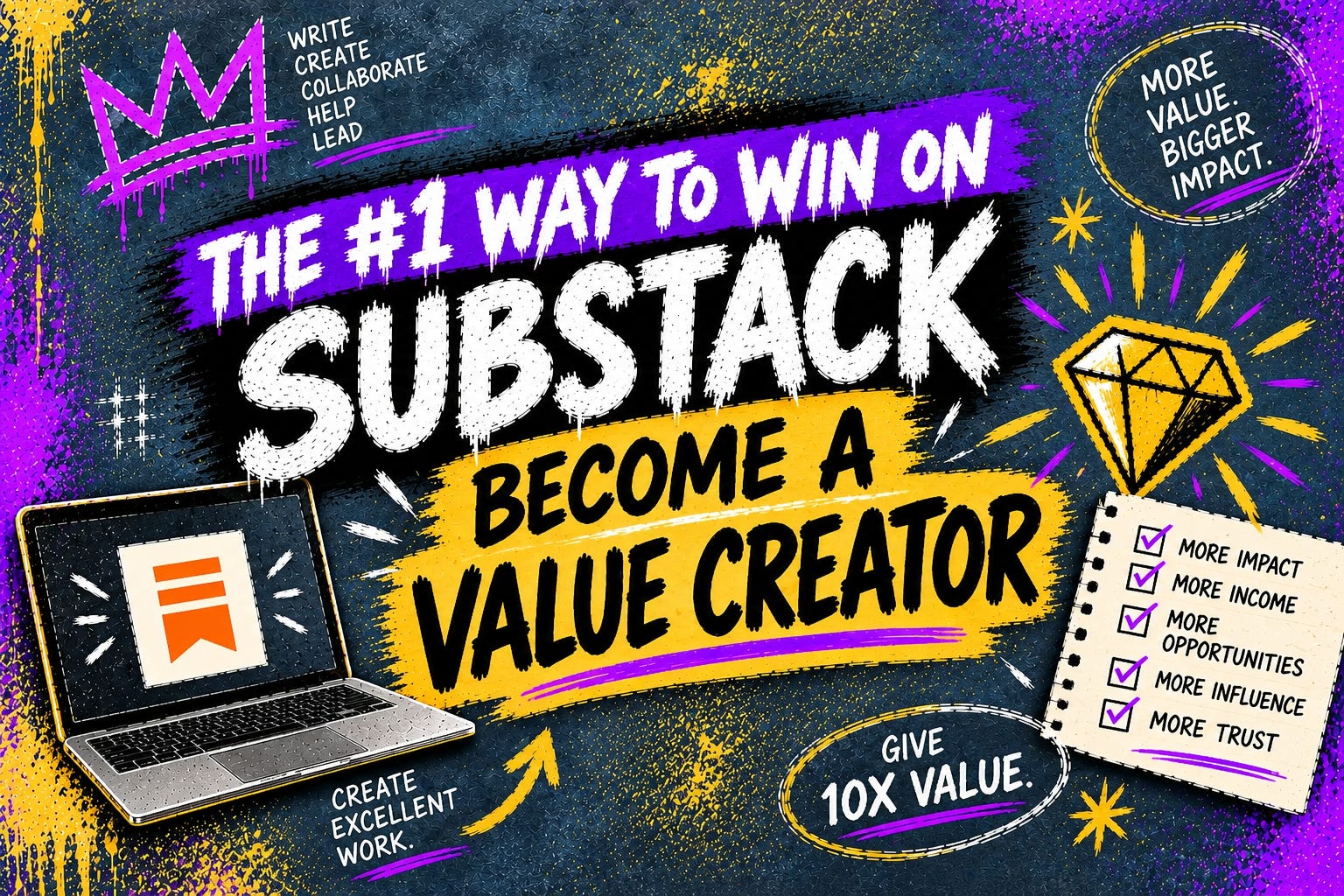
Stop Creating Content. Start Creating Value.
We have enough content.
Seriously. There’s no shortage.
Articles. Podcasts. Videos. Notes. Threads. Posts. Emails. Courses. Guides.
And now AI has made it possible to produce even MORE of it, faster than ever; however, easier creation doesn’t automatically produce better work and publishing something doesn’t automatically make it valuable.
You can publish five Notes today and give me absolutely nothing or you can write one paragraph that changes how I think about something for the next five years.
Which one created more value?
This is why I don’t want you obsessed with becoming a content creator.
I want you obsessed with becoming a VALUE CREATOR.
There’s a difference.
Content fills space.
Value does something.
It teaches and clarifies.
Solves and connects.
Challenges and entertains.
Saves time and creates opportunity.
Makes someone think and moves someone to act.
→ It leaves the person on the other side with something they didn’t have before.
THAT is the standard.
Give 10X Value
When I say 10X value, I don’t mean make everything ten times longer.
Please don’t.
A 6,000-word article that should have been 800 words isn’t generous.
It’s holding me hostage. More isn’t automatically better.
I’m talking about the value of the exchange.
Someone gives you their attention.
What do you give them back?
If someone spends ten minutes reading your article, can you give them an idea that saves them an hour?
Can you answer the question AND anticipate the next one?
Can you give them the template instead of merely telling them what a template should contain?
Can you take something complicated and make it stupidly simple?
Can you give them an example they can actually use?
Can you connect them with someone who can help?
Can you make them laugh?
Can you make them feel understood?
Can you introduce an idea that changes what they do next?
That’s 10X value.
It isn’t about volume.
It’s about making the exchange wildly worthwhile for the person who trusted you with their attention.
Reject The Cult of Mediocrity
The internet rewards activity.
Post again.
Publish again.
Stay visible.
Feed the algorithm.
Keep the content machine moving.
Somewhere in there, we started confusing consistency with excellence.
They’re not the same thing.
You can consistently produce mediocre work.
You can also consistently produce excellent work.
→ Your choice.
I don’t want to publish something because it’s Tuesday and Tuesday is apparently when I’m supposed to publish.
I don’t want to slap something together because I haven’t posted a Note in six hours and OH GOD THE ALGORITHM MIGHT FORGET ME.
I also don’t want to create something merely so I can say I created something.
If I’m asking another human being to give me their time, I want to respect that time.
Will every single thing I create be brilliant?
Of course not. I’m human.
Some things will work better than others and some ideas won’t land.
Sometimes I’ll look back six months later and think: “Well. That could’ve been better.”
Good. That means I’m growing.
However, I never want mediocrity to become the goal because it’s easier.
Excellence ISN’T Perfectionism
This distinction matters because I’ve spent a lot of time telling writers:
Move first. Refine second. Publish with structure.
And I still believe that.
I don’t want you staring at the same draft for three weeks because you’re terrified somebody might find a comma you should’ve moved.
I don’t want you endlessly researching because there’s always one more source you could read.
I don’t want you polishing the personality out of your writing until it’s technically perfect and completely dead.
That’s not excellence. That’s fear wearing a fancy outfit.
Excellence doesn’t mean waiting until your work is flawless.
It means caring about the quality of what you contribute.
Create.
Move.
Experiment.
Ship.
Learn.
Get better.
But don’t use “done is better than perfect” as permission to stop giving a shit.
Move first.
Refine second.
Then publish.
There’s a reason refine is in the middle.
Become A Magic Worker
A magic worker is the person who makes you wonder: How the hell did they think of that?
They anticipate, they notice, they solve, and they bring something nobody asked for but everybody needed.
You invite them into a collaboration and they don’t simply complete their part.
→ They make the whole thing better.
You ask them a question and they don’t send you down another rabbit hole.
→ They give you the answer, the context, and the resource you didn’t know you needed.
You hire them and think: Thank GOD I found this person.
You read their work and bookmark it because you KNOW you’re coming back.
That’s magic. Except it isn’t actually magic.
→ It’s someone paying an unusual amount of attention and caring enough to do excellent work.
Become that person.
Be The Person People Want In The Room
I think this is a better goal than trying to become “indispensable.”
Nobody should have to depend on you, but you can become the person people WANT involved.
The writer people want contributing.
The creator people want collaborating.
The expert people recommend.
The person whose name comes up when an opportunity appears.
The person someone mentions when you’re not even in the room.
“You want Jessica for this.”
THAT is powerful and you don’t get there by declaring yourself a thought leader in your bio.
→ You get there because people have experienced your value again and again and again.
Your work creates your reputation before your title ever will.
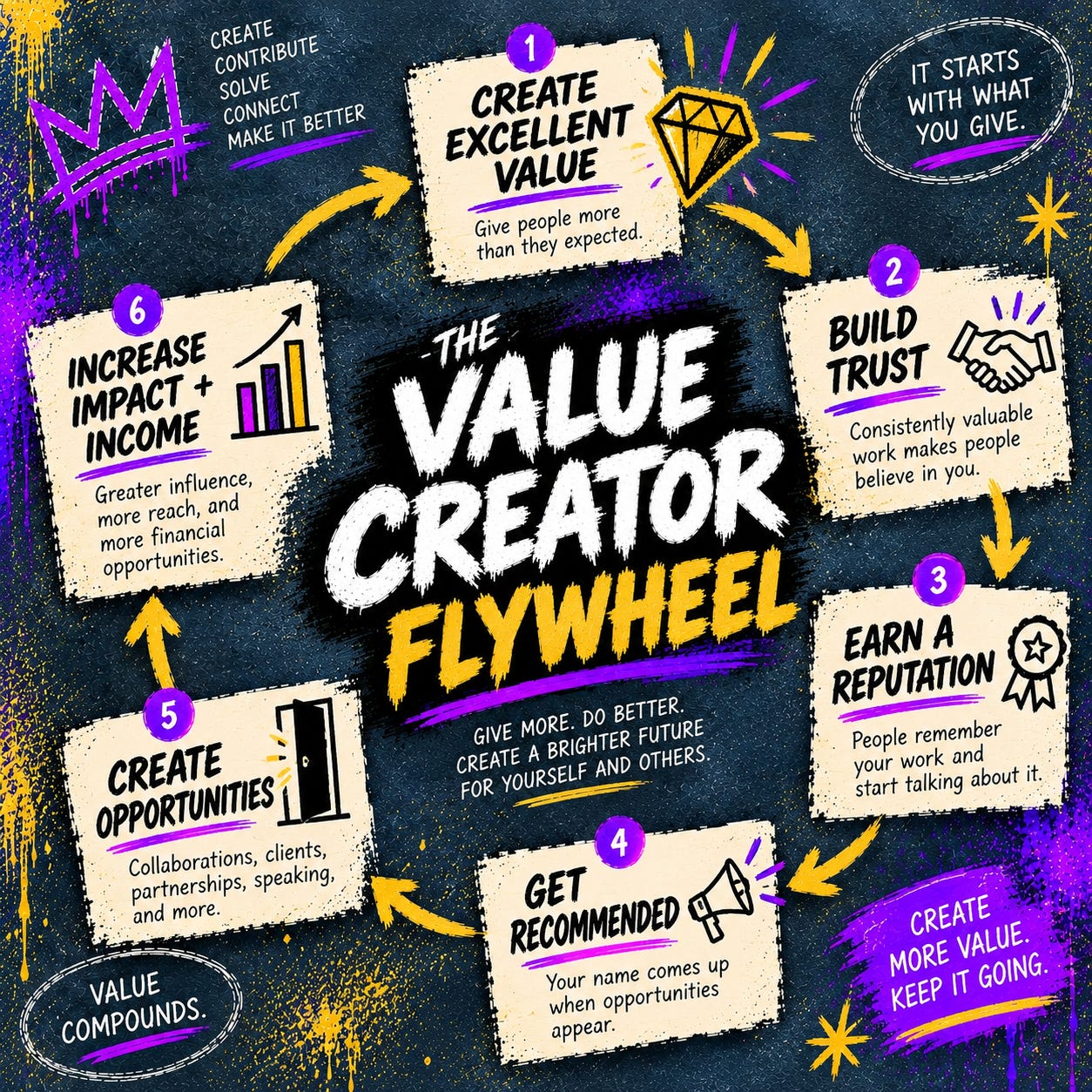
Value Compounds
Here’s where this becomes a business strategy whether you intended it to or not.
Excellent work builds trust.
Trust builds reputation.
Reputation creates recommendations.
Recommendations create opportunities.
Opportunities can create income.
Someone reads your article and it helps them.
Three months later, somebody asks them a question about that subject and they remember you and they send your article.
Now somebody else knows your work.
Maybe that person subscribes.
Maybe they hire you.
Maybe they recommend you to somebody else.
Maybe nothing happens at all.
You don’t control that part.
→ You control whether you created something worth remembering.
That’s why I’d rather ask: How can I become more valuable to my audience?
Because impact, opportunity, and income are often downstream from value.
Reciprocity Is Human
When someone does something genuinely good for us, we remember.
Someone recommends us.
Makes an introduction.
Gives us an incredible resource.
Solves a problem.
Goes far beyond what we expected.
We naturally WANT to respond to that, but don’t turn reciprocity into a manipulation tactic.
I’m going to give them something so now they owe me.
Nope.
That’s not generosity. That’s an invoice you forgot to mention.
Create value because creating value is what you DO.
Help because you can.
Make the introduction.
Share the opportunity.
Give people more than they expected.
→ Don’t keep score and don’t be surprised when some of that goodness eventually finds its way back to you.
Sometimes it will and sometimes it won’t. Do good anyway.
Excellence Builds Self-Respect
This might be the part I care about most because becoming a value creator doesn’t only change how other people see you.
→ It changes how YOU see you.
Every time you refuse to half-ass something with your name on it, you’re building evidence.
I do what I say I’m going to do.
I care about my work.
I can be trusted.
I make things better.
I contribute.
I create value.
I finish.
I keep my standards.
That builds self-respect.
I think self-respect is a hell of a lot more useful than constantly chasing external validation.
Views fluctuate.
Subscriber numbers change.
Notes flop.
Articles you thought would explode sometimes disappear into the abyss.
However, you can still close your laptop knowing: I did excellent work today.
Nobody can take that from you.
Become A Domain Leader
Don’t tell me you’re a thought leader. Show me.
Teach me something I didn’t know.
Solve something nobody else has solved.
Connect ideas other people haven’t connected.
Develop a point of view.
Experiment.
Share what you learn.
Create original work.
Help the people coming behind you.
Raise the standard in your corner of the internet and apply that standard everywhere you show up on Substack.
In your writing.
Your Notes.
Your comments.
Your collaborations.
Your recommendations.
Your products.
Your community.
Don’t ask how much attention you can extract from each one.
Ask: What can I ADD here?
Do that long enough and people start associating your name with the subject.
→ That’s a domain leader.
You don’t need to call yourself one. Other people will decide that for you.
Before You Hit Publish
I don’t want to give you another content strategy.
→ I want to give you a standard.
Before you publish the article, Note, podcast, video, course, product, or whatever else you’re creating, ask:
Is this valuable?
Is this excellent?
Did I give them more than they expected?
Did I respect the time they’re about to give me?
Would I be proud if this were the first thing someone ever saw from me?
You don’t need a yes to every question every time.
But if you’re consistently answering no?
Don’t blame the algorithm. Raise the standard.

20% OFF UNSTUCK TO PUBLISHED 💜
If you’ve been thinking about joining the paid side of Unstuck to Published, now’s a pretty damn good time.
Join annually for $177.60/year (normally $222) and unlock:
📕 The Ultimate Substack Beginner’s Blueprint ($47 value!!)
🎓 My Substack Masterclass — 10 Things I’d Do If I Were Starting My Substack Today ($197 value!!)
✅ Build Your Substack in 90 Minutes Foundational Checklist
💬 Private Community Chat & direct access to me for questions and hands-on support
🔓 Full access to my paid Substack content + subscriber perks
20% off. One year. Everything inside.
👉 Join Unstuck to Published for $177.60/year
The tools are here. Let’s build the damn thing. 💜
If You’re Stuck Right Now: The #1 Way To Win On Substack
Maybe winning on Substack isn’t becoming the person with the most attention.
Maybe it’s becoming the person worthy of it.
So stop trying to create more content.
Create more value.
→ Become obsessed with excellence and give people more than they expected.
Do work that makes you respect yourself when nobody’s applauding and then put your name on work that proves it.
Thank you so much for being here. I truly appreciate you.
— Jessica
Move first. Refine second. Publish with structure.
Recent Articles & Live Episodes
How I Use One Bullet Journal Page To Keep Three Substack Publications Moving

About a month ago, I wrote an article called If You Want to Become a Better Writer, Start Journaling.
How To Set Up Subscriber Perks On Substack

Someone asked me today how to set up subscriber perks on Substack.
Scan the QR code below to subscribe to Unstuck to Published →

Before you publish your next article or Note, ask yourself:
Did I create content… or did I create VALUE?
There’s a difference.
What’s one thing you could do to give your readers MORE than they expected this week?
I want to hear your answer. 👇
This is exactly how I think about Substack.
The goal isn’t to become good at “growing on Substack.”
The goal is to become so good at creating value that growth becomes a natural consequence of the work.
Since joining on August 1, I’ve watched this play out in real time.
Yes, I care about subscribers. I care about reach. I care about Notes, recommendations, restacks, discovery and distribution.
But none of those things are the actual mission.
The mission is the value.
If someone reads something I wrote and thinks differently, takes action, makes a connection, gets clarity, discovers an opportunity, or feels less alone in what they’re building — that’s a win.
That’s what I’m trying to build with Growth OS.
Not just an audience.
A network of people building things.
Founders. Creators. Operators. Career builders. Ambitious people figuring things out in public.
And I think that distinction matters because you can absolutely manufacture growth.
You can follow people because they followed you.
You can participate in growth challenges.
You can optimize every post for engagement.
You can chase whatever format the algorithm seems to reward this week.
And you can end up with a very impressive number attached to your profile.
But numbers don’t automatically equal influence.
Attention isn’t trust.
Followers aren’t community.
Subscribers aren’t relationships.
Reach isn’t impact.
The real question is:
What happens because you showed up?
That’s the part of your argument I keep coming back to, Jess.
I don’t want to simply become a bigger creator.
I want to become a more valuable creator.
And if I do that consistently enough, I trust the growth will follow.
Build the value.
Build the trust.
Build the relationships.
Build the network.
Then scale the distribution.
That’s a much better game than chasing the number.