

A few days ago, I published an article called What Investing Taught Me About Publishing.
The response surprised me.
Not because people were interested in investing, but because people recognized themselves in the invisible phase.
One reader told me they saved the article for later.
Not because they needed it today, but because they knew those feelings would eventually return.
The doubt.
The uncertainty.
The temptation to wonder:
“Is this actually working?”
That comment stuck with me because every creator eventually reaches a point where the excitement of starting wears off and the results haven’t arrived yet.
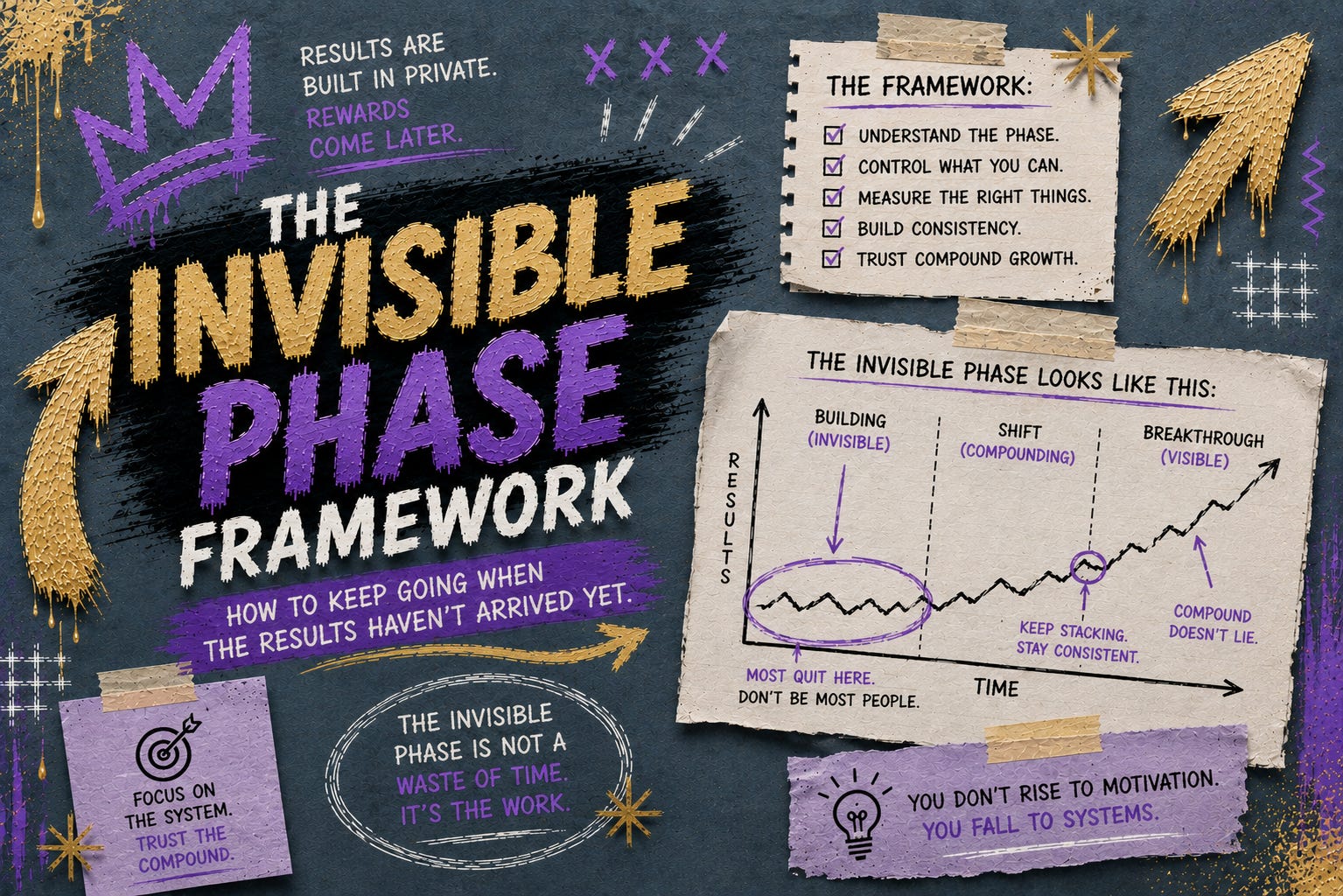
That’s the invisible phase.
The stretch of time where effort goes in and very little seems to come back.
And if you’re not careful, you’ll mistake invisible progress for no progress.
That’s why I wanted to write this article.
Not about growth, not about algorithms, and not about subscriber counts.
About survival because most creators don’t quit because they lack information.
They quit because they lose belief before the results become visible.
The Psychology of The Invisible Phase
The invisible phase feels difficult because it works against how humans are wired.
We like immediate feedback.
Immediate rewards and immediate proof.
You touch a hot stove and you get instant feedback.
You go to the gym and you eventually see physical changes.
You publish an article?
Sometimes the reward arrives months later.
That’s a difficult relationship for the brain to maintain.
Psychologists sometimes refer to this as delayed reinforcement.
The longer the gap between effort and reward, the harder it becomes to stay motivated.
Publishing is filled with delayed reinforcement.
You write today.
The opportunity arrives six months later.
You publish this month.
The subscriber joins next year.
You share an idea.
Someone remembers it long after you’ve forgotten you wrote it.
The problem is that while those things are happening, your brain is asking:
“Is this worth continuing?”
That’s where most people leave.
Not because the process is broken, but because the feedback is delayed.
🔒 Paid subscribers continue reading below.
Understanding the invisible phase is helpful.
Surviving it is what changes everything.
Below, I’m sharing the six-part framework I use to evaluate progress, stay consistent, and keep publishing when the results haven’t arrived yet.
Rule #1: Stop Looking For Proof In The Wrong Places
Most creators look for proof in subscriber counts, views, likes, and revenue.
Those things matter; however, they’re lagging indicators.
They happen after the work.
The problem is that creators often use lagging indicators to decide whether to continue.
Imagine an investor checking their retirement account every hour.
The information exists, but it’s not useful.
Publishing works the same way.
The question isn’t:
“Did I gain subscribers today?”
The question is:
“Am I doing the things that eventually create subscribers?”
Those are very different questions.
Rule #2: Track Leading Indicators Instead
When growth feels slow, I focus on leading indicators.
Things I can actually control.
For example:
Articles published
Consistency of publishing
Conversations started
Reader replies received
Clarity of message
Relationships built
These indicators matter because they’re the inputs.
Subscribers are outputs.
Most creators obsess over outputs while ignoring the inputs that create them.
The invisible phase becomes much easier to survive when you focus on the work instead of the scoreboard.
Rule #3: Separate Process From Results
One of the biggest lessons investing taught me is that good decisions don’t always produce immediate rewards.
→ You can make a smart investment and watch it go nowhere for a while.
→ You can write a great article and watch it get ignored.
The quality of the decision and the timing of the reward aren’t always connected.
Publishing works the same way.
→ A good article can underperform.
→ A mediocre article can surprise you.
That’s why you can’t judge the quality of your process based solely on short-term outcomes.
The process comes first.
The results follow. Eventually.
Rule #4: Create A Minimum Commitment
Most creators evaluate their progress far too early.
They publish three articles.
Maybe five.
Then they start asking:
“Should I quit?”
Imagine planting a seed and digging it up every week to see if it’s growing.
That’s how many creators approach publishing.
Before you begin, create a minimum commitment.
Maybe it’s:
25 articles
50 articles
90 days
6 months
The exact number doesn’t matter.
What matters is deciding before your emotions get involved because emotions make terrible long-term business advisors.
Rule #5: Learn To Recognize Invisible Progress
This is where most creators miss what’s actually happening.
Compounding rarely announces itself.
Instead, it shows up quietly.
Writing becomes easier.
Ideas come faster.
Readers start replying.
People remember your work.
Your message becomes clearer.
Opportunities begin appearing.
None of these things look dramatic, but they matter because they’re often the first signs that compounding has already started.
The mistake is waiting for subscriber growth before acknowledging progress.
Many forms of growth arrive long before the numbers do.
Rule #6: Ask A Better Question
Most creators ask:
“Is this working?”
The problem is that question usually comes too early.
A better question is:
“Am I becoming better at the thing I’m trying to do?”
Am I becoming a better writer?
A better communicator?
A better teacher?
A better observer?
A better creator?
Because improvement is often the first form of compounding and unlike subscriber counts, it’s something you can influence directly.
The Real Purpose of The Invisible Phase
For a long time, I thought the invisible phase existed to test my patience.
Now I think it serves a different purpose.
I think it’s teaching us who we’re becoming.
The invisible phase forces you to keep showing up before anyone is applauding, before anyone is validating the effort, and before there’s enough evidence to feel certain.
That’s not just a publishing lesson.
That’s a life lesson because eventually every meaningful thing requires a period of investment before the return arrives.
Publishing.
Business.
Relationships.
Health.
Investing.
The invisible phase isn’t a sign that you’re failing.
It’s often the price of admission.
The problem is that most people leave before they collect the return.
Final Thoughts: If You’re Stuck Right Now
If you’re reading this during a difficult week, I want you to remember something.
The absence of visible results isn’t proof that nothing is happening.
Sometimes it’s simply proof that you’re earlier than you think.
→ Keep publishing.
→ Keep learning.
→ Keep improving.
→ Keep collaborating.
→ Keep showing up.
Because compounding rewards the people who stay and most people never experience it.
Not because it doesn’t work, but because they leave before it arrives.
Thank you so much for being here. I truly appreciate you.
— Jessica
Move first. Refine second. Publish with structure.
Recent Articles👩🏻💻
What Investing Taught Me About Publishing

I used to think investing and publishing had nothing in common.
The Publication Audit Checklist I Use With Every Client

One of the most common mistakes I see from new creators is assuming they have a growth problem.
