


A collaboration between Unstuck to Published × The Creator’s Edge.
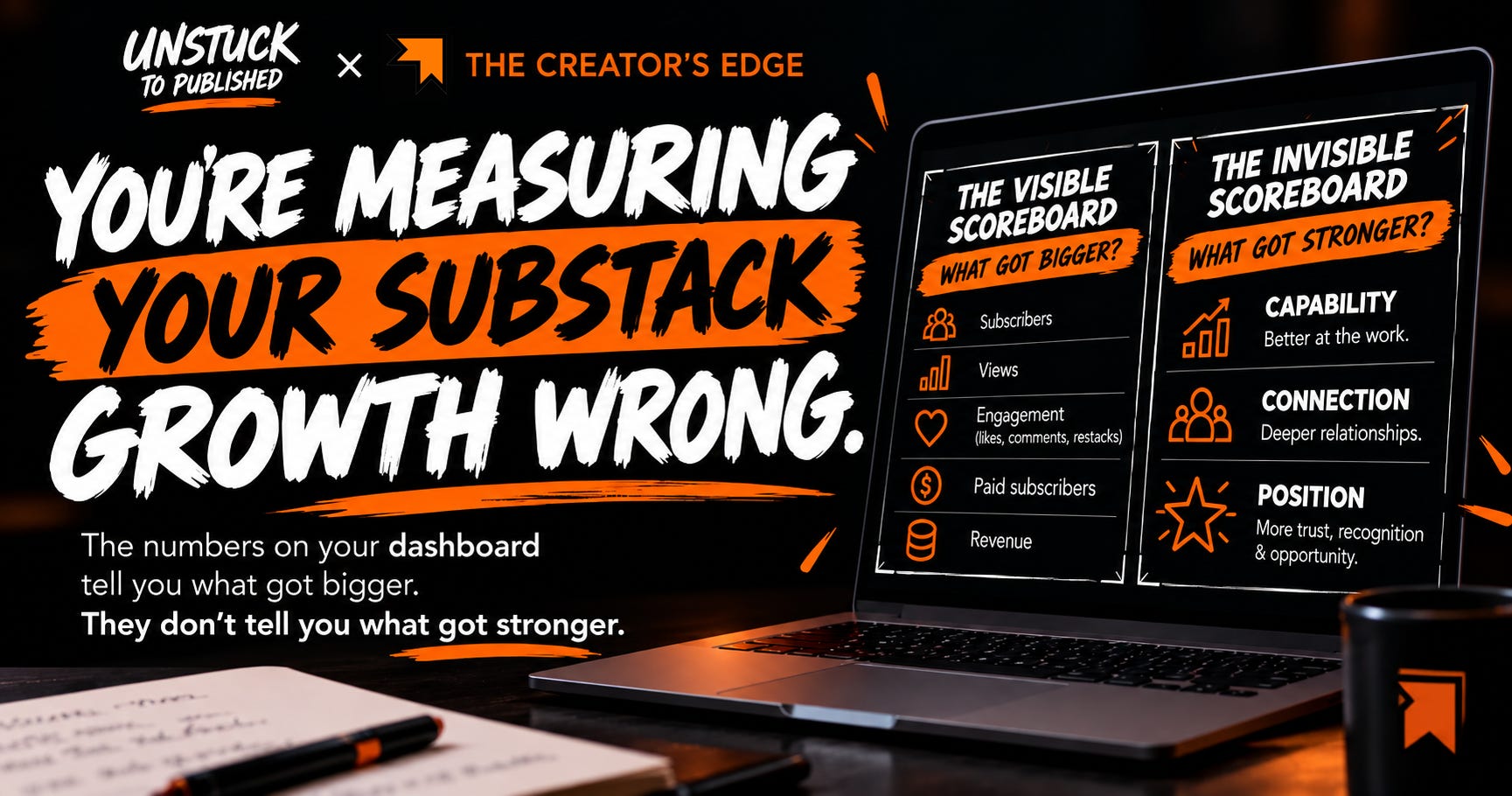
Open your Substack dashboard.
What do you see?
Subscribers.
Views.
Open rates.
Revenue.
Numbers.
And if the little line is moving up and to the right?
Hell yeah. We’re growing.
Except...are we?
Because you can gain 1,000 subscribers without becoming a better writer.
You can get more views without earning more trust.
You can publish more without becoming more valuable.
You can have a Note blow up without making a single meaningful connection.
And you can have a smaller publication while still building relationships, skills, reputation, opportunities, and a body of work that’s becoming harder and harder to ignore.
→ Unfortunately, you can’t see the valued created by relationships in your analytics.
Your dashboard tells you which numbers are growing. But It doesn’t tell you what got stronger. If you only measure what’s easy to count, you can completely miss some of the most important growth happening in your creative career.
Bigger Isn’t Always Stronger
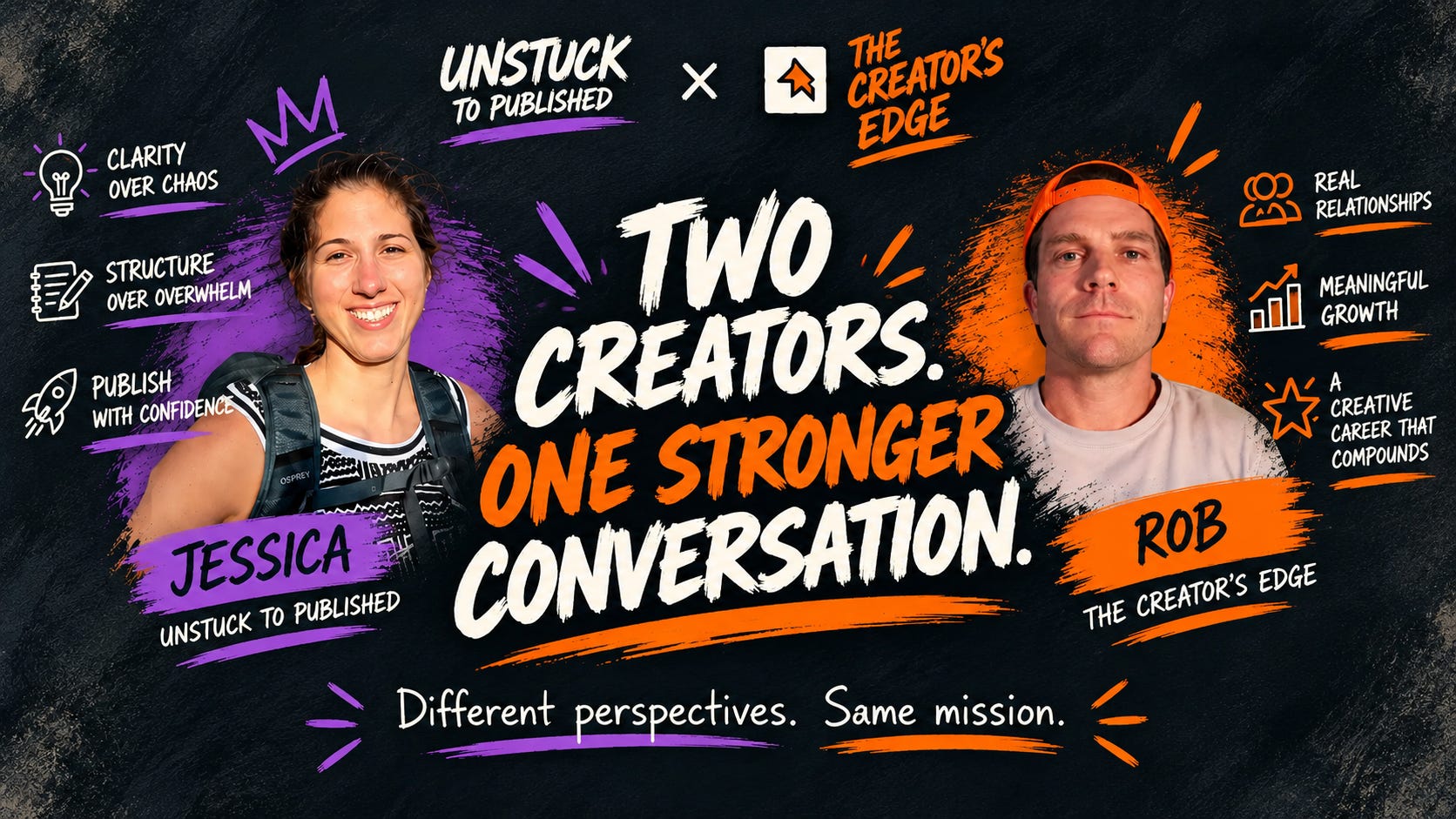
Rob and I both want our publications to grow.
Let’s get that out of the way.
Subscribers are good, readers are good, and paid members are REALLY good.
Neither of us is going to pretend numbers don’t matter while secretly refreshing the subscriber count; however, numbers only tell you part of the story.
Imagine two creators.
One goes from 1,000 subscribers to 10,000.
The other goes from 1,000 to 3,000.
Who grew more?
Easy. The first one.
Right? Maybe.
What if Creator #1 has 10,000 subscribers who barely know who they are?
Meanwhile, Creator #2 has 3,000 subscribers, readers who recognize their name, several strong collaborators, people regularly recommending their work, a growing paid community, and clients arriving through referrals?
Now the answer gets messier because we’ve been using size as a synonym for strength.
→ They’re not the same thing.
Some growth is easy to see and that doesn’t make it bad. But other growth types of growth are invisible, and we think creators need to pay attention to both.
The Visible Scoreboard
This is the scoreboard we know how to measure.
Subscribers.
Paid subscribers.
Views.
Likes.
Comments.
Restacks.
Open rates.
Revenue.
Follower count.
Features.
Look at this feature for example. Rob could tally that as one more feature. But why did Substack decide to feature him on their social media account? We actually don’t know why, and that the argument we’re trying to make.
We screenshot milestones, we celebrate them, we compare them, and we watch the numbers move and use them as evidence that something is working. There’s nothing wrong with that.
The problem starts when those numbers become the only evidence we’re willing to accept because then it becomes really easy to optimize for whatever moves the scoreboard fastest.
Did the subscriber count increase?
Cool, but where did those people come from?
Did you get a bunch of likes?
That’s nice, but do they care about your work?
Did you get a bunch of comments saying “congrats!”?
Awesome, but would they recognize your name tomorrow?
Do they trust you?
Will they come back?
Are they going to go out of their way to help you?
Those questions are harder.
There’s no giant number at the top of your dashboard saying: Congratulations! 55 more people trust you this month.
Would be nice though, but that doesn’t mean trust isn’t growing.
It means you need another way to look at growth.
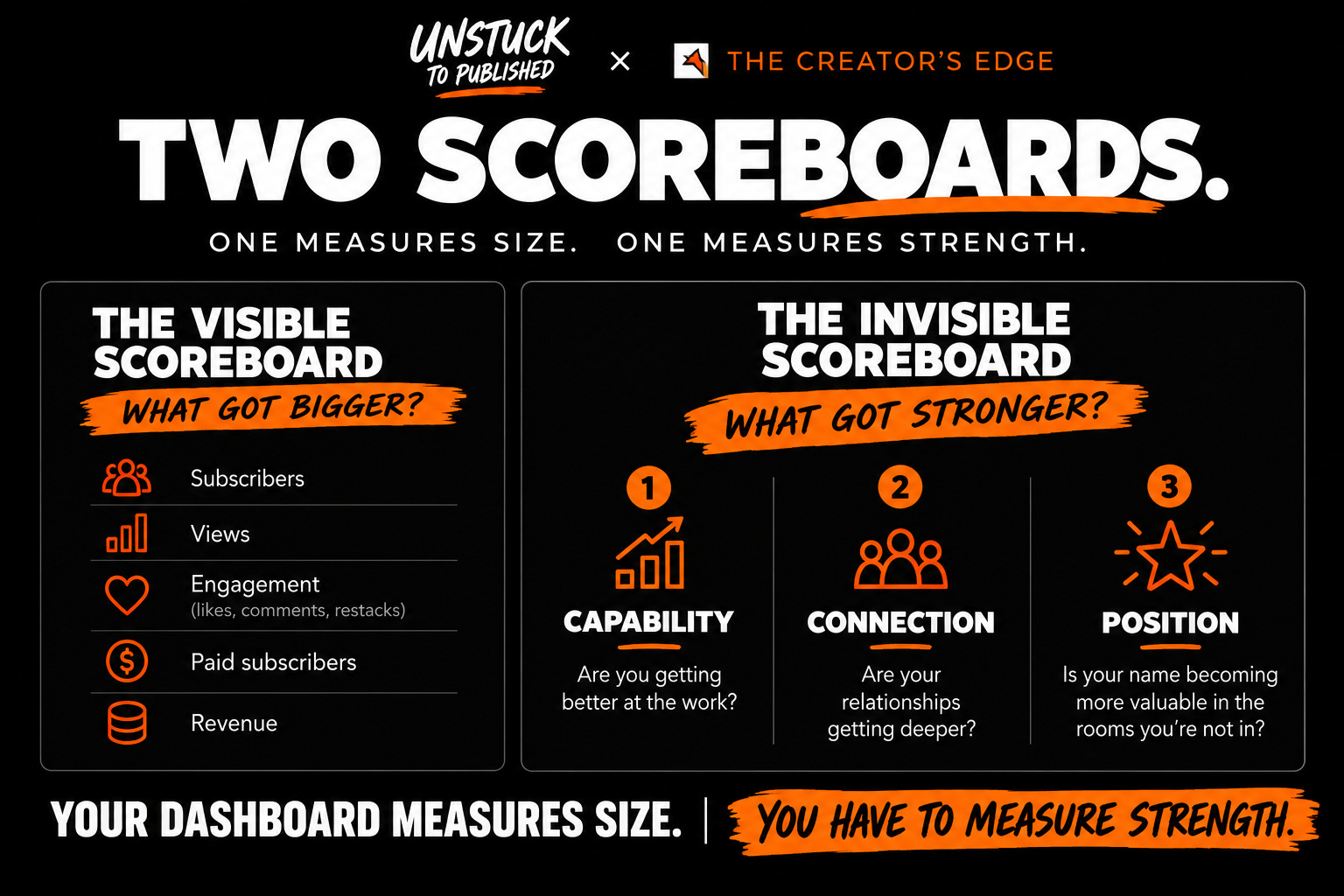
The Invisible Scoreboard
There’s another scoreboard running alongside your analytics.
→ You can’t open it in Substack.
There’s no graph, no percentage change from last month, and no little green arrow telling you things are going well.
However, it might tell you more about the strength of what you’re building than your subscriber count ever could.
We think about this scoreboard in three areas:
1. Capability
Are you getting better at the work?
Your publication isn’t the only thing you’re building.
→ You’re building the person running it.
Think about the creator you were six months ago.
Can you communicate an idea more clearly now?
Write a stronger headline?
Recognize a good idea faster?
Turn that idea into something worth publishing?
Understand what your readers actually care about?
Make an offer?
Handle a difficult comment?
Collaborate with someone else without losing your own point of view?
Get on camera without immediately wanting to disappear into the floor?
→ That counts.
Every article gives you reps.
So does every Note that flops.
Every conversation with a reader, even the awkward ones.
Every collaboration.
Every Live.
Every launch.
Every experiment that works.
And every experiment that makes you wonder what the hell you were thinking.
→ You learn and then you carry that knowledge into the next thing.
The problem is that capability grows gradually. You probably won’t feel any different when you’re 10% better at writing. But you’ll sure as hell notice the extra 100 subscribers your Substack dashboard waves in your face.
Nobody sends you an email saying: “Congratulations! You’re significantly less awkward on camera than you were eight months ago.”
→ That would be rude honestly, but becoming better at the work makes everything you build next stronger.
That belongs on the scoreboard.
2. Connection
Are your relationships getting deeper?
A subscriber is a number.
A relationship has depth.
Someone discovers your work and they like hit like and leave a thoughtful comment. Then you recognize their name the next time and eventually you talk in the DMs.
Maybe you exchange ideas, maybe you start supporting each other’s work, or maybe they become a collaborator, customer, peer, mentor, supporter, or actual friend.
Not every relationship needs to become something bigger, but some will and one of the mistakes creators make is measuring connection only by the number of new subscribers.
Rob Riker spends a lot of time thinking about relationship-building through meeting people, deepening those relationships, and maintaining the connections worth keeping.
That raises a different growth question.
Instead of only asking:
How many new people found me?
Ask:
Did any of the people already here get closer?
Did familiarity become trust?
Did a casual reader become a regular?
Did someone from the comments become someone you now exchange ideas with?
Did a fellow creator become someone you’d happily recommend?
Did someone start recommending YOU?
Did you strengthen a relationship you actually care about instead of chasing another hundred strangers?
None of those movements necessarily increase your subscriber count, but they can make what you’re building dramatically stronger because there’s a difference between having thousands of people on a list and having people in your corner.
3. Position
Is your name becoming more valuable in the rooms you’re not in?
This one is harder to see because sometimes you don’t know it’s happening until an opportunity appears.
Someone recommends your article.
Someone sends your publication to a friend.
Someone needs a collaborator and thinks of you.
Someone asks for an expert and your name comes up.
Someone trusts your recommendation because you’ve consistently given them good ones.
Someone sees an opportunity that fits you and sends it your way.
→ That’s position.
It’s reputation, it’s trust, and it’s becoming known for something and you can’t manufacture it by putting “thought leader” in your bio and declaring victory.
Other people decide what your name means. Your job is to give them enough evidence.
Your work.
Your ideas.
Your behavior.
Your consistency.
The way you treat people.
The things you contribute.
Over time, people start attaching expectations to your name.
“Oh, ask Rob. He’s an expert in relationship-building.”
“Jessica probably has an article about that.”
“You two should collaborate.”
“Go read this.”
“You should talk to them.”
→ Eventually, something interesting happens like an opportunity seems to appear out of nowhere, except it didn’t.
These things happen later, but only if you put in the work and build the relationships today.
Growth Has A Lag
This is one of the hardest parts of building anything online.
→ We want immediate proof.
Publish an article and get subscribers.
Post a Note and get engagement.
Make an offer and get the sale.
Do the thing and receive a reward.
And we want it now. But a lot of meaningful growth doesn’t work like that.
You publish something today, someone reads it, and nothing happens.
Then three months later, somebody asks them for a recommendation and your name comes up!
→ You spend months becoming better at something and nothing happens.
Then an opportunity appears that requires exactly the skill you’ve been developing.
→ You build a relationship with another creator and at first nothing happens.
But eventually one of you has an idea. And now you’re making something together, being innovative, and creating your own opportunities.
From the outside, the result looks sudden. It wasn’t.
The visible outcome just came after the invisible growth.
→ That’s why measuring your progress only by immediate results can mess with your head.
You can stare at a slow month and think: Nothing is happening.
Meanwhile, your capability is getting stronger.
Your connections are strengthening.
Your position is getting stronger.
Something is happening. You just don’t have to have a graph confirm it for you.
Run Both Scoreboards
We’re not telling you to stop looking at your analytics. Please look at them.
If nobody’s reading your work, that’s useful information.
If subscribers are leaving, pay attention.
If your paid offer isn’t converting, figure out why.
If something takes off, study that too.
Numbers give you feedback. Use it, but don’t ask one scoreboard to measure a multidimensional thing.
Track what’s getting bigger and pay attention to what’s getting stronger.
You can even do a quick check-in every month:
Capability: What can I do better now than I could a month ago?
Connection: Which relationships became stronger?
Position: What evidence do I have that people increasingly trust, remember, recommend, or think of me?
Those answers might tell you something your analytics missed.

20% OFF UNSTUCK TO PUBLISHED 💜
Ready to go deeper?
If you’ve been thinking about joining the paid side of Unstuck to Published, now’s a pretty damn good time.
Join annually for $177.60/year (normally $222) and unlock:
📕 The Ultimate Substack Beginner’s Blueprint ($47 value!!)
🎓 My Substack Masterclass — 10 Things I’d Do If I Were Starting My Substack Today ($197 value!!)
✅ Build Your Substack in 90 Minutes Foundational Checklist
💬 Private Community Chat & direct access to me for questions and hands-on support
🔓 Full access to my paid Substack content + subscriber perks
20% off. One year. Everything inside.
👉 Join Unstuck to Published for $177.60/year
The tools are here. Let’s build the damn thing. 💜
If You’re Stuck Right Now: Build Something That Gets Both Bigger & Stronger
That’s what we want.
We want the subscribers.
We want the readers.
We want the paid members.
We want the revenue.
We want the opportunities.
However, we also want the skills to keep creating excellent work.
The relationships that make this worth doing.
The reputation that makes people trust our names.
The people who teach us things we never would’ve figured out alone.
The body of work that gets better every year.
The ability to create opportunities we couldn’t have predicted when we started.
Because what’s the point of building a huge publication if everything underneath it is fragile?
Give us both—bigger and stronger.
So yes.
Open your dashboard.
Look at the numbers.
Celebrate when they go up.
Figure out what happened when they go down.
However, don’t let a graph convince you it’s capable of measuring everything you’re building.
→ Some of the most important growth happening on your Substack will never appear there because the numbers can tell you what got bigger.
Only you can look at what you’re building and ask: What got stronger?
→ Before you close this article, run your own Invisible Scoreboard.
Think about the last 30 days.
Capability: What can you do better now than you could a month ago?
Connection: Which relationship became stronger?
Position: What evidence do you have that more people trust, remember, recommend, or think of you?
You don’t need a perfect answer for all three.
Just stop letting your subscriber count be the only answer to: “Am I growing?”
Thank you so much for being here. We truly appreciate you.
— Jessica & Rob
Move first. Refine second. Publish with structure.
Want More From Rob?
Rob Riker writes The Creator’s Edge, where he helps creators build real relationships, grow an audience of true fans, and turn those connections into a stronger creative career.
Go follow Rob and subscribe to The Creator’s Edge here →

Scan the QR code below to subscribe to The Creator’s Edge →

Recent Articles & Live Replays
The #1 Way To Win On Substack: Become A Value Creator

Everyone wants to know how to win on Substack.
How I Use One Bullet Journal Page To Keep Three Substack Publications Moving

About a month ago, I wrote an article called If You Want to Become a Better Writer, Start Journaling.
Scan the QR code below to subscribe to Unstuck to Published →
Let’s run the Invisible Scoreboard. 👇
What got stronger for you in the last 30 days?
CAPABILITY: You got better at something.
CONNECTION: A relationship got deeper.
POSITION: More people started trusting, remembering, recommending, or thinking of you.
Pick ONE and tell us what changed.
Your dashboard probably won’t give you credit for it. We will. 😂