

Substack just made finding potential collaborators a whole lot easier, which sounds great.
Until you open Creator Match, see a bunch of names, match ratings, subscriber counts, audience numbers, and a shiny Message button and realize:
Okay...now what?
Because finding someone you could collaborate with isn’t the same as knowing whether you should collaborate with them and it definitely doesn’t mean you know what the hell to say when you message them.
That’s where Creator Match gets interesting.
→ Substack can do some of the discovery work for you. It can surface creators whose audiences cross over with yours, show you shared subscribers, and give you information about the potential audience on both sides.
It can even put the Message button right there, but it can’t think for you and the thinking is where the opportunity is.
→ So yes, I’m going to show you where Creator Match lives and what you’ll find there; however, more importantly, I’m going to show you how to evaluate your matches, spot promising collaboration opportunities, and approach another creator like an actual human being because a match is data.
A collaboration is still a relationship.
What Is Substack Creator Match?
Creator Match is a new feature that helps publishers find other Substack creators who may be a natural fit for collaboration.
→ Substack says it identifies writers and creators with similar audience sizes and interests, then curates potential matches based on how promising a collaboration could be for both publishers.
Creator Match is now available to all publishers.
You’ll find it here: Publication Dashboard → Audience → Creator Match
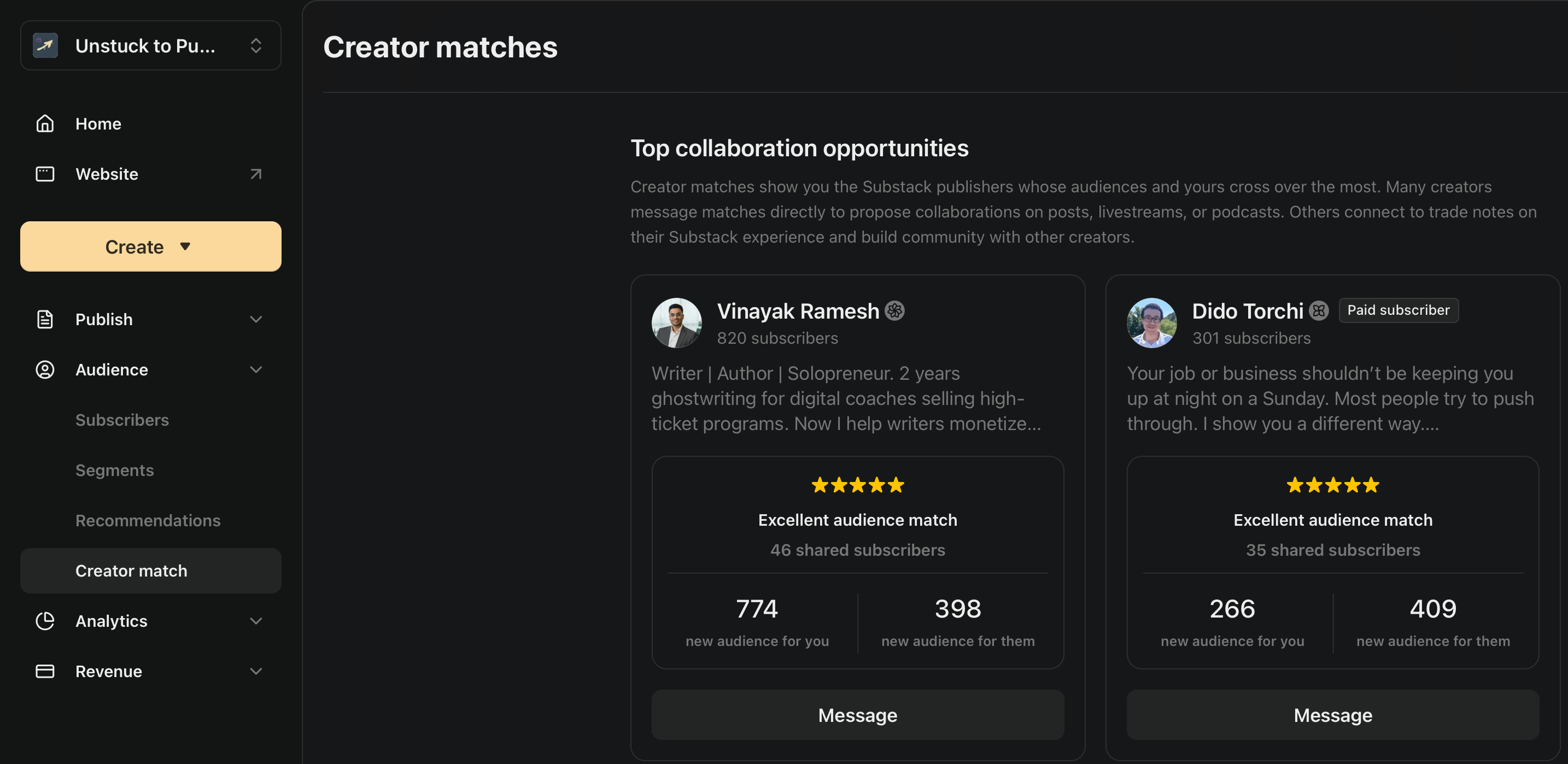
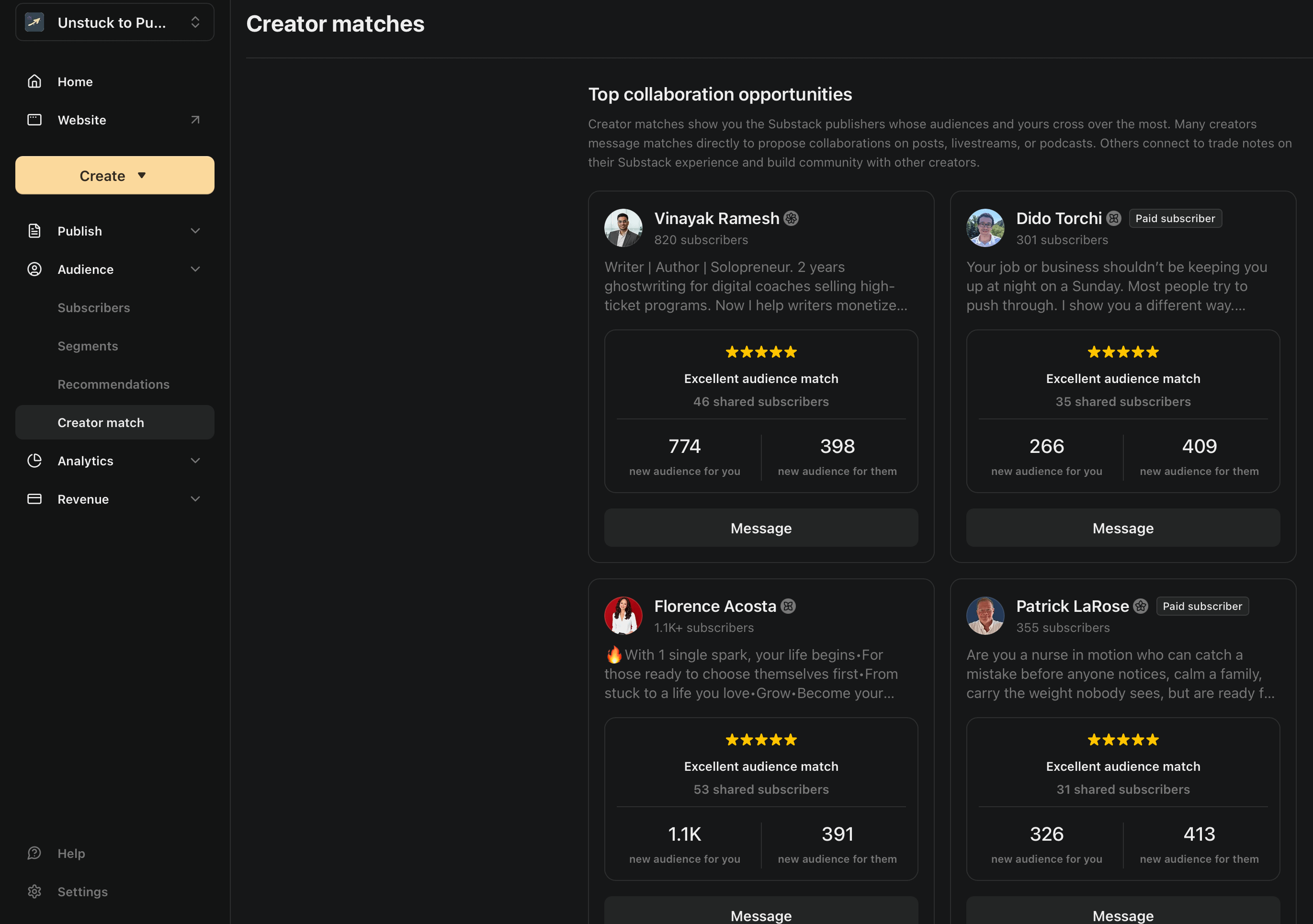
Once you’re inside, you’ll see your Top collaboration opportunities.
Depending on the match, you may see information including:
The creator and their publication.
Their subscriber count.
A description of their work.
The strength of the audience match.
Shared subscribers.
Potential new audience for you.
Potential new audience for them.
A button to message them directly.
You may also see additional context, such as whether someone is already a paid subscriber to your publication.
→ That’s a lot of information packed into one little card and I can already see how people are going to use it wrong.
They’re going to look for the biggest number.
Don’t Automatically Pick The Biggest Creator
Big creator = best collaboration.
Right? Nope.
→ Subscriber count tells you how large someone’s publication is. It doesn’t tell you whether they’re the right person for you to collaborate with.
That’s why one of the most interesting pieces of information Creator Match gives us isn’t total subscriber count.
→ It’s audience overlap.
Before Creator Match, you might find another creator writing about almost exactly what you write about and assume: We probably have all the same readers anyway.
Now you have more information to challenge that assumption and that matters because similar audiences aren’t necessarily the same audience.
→ A creator can operate in your space, talk about similar subjects, and still have plenty of relevant readers who haven’t discovered your work and the reverse can also be true.
Suddenly, collaboration looks a little different.
Read The Overlap Number Differently
Don’t open Creator Match and ask only: Who has the biggest audience?
Ask: Where is there meaningful fit AND room for discovery?
A large creator isn’t automatically your biggest opportunity.
A smaller creator isn’t automatically a smaller opportunity.
And a low audience overlap isn’t automatically a bad thing.
If two creators have compatible work and audiences, but relatively little crossover, that could make a collaboration more interesting because you’re introducing relevant people to someone they may not already know.
However, before everybody starts hunting for the smallest overlap number like we’ve discovered a secret Substack growth hack...low overlap doesn’t automatically mean good collaboration either.
You could have almost no audience overlap because your work has absolutely nothing to do with theirs.
Congratulations. You’ve discovered strangers. So don’t choose a Creator Match based on one number.
I’d think about it in this order: FIT → OPPORTUNITY → NUMBERS
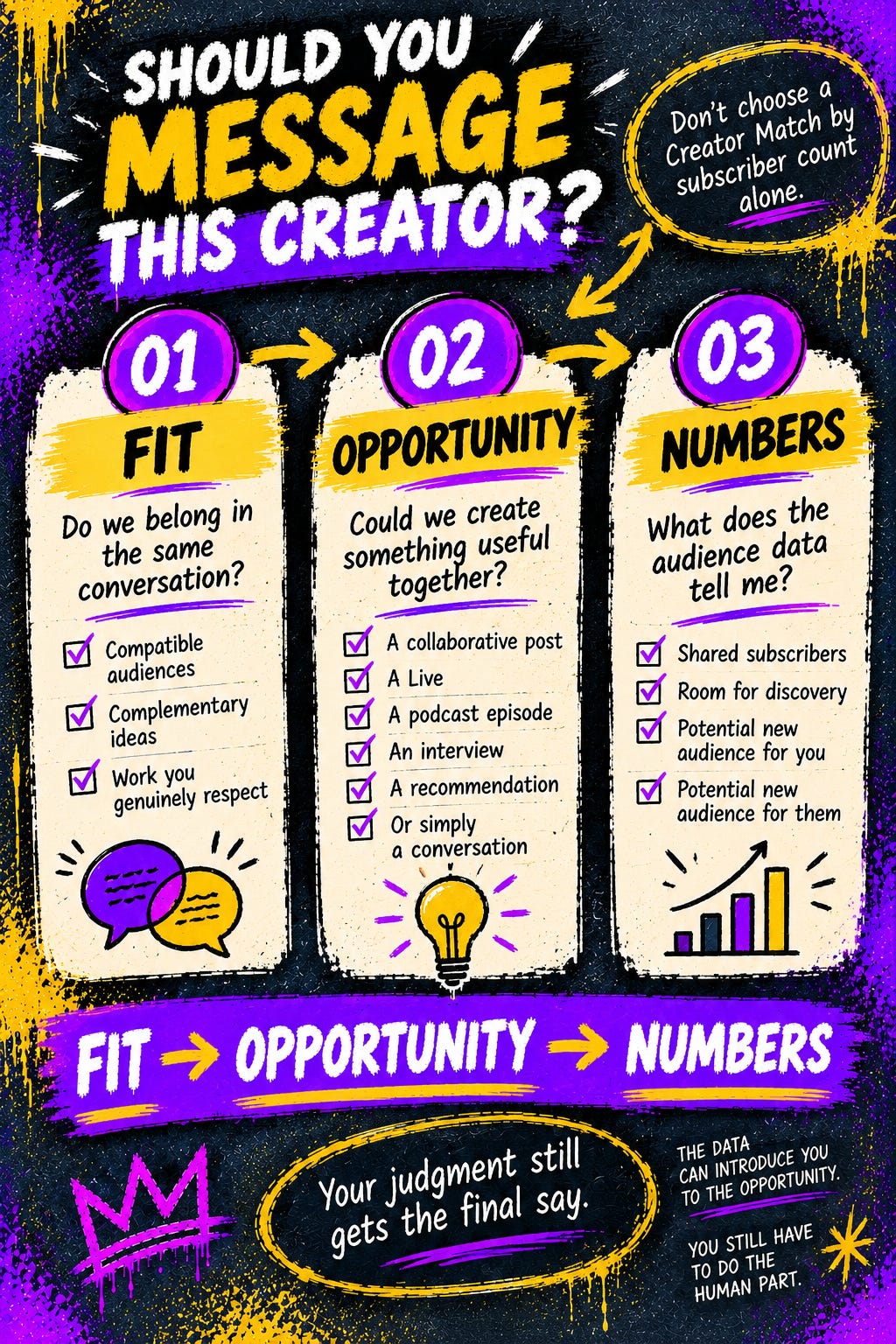
1. FIT
Do your work, ideas, audiences, or perspectives actually belong in the same conversation?
2. OPPORTUNITY
Can you see something the two of you could create or do together that would genuinely serve both audiences?
3. NUMBERS
What does the information Creator Match gives you tell you about the potential audience opportunity?
→ Notice where subscriber count landed. Third.
Because 50,000 irrelevant readers aren’t automatically more valuable than 2,000 highly relevant ones.
Creator Match Did Some Homework. You Still Have To Do Yours.
You found someone who looks promising.
Don’t hit Message yet, go look at their publication.
Here’s a real example from my Creator Matches.
Vinayak Ramesh showed up as one of my top matches and this one immediately caught my attention because we’ve already collaborated. I was recently a guest on his Sustainable Side Hustle podcast.
So in this case, Creator Match surfaced someone I already knew made sense for me.
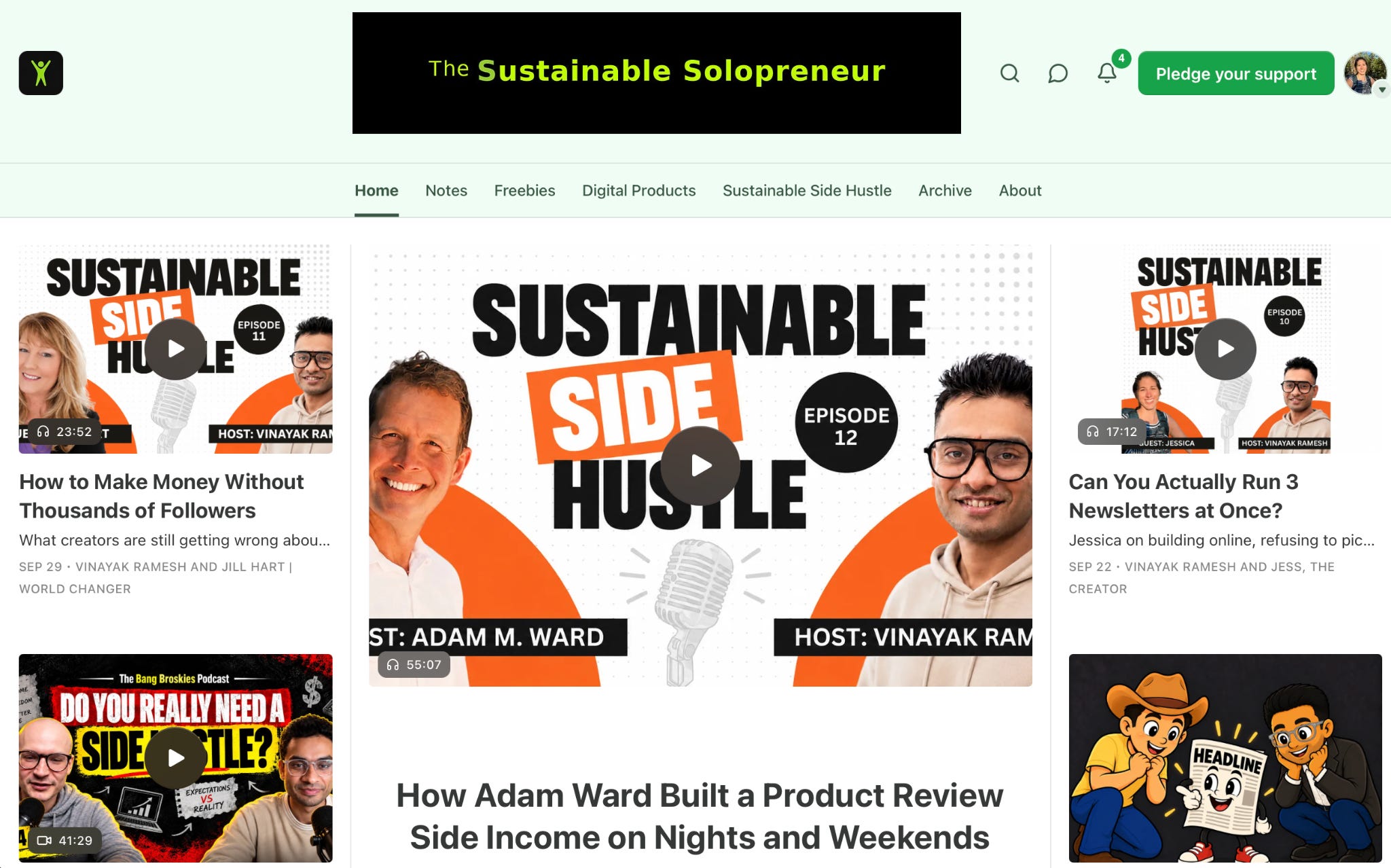
However, if I didn’t already know Vinayak, this is where I’d start doing my homework.
Actually read their work.
What do they write about?
What do they care about?
What have they published recently?
What kind of conversations happen around their work?
Do they host Lives?
Do they have a podcast?
Have they collaborated with other creators?
Is there something you genuinely appreciate about how they think?
And most importantly: Can you see WHY the two of you should have a conversation?
You don’t need the exact collaboration figured out yet, but you need something better than: “Substack says we’re a match!”
Yes, they can see that too.
Creator Match gave you the introduction.
Give yourself a reason for the conversation.
If Substack shows you a highly rated match that makes you think, In what universe?
→ Skip it.
Creator Match is giving you possibilities. Your judgment still gets the final say.
Don’t Ask Only What They Can Bring You
This becomes especially important if you’re a smaller creator looking at a match with a much larger publication.
→ I can already hear it: “They have 20,000 subscribers. I have 2,000. Why the hell would they collaborate with me?”
Because subscriber count isn’t the only thing you can bring to a collaboration.
Maybe you bring expertise they don’t have.
A perspective their audience hasn’t heard.
A highly engaged community.
Research.
A story.
A skill.
A great interview format.
A different audience.
An idea so damn good that your subscriber count becomes the least interesting part of the conversation.
Creator Match itself gives us a useful reminder here because the opportunity isn’t presented as entirely one-sided.
→ You can see potential new audience for you and potential new audience for them.
So don’t approach someone thinking only: What can I get from this creator?
→ Ask: What could we do together that makes sense for both of us?
Very different energy.
Decide What Kind Of Collaboration Makes Sense
Please don’t send: “Want to collaborate sometime? because now you’ve given the other person homework.
Collaborate on WHAT?
There are plenty of ways two Substack creators could work together.
You could:
Write a collaborative post.
Host a Live.
Record a podcast episode.
Interview each other.
Explore the same question from different perspectives.
Recommend each other’s publications.
Share and discuss each other’s work in Notes.
And sometimes? Don’t collaborate yet.
Talk.
Exchange ideas.
Get to know their work.
See if there’s anything there.
→ Creator Match doesn’t mean you need a joint livestream scheduled by Thursday.
Sometimes it simply introduces you to a creator worth knowing.
Okay, But What The Hell Do You Message Them?
THIS is where I expect a lot of Creator Matches to fall through.
Substack surfaced the creator, showed you the audience information, put a button directly underneath their name, and then you stare at: Message for four days.
Eventually you type: “Hi! Substack says we’re an excellent Creator Match. I think our audiences would be a great fit. Would you be interested in collaborating?”
Nothing’s terribly wrong with that. There’s just almost nothing interesting about it and they already know Creator Match connected you.
Tell them why YOU think the match makes sense.
I’d use four pieces: CONTEXT → CONNECTION → IDEA → EASY NEXT STEP
1. CONTEXT
Tell them how you found them.
Creator Match makes that easy.
2. CONNECTION
Why do you think there’s a fit?
Mention something specific about their work, expertise, audience, or perspective.
3. IDEA
→ Give them something to react to. One idea.
Not a 14-paragraph proposal complete with deliverables, deadlines, and a shared Google Drive.
4. EASY NEXT STEP
Don’t make them plan the entire collaboration before they can answer you.
→ Open the conversation.
Something like: “Hey [Name] — you popped up as one of my Creator Matches, and after looking through your publication, I can see why.
I really liked your piece about [specific thing], especially your point about [specific idea]. I write about [your area], and I think there’s an interesting crossover around [shared idea].
I had an idea for a Live where we could explore [specific topic/question] from both perspectives. I think both of our audiences could get something useful from it.
If that sounds interesting, happy to kick around the idea.”
Notice what’s missing?
“LET’S CROSS-PROMOTE SO WE CAN BOTH GET MORE SUBSCRIBERS!!!!”
→ Please don’t arrive in someone’s inbox waving their audience numbers around like a Groupon.
The information helped you identify the opportunity. The message should still sound like one human talking to another.
Make The First Collaboration Easy To Say Yes To
They replied and they’re interested. HELL YES!
→ Now don’t immediately turn this into a six-week production involving seventeen Google Docs, three planning calls, and somebody’s emotional-support Trello board.
Start small.
A Live.
A short interview.
A Q&A.
A Note exchange.
A podcast conversation.
A collaborative post.
Because now you’re learning something Creator Match can’t tell you:
Do we actually work well together?
Do they communicate?
Do they follow through?
Does conversation flow naturally?
Do your audiences respond?
Did you enjoy working together?
Would either of you want to do it again?
→ Creator Match can surface potential audience compatibility. It can’t tell you whether you’ll have human compatibility.
You discover that part yourself.
Before You Hit Message, Run This 60-Second Check
Found someone promising?
Ask yourself:
Do I genuinely respect their work?
Are our audiences compatible?
Is there meaningful room for discovery or another clear opportunity for both of us?
Can I see something useful we could create or do together?
And finally ask yourself:
Would I still want to know this person if neither of us gained a single subscriber?
→ Oof. That last one matters because yes, Creator Match can be a growth tool, but you’re still dealing with people.
If all you see when you look at another creator is access to their audience, you’re probably not ready to hit Message.
Creator Match Is Also A Signal
There’s one more reason I’m paying attention to this feature.
→ Substack built an entire tool around helping creators find other creators.
Add that to Recommendations, Notes, Lives, podcasts, cross-posts, comments, and direct messaging, and there’s a pretty obvious pattern: Substack is giving creators more ways to grow through other people.
When another creator introduces you to their audience, you’re not arriving as a complete stranger yelling: “HELLO PLEASE SUBSCRIBE TO MY NEWSLETTER.”
→ You’re being discovered through someone those readers already know.
That doesn’t guarantee they’ll care about your work, but it gives the introduction a head start.
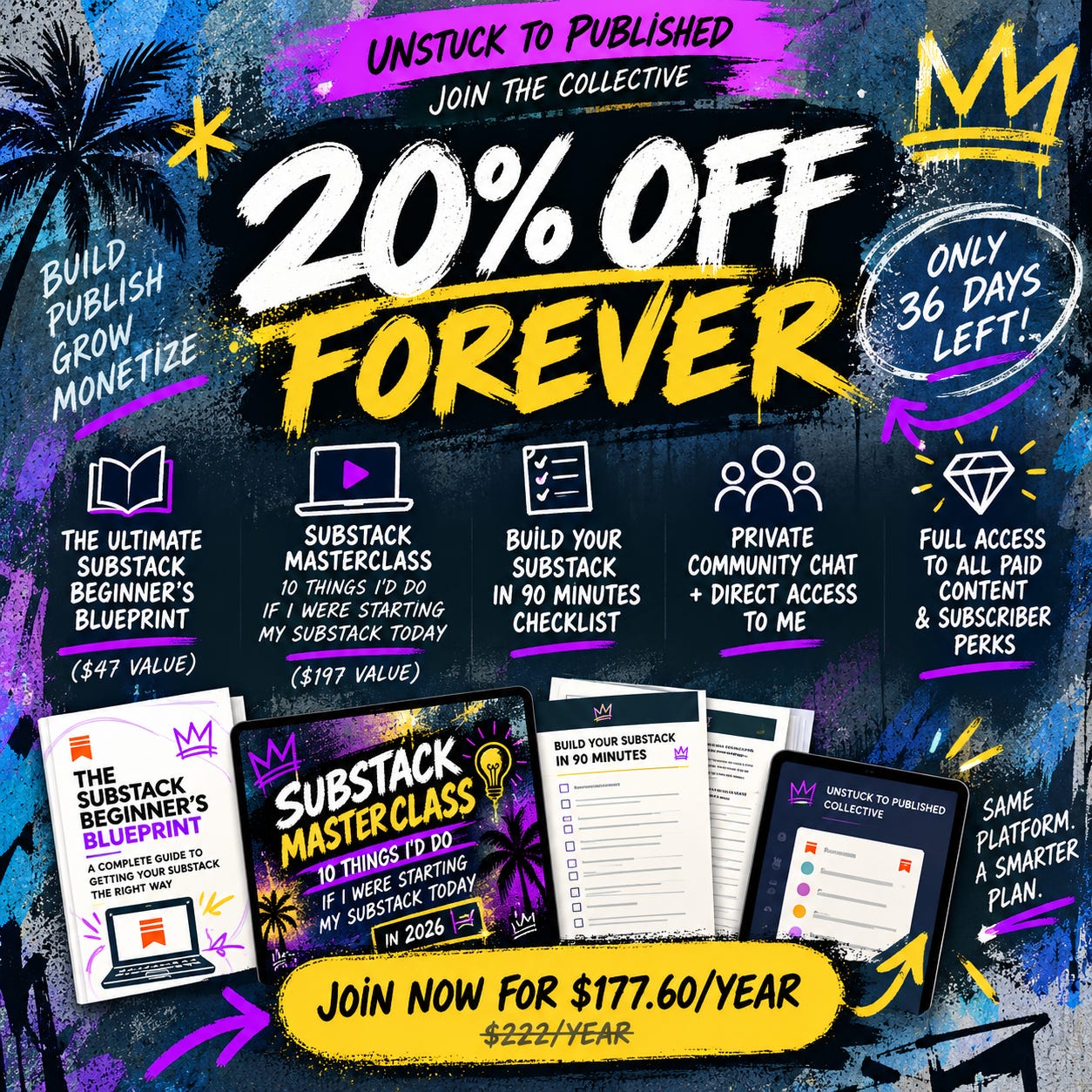
20% OFF UNSTUCK TO PUBLISHED 💜
If you’ve been thinking about joining the paid side of Unstuck to Published, now’s a pretty damn good time.
Join annually for $177.60/year (normally $222) and unlock:
📕 The Ultimate Substack Beginner’s Blueprint ($47 value!!)
🎓 My Substack Masterclass — 10 Things I’d Do If I Were Starting My Substack Today ($197 value!!)
✅ Build Your Substack in 90 Minutes Foundational Checklist
💬 Private Community Chat & direct access to me for questions and hands-on support
🔓 Full access to my paid Substack content + subscriber perks
20% off. One year. Everything inside.
👉 Join Unstuck to Published for $177.60/year
The tools are here. Let’s build the damn thing. 💜
If You’re Stuck Right Now: Creator Match Removes The Guesswork. Not The Work.
Creator Match can surface creators worth looking at, show you useful audience information, and give you a direct way to start the conversation.
That’s pretty damn useful, but it can’t decide whether you respect someone’s work, come up with something worth creating together, or build the relationship for you.
Creator Match removes some of the guesswork. You still have to do the human part.
So open Creator Match.
Pick one creator who catches your attention.
Run them through the 60-second check.
Read their work.
Find the connection.
Bring one idea.
And if it still makes sense?
→ Hit Message because the most valuable thing Creator Match gives you might not be another thousand subscribers.
It might be the person on the other side of the match.
Thank you so much for being here. I truly appreciate you.
— Jessica
Move first. Refine second. Publish with structure.
Recent Articles & Live Episodes
The #1 Way To Win On Substack: Become A Value Creator

Everyone wants to know how to win on Substack.
How I Use One Bullet Journal Page To Keep Three Substack Publications Moving

About a month ago, I wrote an article called If You Want to Become a Better Writer, Start Journaling.
How To Set Up Subscriber Perks On Substack

Someone asked me today how to set up subscriber perks on Substack.
Scan the QR code below to subscribe to Unstuck to Published →
This is so helpful, Jess!! I love making new friends. I think that alone holds so much value. That can have such an impact on our creativity. Appreciate this comprehensive guide!
I think this is a great way to see who you can connect with. Sometimes you lose sight of the people around you.