

Someone asked me recently:
“I finally published my first article… but what do I actually post on Notes?”
And honestly?
That’s the question most new creators hit right after they publish because writing the article is one thing.
Showing up between articles?
That’s where people freeze.
Do you post the article link?
Write something completely new?
Promote the same article all week?
Disappear until your next newsletter is ready?
Most creators aren’t struggling because they don’t have ideas.
They’re struggling because they don’t know what belongs in Notes.
Here’s the mindset shift that changed everything for me:
→ Your newsletter builds authority.
→ Your Notes build familiarity.
→ Authority gives people a reason to subscribe.
→ Familiarity gives them a reason to stay.
When you understand this Notes stop feeling like another content chore.
They become part of the publication.
Every Note Has A Job
One mistake I see new creators make is expecting every Note to do everything.
Get subscribers.
Go viral.
Start conversations.
Promote an article.
Build relationships.
Create trust.
That’s a lot of pressure for one tiny post.
No wonder people stare at the box like it owes them money.
Instead, think of Notes like a team.
Each type has a different job.
Some introduce people to your ideas.
Some deepen relationships.
Some invite conversation.
Some show personality.
Some build trust over time.
And when those Notes work together?
That’s where familiarity compounds.
So if I were starting Substack today, these are the Notes I’d be posting.
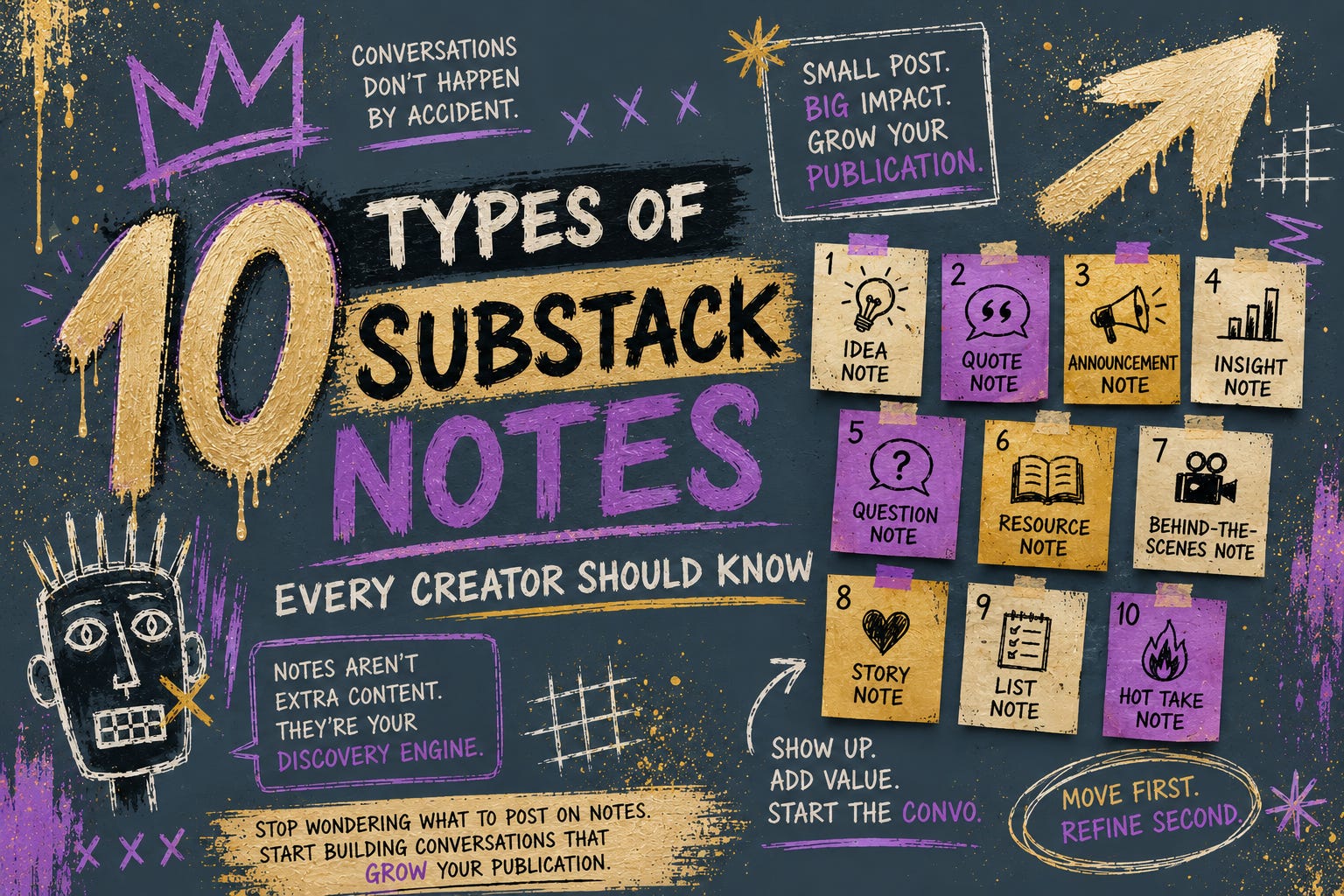
1. The Thought Note
A Thought Note is one idea from your latest article.
Not the whole thing and not the link.
One idea.
That’s it.
Why It Works
People scrolling Notes don’t want another “new post is live” announcement every five seconds.
They want something interesting enough to stop them.
A strong Thought Note gives value before asking for attention.
Curiosity brings people back to the article.
Try This
Finish one of these sentences:
Most people think…
I’ve realized…
One lesson I’ve learned recently…
Something I wish I knew sooner…
Example:
Most creators don’t have a content problem.
They have a decision problem.
That’s a Note.
Short. Clear. Useful. Valuable.
2. The Quote Note
What It Is
A Quote Note pulls one memorable sentence from something you’ve already written.
One sentence.
That’s it.
Why It Works
Great writing deserves more than one life.
One strong sentence introduces people to your voice without asking them to read a 2,000-word article first.
Sometimes one sentence is enough to make someone curious.
Try This
Open your last article.
Find the sentence that made you pause when you wrote it.
Turn that sentence into a Note.
Example:
Many successful writers treat Notes as a distribution system, not an extra feature.
That line can live in more than one place.
Let it.
3. The Question Note
What It Is
A Question Note asks your readers something real.
Not fake engagement bait and not “what do you think?” tossed at the end because you didn’t know how to close.
A real question.
Why It Works
→ Questions invite participation.
→ Participation builds community.
The answers often become your next articles, offers, or paid posts because when people tell you what they’re stuck on?
They’re handing you the language your publication should be using.
Try This
Ask questions like:
What’s the hardest part about starting your Substack?
What’s one thing you’re currently overthinking?
What topic would actually help you this week?
What’s the one decision keeping you stuck?
Simple questions create meaningful conversations and conversations are where trust starts.
4. The Milestone Note
What It Is
A Milestone Note shares progress.
Not to flex and not to perform.
To bring people along with you.
Why It Works
Readers enjoy watching something become real.
Milestones make your publication feel alive.
They show movement and movement makes people pay attention.
You can share:
Your first subscriber
Your first paid subscriber
Your tenth article
Your first workshop
Your first collaboration
Your first month publishing consistently
Becoming a Best Seller
However, here’s the part most people miss:
Don’t just announce the milestone. Tell people what it taught you.
Try This
Instead of:
I just published my 25th article!
Try out something like this:
I just published my 888th article.
The biggest lesson?
Consistency gets easier when you stop trying to turn every article a science project.
Here’s another Milestone Note example:
Now the milestone becomes useful. That’s the difference.
5. The Restack Note
What It Is
A Restack Note shares someone else’s work and explains why it matters.
Not just:
Great article!
That’s lazy.
And honestly? It tells us nothing.
Why It Works
Not every Note needs to start with you.
A thoughtful Restack helps your audience discover valuable work, builds relationships with other creators, and shows people how you think.
The best Restacks answer one question:
Why should someone else read this?
That’s what turns a share into a recommendation.
Try This
When you Restack someone, add your perspective.
Example:
I liked this because it names something a lot of creators feel, but don’t know how to explain.
Or:
This changed how I think about consistency. Especially the part about showing up before the results are visible.
That’s useful and that’s signal.
6. The Perspective Note
What It Is
A Perspective Note shares your opinion about something happening now.
That could be:
A Substack update
A trend in your niche
Something another creator wrote
A book you’re reading
A lesson from your own work
A mistake you keep seeing
Why It Works
People don’t just follow creators for information.
They follow them for perspective.
→ Two people can see the same thing and walk away with completely different lessons.
Your perspective is what makes your publication feel like yours.
Try This
Start with:
I’ve been thinking about…
Everyone seems to believe…
Here’s what I see differently…
One thing I’ve noticed…
Example:
Everyone talks about getting more subscribers.
I think more creators need to ask whether their publication is clear enough for one right person to pay.
That’s a perspective. Not just content.
7. The Photo Note
What It Is
A Photo Note shares a real moment from your day.
Not because it’s perfect, but because it’s human.
Examples:
Your workspace
Your notebook
Your whiteboard
Your coffee
Your walk
Your bookshelf
Behind the scenes of something you’re building
Your pets
Why It Works
Readers don’t just subscribe to publications. They subscribe to people.
Photos create familiarity fast.
Sometimes one simple photo says more than five paragraphs.
Try This
Don’t ask:
Is this photo impressive enough?
Ask:
Does this help people know me a little better?
That’s the job.
8. The Video Note
What It Is
A Video Note is a short video posted directly to Notes.
No fancy setup, no ring light production studio, and no 14 takes because one eyebrow moved weird.
Just talk.
Share:
What you’re building
What you learned
A quick lesson
An observation
Something easier to say than write
Why It Works
Video builds familiarity quickly.
People hear your voice.
They see your face.
They get a better sense of how you think and that matters because trust isn’t built from information alone.
It’s built from repeated exposure.
Try This
Record a 30-second video answering:
What have I been thinking about today?
Don’t script it.
Talk like you’re talking to a friend because that’s the whole point.
9. The Story Note
What It Is
A Story Note shares a short moment from your life.
Not a full essay and not your entire origin story.
One moment.
Something that happened.
Something you learned.
Something that changed how you think.
Why It Works
Information teaches and stories stick.
Think about the creators you remember most.
You probably remember:
Where they were
What happened
How they felt
What they learned
Long after you’ve forgotten the exact advice they gave.
→ That’s emotional memory and emotional memory builds relationships.
Try This
Start with:
Yesterday…
When I first started…
I almost…
I’ll never forget…
Example:
On Thursday morning, this workshop didn’t exist.
By Saturday afternoon, I was hosting it live.
In less than 48 hours, I made $291 from a $97 offer and ran a session where two creators left with structured, monetizable Substacks built correctly.
No long runway, no polished funnel, and no months of planning.
Just a clear idea and decisive action.
You don’t need dramatic stories. You need honest ones.
10. The Build-In-Public Note
Share something you’re actively working on.
A draft.
A question.
A headline.
A podcast episode.
An article.
A framework.
A decision you’re making.
A product you’re creating.
Why It Works
People love watching things being built.
Not because they’re finished, but because they feel included.
Build Your Signature Series
Once you experiment with these different Note types, you’ll start noticing something.
Some formats feel more natural than others.
Good. Lean into that.
Maybe every Monday becomes a writing lesson.
Maybe every Friday becomes a personal story.
Maybe every Sunday becomes your weekly reflection.
That’s how recognizable creators are built.
Not by posting randomly, but by developing rhythm.
Readers don’t just remember what you write. They remember how you show up.
Your First Week On Notes
If you’re wondering where to start, borrow this.
Don’t overcomplicate it; seriously.
Monday
Post a Thought Note from your latest article.
Tuesday
Ask a Question Note your reader can answer easily.
Wednesday
Share a Quote Note from something you’ve already written.
Thursday
Post a Story Note from your own experience.
Friday
Share a Perspective Note on something you’ve noticed.
Saturday
Restack another creator and explain why their work matters.
Sunday
Post a Photo, Video, or Milestone Note.
This isn’t a prison sentence so please don’t turn it into one.
It’s a starting point.
The goal isn’t consistency for the sake of consistency.
The goal is to make showing up easier.
Your Challenge
Before you close this article, open Notes.
Choose one of the ten Note types above.
Spend five minutes writing it.
Not thirty. Five.
Don’t overthink it, don’t edit it into a TED Talk, and don’t wait until tomorrow because you “want to make it better.”
Publish it because the goal isn’t to master Notes today.
The goal is to become visible today.
One conversation at a time.
Final Thoughts: If You’re Stuck Right Now
The biggest mistake I see creators make is treating Notes like advertisements.
They only show up to say:
“My new article is live.”
Then they disappear until next week.
Imagine treating a friendship that way.
Awful.
Notes aren’t advertisements. They’re conversations.
→ Your newsletter builds authority.
→ Your Notes build familiarity.
→ Familiarity builds trust.
The more consistently you participate, the more recognizable you become.
Eventually, you stop asking:
What should I post today?
And start asking:
What conversation do I want to start today?
The creators who succeed on Notes aren’t always the ones posting the most.
They’re the ones who become recognizable.
One conversation, one familiar face, and one Note at a time.
If you’re building your Substack and want more clear, foundational breakdowns like this, subscribe and follow along.
Unstuck to Published exists to help you build correctly from day one, with structure.
Thank you so much for being here. I truly appreciate you.
— Jessica
Move first. Refine second. Publish with structure.
ICYMI, Previous Articles & Live Episodes →


Scan the QR code below to subscribe to Unstuck to Published →
Stop asking:
What should I post today?
And start asking:
What conversation do I want to start today?
The creators who succeed on Notes aren’t always the ones posting the most.
They’re the ones who become recognizable.
Jess, the restack note framing is the one that most people get wrong, and you've nailed exactly why adding your perspective turns a share into an actual recommendation: which of the ten do you find creators resist the most?