

Last week, I published an article explaining how the Substack paywall works and why it’s one of the most important tools on the platform.
Afterward, several readers wrote back with thoughtful follow-up questions.
Four questions in particular came up:
When is the right time to turn on paid subscriptions?
Will having a paywall create pressure to produce content?
How might the paywall work for fiction writers?
What part of the article goes behind the paywall?
These are excellent questions, especially for new writers who are building their Substack publication for the first time.
Let’s go through them one by one.
Question 1: When is the right time to turn on paid subscriptions?
My perspective is simple: sooner than most people think.
The timing is less important than the clarity of your offer.
Before turning on paid subscriptions, you should understand three things regarding the clarity of your paid offer:
What the reader is getting. What can they expect from you every week.
What outcome or transformation your publication promises to give the reader.
What your posting structure will look like.
If those three elements are clear, there’s no real reason to delay.
You can still publish plenty of free articles while your archive grows.
Turning on paid simply allows readers to support your work and gives you the option to build something sustainable over time.
Many new writers wait months before enabling paid subscriptions because they feel they need a large audience first.
In reality, what matters more is clarity and consistency, not audience size.
Question 2: Will I feel pressure once I turn on the paywall?
Yes, some pressure is normal.
When someone pays for your work, you’re making a promise to the reader.
That responsibility can feel intimidating at first, but it’s also motivating. The presence of paid subscribers creates structure and accountability.
The key isn’t to overcommit, but to overdeliver.
Before turning on paid subscriptions, decide:
How often you will post.
For example, a free article every Saturday and a paid article every Wednesday.
What type of content or product will be behind the paywall for paid subscribers only.
What readers can consistently expect from you.
If those expectations are clear, the pressure becomes productive rather than stressful.
In other words, it becomes a framework and provides the structure that helps you show up consistently and deliver.
Question 3: How might the paywall work for fiction writers?
My own publications focus on nonfiction, so fiction writing isn’t my primary area of expertise.
However, the Substack paywall can absolutely work for fiction writers.
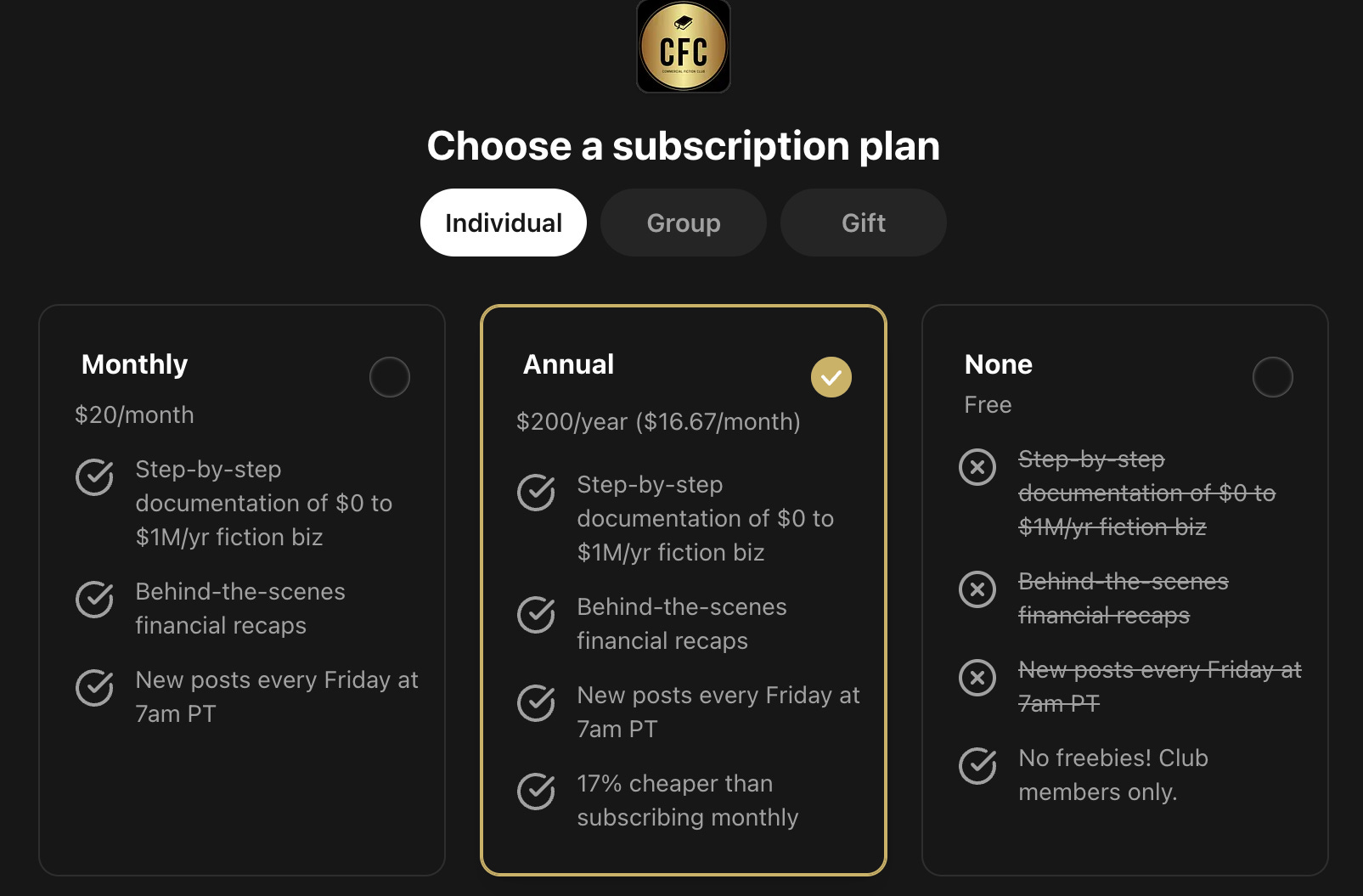
One example above is Nicolas Cole’s Substack publication, Commercial Fiction Club, which focuses on commercial fiction writing and has built a successful paid reader base and generates $1,000,000/year.
For fiction writers, the paywall could be used in several ways:
1 new paid post every Thursday morning.
Behind-the-scenes commentary on the writing process and financial recaps.
Step-by-step documentation to show how you built your paid newsletter from $0 to $1 million/year fiction business.
Writing lessons or craft discussions.
Exclusive chapters of a serialized story or early access to upcoming work of a new self-published book.
The exact format will vary, but the underlying principle remains the same.
Readers subscribe when they feel they’re receiving consistent value and meaningful content. That principle applies whether you’re writing essays, deep dives, poems, teaching skills, or publishing fiction.
Link to Commercial Fiction Club substack publication by Nicolas Cole
Question 4: What part of the article goes behind the paywall?
This is one of the most common questions new Substack writers ask.
The short answer is: the part that contains the deeper value.
Most successful Substack writers structure their articles like this:
1. Free section (before the paywall):
Introduce the topic.
Explain the problem.
Share context or a short story.
This allows free readers to understand the idea and still receive value.
Then the paid section goes deeper.
2. Paid section (after the paywall):
Frameworks
Step-by-step breakdowns
Detailed insights
Actionable guidance
In other words, the free portion opens the conversation, while the paid portion delivers the deeper expertise.
A helpful way to think about it is this:
The free section shows the idea.
The paid section shows how to apply it.
If you want to use the paywall like a high-performing Substack writer remember to follow the Simple Paywall Framework.
Context → Insight → Depth.
If you’re just getting started, don’t overthink it. Focus on writing a strong article first, then place the paywall right before the most detailed insights or frameworks.
Final Thoughts: If You’re Stuck Right Now
The Substack paywall isn’t something to fear at all.
It’s simply a tool to monetize your work and build a reoccurring revenue machine that has the potential to generate you unlimited profits.
What matters most is clarity.
Clarity about your publication angle and your paid subscription offer positioning.
Clarity about what outcome or transformation the reader can expect to experience or achieve.
Why someone would want to support it and who are they becoming by joining the paid tier.
When that’s clear, the rest becomes much easier.
It simply means you are creating the option for your work to become sustainable over time.
If you are building your Substack from scratch, focus on getting the fundamentals and foundation right first, so you can start posting with a top-tier, monetized, and professional looking publication.
Choose a clear publication name.
Write a strong About page.
What is this about, who is it for, who are you, and your promise to the reader and why they should the subscribe to your publication.
Write a solid welcome email to the free subscribers with instant access to a free lead magnet and upsell to the paid tier subscription plan.
Understand how the paywall works inside and out; it’s very simple.
When the structure is clear, publishing becomes much easier and frictionless.
That’s exactly what Unstuck to Published is designed to help you do.
Subscribe and follow along if you want step-by-step guidance on building your Substack the right way from day one.
— Jessica
Move first. Refine second. Publish with structure.
👩🏻💻Recent Articles
How To Choose Your Substack Name (Without Overthinking It)

One of the biggest reasons creators delay launching their Substack is the name.
How The Paywall Works on Substack (And When to Use It)

Last week, someone asked me a simple question:
I especially like the idea that clarity matters more than audience size—many writers wait for some imaginary milestone before turning on paid subscriptions when what really matters is having a clear promise and consistent structure for readers. The way you described the free section opening the conversation and the paid section delivering deeper value is a helpful way to think about it. It reminds me that building a publication is less about perfection and more about steadily showing up with a clear voice over time. I’ve been experimenting with that process myself while sharing reflections like Compound Iniquity, about how small inner patterns gradually shape our lives. If you’re curious, you can read it here: https://theeternalnowmm.substack.com/p/compound-iniquity