


I used to think getting a sponsor started with the pitch.
Find a company, write the email, ask for money, and hope they say yes.
Turns out, I was skipping most of the process.
Recently, Robyn Levin and I did something a little dangerous on Unstuck to Finding Your Edge.
I brought my actual sponsorship dream list.
Not hypothetical brands.
Companies I’d genuinely love to work with.
Nike. Thorne. Apple. Oura. GORUCK. Spotify and several others.
And instead of sitting around talking about how nice it would be if one of them magically discovered me, Robyn started walking me through what it would actually take to approach them.
Then she told me something important:
“Don’t pitch anyone yet.”
Really?
I thought that was the assignment, but as we worked through the list, I understood why.
Before I contact a company, I need to know why they should care about my publication, why their brand makes sense for my readers, what I could offer them, what evidence I have that the opportunity is worth considering, and who I should actually contact.
The pitch isn’t where this process starts.
It’s almost where it ends.
So I took what Robyn and I worked through in Episode 017 and turned it into a mini guide you can use for your own Substack.
Grab a notebook.
Better yet, grab your dream sponsor list.
We’re going to make it useful.
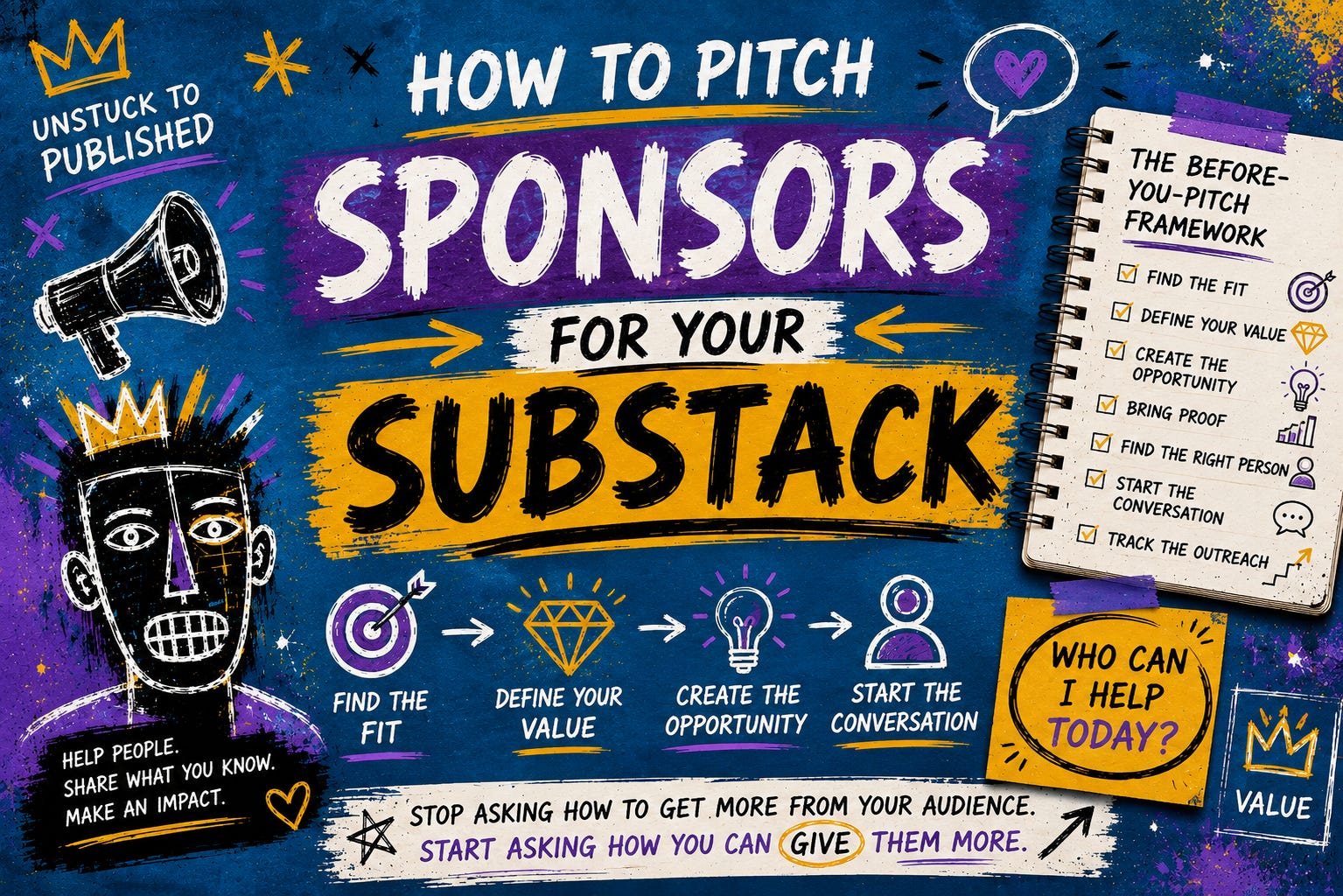
Step 1: Build Your Dream Sponsor List
Before you worry about pitch emails, pricing, or media kits, answer a much easier question:
→ Who would you genuinely love to work with?
Start there.
Don’t censor yourself because you think your publication is too small, don’t worry yet about whether the company would say yes, and don’t fill the list with random companies simply because they have marketing budgets.
Look for companies that make sense for:
Your publication.
Your audience.
Your subject matter or topic.
Your values.
The things you already talk about.
The products or services you genuinely use.
My list included everything from large companies like Nike and Apple to smaller health and wellness brands.
The size of the company wasn’t the first filter.
→ The connection was.
Your turn:
→ Write down 10 companies you’d genuinely be excited to work with.
Don’t pitch them. We’re nowhere near that yet.
Step 2: Find The Fit
Now pick one company from your list.
And ask:
→ Why them?
This question sounds almost insultingly simple. It isn’t.
Nike was one of the biggest companies on my list.
My original explanation was basically:
I love Nike, I wear Nike, and I’ve worn the brand forever.
Okay…so have approximately half the people at my gym.
That’s not much of a sponsorship story.
Robyn kept digging.
Why Nike?
That’s when the actual connections started appearing.
I grew up playing competitive hockey. Sports and movement have been part of my life for years. Health, discipline, and mindset overlap naturally with my work.
I’ve worn Nike since elementary school.
There’s Nike artwork in my office and during the conversation, another connection surfaced that I hadn’t even considered:
→ My dad used to design shoes.
Suddenly, the story wasn’t:
I like Nike.
There was history behind it.
Family.
Athletics.
Identity.
Health.
A genuine relationship with the brand.
You don’t need a childhood story about every company you approach.
That’s not the lesson.
The lesson is:
→ Find the real reason this company belongs on your list.
Ask:
Why this company?
Why my publication?
Why my audience?
If your best answer is because I’d like them to give me money...we have more work to do.
Step 3: Define Your Value
Now flip the question.
You’ve figured out why you want them.
→ Why should they want you?
And please don’t immediately panic because you don’t have 100,000 subscribers.
Subscriber count is one part of your value.
It isn’t the whole damn thing.
Look at what you’ve already built.
Do you have a clearly defined audience?
A trusted publication?
A podcast?
A recurring series?
Strong reader engagement?
Expertise in a particular subject?
A community?
A distinctive point of view?
For my health & wellness publication, NP Fellow Become the CEO of Your Health, the value isn’t simply a number on a subscriber dashboard.
There’s an established publication, a defined audience, recurring content, a podcast, and readers who have developed trust in the work.
→ That’s what you need to identify for yourself.
Your turn:
Finish this sentence:
A company would want to reach my audience because ________.
Then:
My publication gives them access to ________.
If those answers feel fuzzy, stay here. You can’t communicate value you haven’t identified yet.
Step 4: Create The Opportunity
This was one of my biggest shifts.
I had been thinking about sponsorship as: Company pays me → I put an ad in my newsletter.
That’s one option, but it’s absolutely not the only one.
Robyn and I discussed several possibilities for NP Fellow:
Sponsoring an individual article
Sponsoring a recurring series
Sponsoring the podcast
A host-read podcast message
A longer-term partnership
Products or gift cards for readers
Sponsoring a reader challenge
The reader challenge caught my attention because I hadn’t considered it.
Imagine a health or fitness company providing products for a challenge I’m already creating for my readers.
The readers get something useful.
The company reaches people who are relevant to its business.
My publication gets to create something better for the audience.
Now we’re no longer talking about slapping a logo at the bottom of an email and calling it a partnership.
→ We’re creating an opportunity.
So before you ask:
How much can I charge?
Ask:
What could we create together that would actually be valuable to my audience AND the company?
Price comes later.
Step 5: Bring Proof
You think your readers would care about the company.
Cool.
→ Can you show it?
This is where your existing work becomes useful.
Go through your publication and look at:
Views.
Engagement.
Comments.
Shares.
Downloads, if you’re podcasting.
Subscriber growth.
Strong individual posts.
And especially look for content connected to the type of sponsor you’re approaching.
Robyn had me do this with content I’d already published.
For example, I’ve previously written about Nike in another publication.
If that article performed particularly well, I now have evidence that goes beyond:
Trust me. My readers will probably like this.
→ I can show what people have already responded to.
Also, don’t get hypnotized by one metric.
Open rates can tell you something, but they don’t tell you everything. Readers consume Substack in different ways, including through the app.
→ Look at the bigger picture.
You’re not trying to bury a sponsor under a mountain of analytics.
You’re giving them a reason to believe the opportunity is real.
Your turn:
→ Find three pieces of evidence that support the partnership you’re considering.
Not twenty-seven. Three.
Step 6: Find A Person, Not An Inbox
Okay.
You’ve got the company.
You’ve found the fit.
You know your value.
You’ve thought about the opportunity.
You’ve gathered some proof.
NOW can we email them?
Almost. 😂
First:
Who the hell are you emailing?
Robyn’s advice was to avoid blindly throwing your idea into a generic company inbox if you can find a better route.
Start investigating and look on the company’s website for departments or programs related to:
Partnerships.
Collaborations.
Creators.
Affiliates.
Influencers.
Marketing.
Look at the company’s website and social accounts and to try to identify the department, or even better, the person, who handles the kind of partnership you’re proposing.
One tactic Robyn suggested surprised me.
→ If you can only find an affiliate department, that can still be an entry point.
You’re not necessarily asking to become an affiliate.
You can contact them and essentially say:
“I see you have an affiliate program. I have a different partnership idea for my publication. Who would be the best person to speak with?”
You’re trying to get closer to a human.
As I said during the Live:
“It’s getting your foot in the door.”
Step 7: Start The Conversation
This may have been the most useful lesson from the entire session.
I thought the first email was the pitch, but Robyn reframed it.
→ The first email is the introduction.
That changes everything.
You don’t need to stuff your entire media kit, life story, pricing structure, proposal, analytics dashboard, childhood memories, and twelve possible deliverables into one poor unsuspecting email.
→ You’re opening a conversation.
The first message needs to communicate four things:
Who are you?
Why them?
Why you?
What opportunity do you see?
Then give them a way to continue the conversation.
Maybe that’s another email.
Maybe it’s a call.
Maybe it’s a meeting.
And eventually, it may become a formal proposal.
But the first objective isn’t necessarily:
GET SPONSOR.
It’s:
→ Get the right person interested enough to talk to you.
That feels a hell of a lot more doable.
Make The Opportunity Easy To Understand
There’s one principle underneath this entire process:
Don’t make the company figure out why it should work with you.
Do that thinking for them.
Make the opportunity visible.
Here’s my audience.
Here’s why your company fits.
Here’s what we could create.
Here’s why it could benefit you.
That’s much stronger than:
“Hi Nike. I have a newsletter. Money please.”
A good sponsorship approach isn’t simply asking a company for something.
It’s showing them an opportunity they may not have considered.
Step 8: Build A Sponsorship Pipeline
Once you start contacting companies, your dream list needs to grow up.
→ Turn it into a working document.
At minimum, track:
Company | Contact | Email | Date Contacted | Status | Follow-Up | Notes
Because after a few conversations, Wait...did I email that person? isn’t a sponsorship strategy.
You need to know:
Who did I contact?
When?
Did they respond?
When should I follow up?
Am I speaking with the right person?
What’s the next step?
Robyn’s assignment for me was to take my original dream list and start adding contacts, dates, status, and outcomes.
That’s the moment the list becomes something else.
A dream list becomes a strategy when you put names, dates, actions, and outcomes beside it.
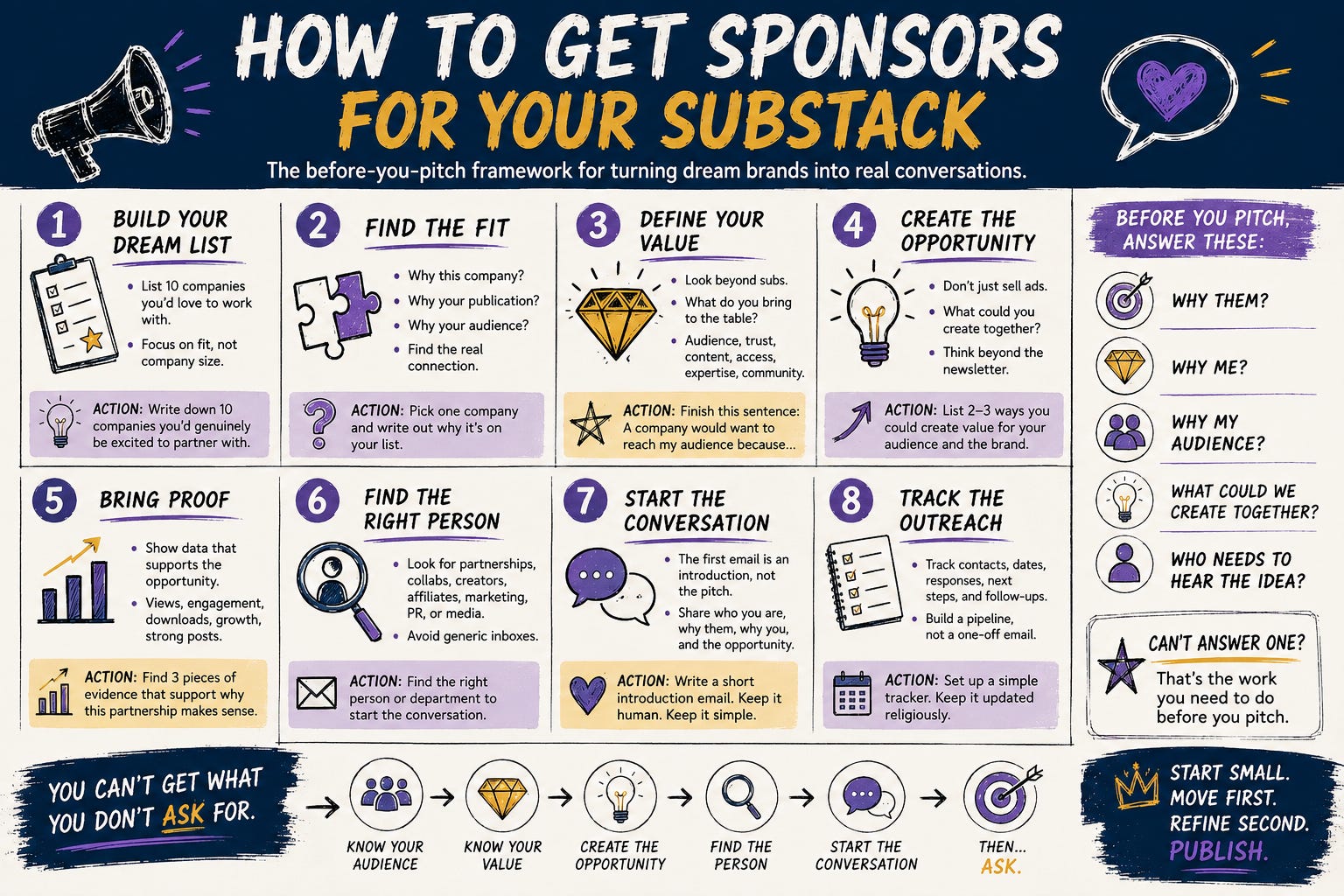
The Before-You-Pitch Framework
Here’s the entire process in one place:
Build your dream list.
Choose companies that genuinely overlap with your publication and audience.Find the fit.
Answer: Why me? Why them?Define your value.
Know what you bring beyond subscriber count.Create the opportunity.
Decide what you could actually create together.Gather proof.
Find the data, content performance, engagement, and audience response that support your idea.Find the right person.
Look for a relevant human or department instead of relying on a generic inbox.Start the conversation.
Introduce yourself and the opportunity. Don’t try to close everything in the first email.Track the outreach.
Record contacts, dates, responses, follow-ups, and next steps.
And then? You ask.
Before You Send Anything, Answer These Five Questions
Take one company from your list.
Don’t write the pitch yet.
First, answer:
Why them?
Why me?
Why my audience?
What could we create together?
Who needs to hear the idea?
Can’t answer one?
Good.
You just found the work you need to do before you pitch.
Final Thoughts: You Can’t Get What You Don’t Ask For
During the Live, Robyn told me about some of the unconventional sponsorships she’s landed over the years.
Coca-Cola.
Bauer.
Rollerblade.
Subway.
Even a Jaguar dealership for an event.
She saw connections between businesses and audiences she already had.
→ Then she asked.
At one point, I said:
“You really don’t know what you don’t ask for.”
Robyn corrected me:
“You really can’t get what you don’t ask for.”
Fair 😂 and that’s probably the biggest thing I took away from Episode 017.
Getting a sponsor doesn’t begin with firing a giant proposal at the biggest company on your dream list.
It begins much smaller.
Know your audience.
Know your value.
Find the connection.
Create the opportunity.
Bring proof.
Find the person.
Start the conversation.
Then ask.
At the end of Episode 017, I still hadn’t pitched Nike, but I finally understood what needed to happen before I did.
Robyn’s next assignment was wonderfully unglamorous: find the contacts, add them to the list, write the email, track the outreach, and then pitch, and that’s your assignment too.
→ Pick one company.
Not ten and not fifty. One.
Work through the framework.
Find the fit.
Find the opportunity.
Find the person.
Then make the first move.
Because your dream sponsor probably isn’t sitting around wondering when you’re finally going to email them.
You’re going to have to ask.
Thank you so much for being here. I truly appreciate you.
— Jessica
Move first. Refine second. Publish with structure.

Want to Go Deeper on Sponsorships with Robyn?
There’s also something worth celebrating.
Robyn’s Finding Your Edge just reached its first 100 subscribers!!
To celebrate, she’s offering a limited-time, one-time upgrade opportunity for her publication.
She’s also introducing her Sponsorship Playbook & Workbook, Your Sponsor Kit Edge™, which draws on decades of her real-world sponsorship experience. 🐐
If these sponsorship conversations have you thinking, “I want to try this with my own publication”, Robyn’s new resource gives you a place to keep going.
→ Click below to learn more and celebrate 100 subscribers with Robyn at Finding Your Edge.
Follow Robyn at Finding Your Edge →

ICYMI, Previous Articles & Live Episodes →


Scan the QR code below to subscribe to Unstuck to Published →
If you could land **one dream sponsor** for your Substack, who would it be?
Drop the company below. 👇
Then use the mini guide above to find the right contact, make your pitch, and **start the conversation**.
You don't need to wait for brands to discover you.
I really like Dr. Teals, Go Ruck, and Riven Mouthwash!