

Everyone wants to know the secret to succeeding on Substack.
Publish more often?
I use all of those things and I teach many of them, but if you asked me for the one thing I’d focus on if I were trying to grow a Substack today, my answer would be much simpler.
→ Become the most helpful person you can possibly be.
That’s it.
Help people.
Answer their questions.
Solve problems you already know how to solve.
Make introductions.
Recommend good work.
Explain the thing that took you three hours to figure out so somebody else can understand it in ten minutes.
Make somebody’s path a little easier because you’ve already walked part of it because the fastest way to become valuable is to create value for other people.
And I think a lot of creators have this backwards.
Stop Asking, “How Do I Grow?”
I understand why we ask it as I also ask it.
How do I get more subscribers?
How do I get more views?
How do I convert more readers to paid?
How do I grow my Notes?
How do I get recommended?
How do I make more money?
There’s nothing wrong with wanting any of those things.
You’re building something.
Of course you want it to work, but notice where every question begins.
Me.
How do I grow?
How do I get subscribers?
How do I make money?
How do I get noticed?
→ Now change the question.
Instead of:
How can I grow my Substack?
Ask:
Who can I help today?
That changes how you operate.
→ You’re no longer looking at every interaction and wondering what you can extract from it.
You’re looking for places where you can contribute and that’s a very different way to build.
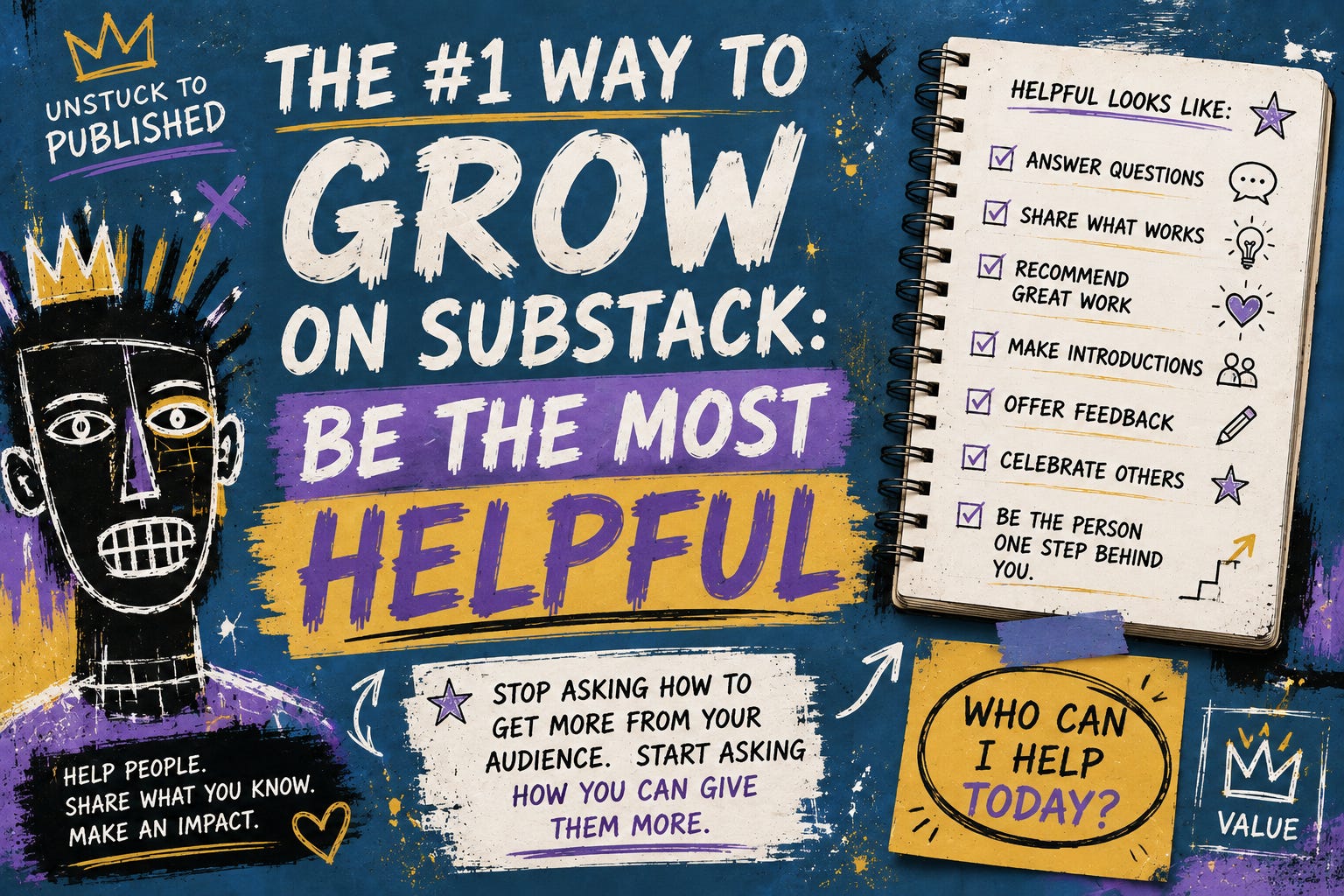
Help The Person One Step Behind You
You don’t have to be the smartest person on Substack, you don’t need the biggest audience, and you don’t need to know everything.
→ You just need to know enough to help the person one step behind you.
If you’ve already figured out how to build a profitable business, teach the person who hasn’t.
If you understand the difference between a stock and a bond, explain it.
If you developed a skill nobody seems to have, be of great use value.
If somebody asks a question and you know the answer, answer it.
Some of my favorite article ideas begin exactly that way.
Someone asks me something that feels obvious to me.
And instead of dismissing the question, I think:
If one person is confused about this, somebody else probably is too.
→ So I write the article.
That’s helpfulness turned into publishing and there’s something else I want you to remember.
→ You don’t need to be ten years ahead of someone to teach them something useful.
Sometimes one step is enough.
Your Readers Are Already Telling You What To Write
If you ever feel like you have no idea what to publish next, stop brainstorming for a minute.
Pay attention and look at your:
Comments
DMs
Notes replies
Chats
Conversations with clients
Conversations with other writers
Questions people keep asking
Those questions are gifts. 🤗🙌
→ They’re showing you exactly where the friction is.
You don’t need to invent a brilliant content strategy every Monday morning.
Find the problem.
Help with the problem.
Write the answer.
Some of the strongest articles are nothing more complicated than:
One person asked me this. Here’s the clearest answer I can give them. (Literally!!)
That’s a publishing strategy I could follow for a very long time.
Being Useful Makes You Memorable
Think about the people you trust online.
At some point, they probably helped you.
Maybe they explained something that had been confusing you for weeks.
Maybe they recommended a resource.
Maybe they introduced you to an idea.
Maybe they gave you language for something you couldn’t explain.
Maybe they made something complicated feel simple.
Maybe they made you laugh on a terrible day.
They gave you something and because they gave you something useful, you remembered them.
→ That’s how trust often begins.
Not with:
“LOOK AT ME”
But with:
→ “Let me help you.”
That’s why I hesitate to call helpfulness a “growth strategy.”
If you start helping people because you’re calculating what you’ll get back, you’ve missed the point, but helpful people do tend to become memorable.
Memorable people get trusted and trusted people get recommended, over time, that can become growth.
Pay Attention To People
I think this may be one of the most underrated skills on the internet.
→ Notice people.
Notice who’s asking questions.
Notice who’s stuck.
Notice who’s doing excellent work without much recognition.
Notice who’s celebrating something.
Notice who’s building something interesting.
Notice where something you already know could save somebody hours of frustration.
→ Then do something about it.
Leave the thoughtful comment.
Make the introduction.
Send the resource.
Restack the writer whose work deserves more attention.
Invite someone onto your Live.
Tell somebody about their work when they’re not in the room.
Check on the writer who suddenly went quiet.
You don’t need a huge audience to do any of that.
→ You just need to be paying attention and you don’t need a title to lead.
Sometimes leadership is simply noticing what someone needs and deciding to help.
Your Reputation Is What People Expect From Your Name
Your reputation is being built every day.
Not only by what you publish, but by how you behave.
People remember:
She answered my question.
He introduced me to someone.
She shared my work before anyone knew who I was.
He helped me without immediately trying to sell me something.
She finally made this complicated thing make sense.
He helped me out and saved me so much time.
→ Those interactions accumulate.
Eventually, your name starts to mean something.
Useful and reliable.
Generous and knowledgeable.
Helpful.
That’s brand.
→ Your brand isn’t only your logo, your color palette, or your tagline.
It’s what people expect from you when your name appears.
That’s built slowly. One interaction at a time.
Helpful Doesn’t Mean Available To Everyone
Now for the part that matters if you don’t want this philosophy to eat you alive.
→ Being helpful doesn’t mean:
Answering every DM.
Working for free.
Giving away everything you know.
Being available 24/7.
Having no boundaries.
Saying yes to everyone.
That’s not generosity.
That’s a fast route to resentment.
You can be extremely helpful and still have boundaries.
Sometimes your free article is the help.
Sometimes your paid article is the help.
Sometimes your workshop is the help.
Sometimes your consulting is the help.
Sometimes the most useful thing you can say is:
“I can’t do that, but here’s the resource I’d recommend.”
→ Helpfulness isn’t measured by how exhausted you are afterward.
It’s measured by whether you genuinely helped.
Helpfulness Looks Different for Different Writers
You also don’t need to become useful to the entire internet.
→ Help your people and remember that helpful doesn’t always mean educational.
If you write about investing, you might help someone understand a financial decision.
If you write about health, you might help someone ask a better question.
If you write fiction, you might give someone an escape.
If you write humor, make them laugh.
If you write essays, give them language for something they’ve been feeling but couldn’t name.
If you write poetry, make them feel understood.
→ If you teach Substack, help the new creator staring at the dashboard thinking:
What the hell do I do next?
Help can look like:
Clarity and entertainment.
Beauty and perspective.
Connection and hope.
A story and a laugh.
→ The question isn’t: Am I teaching enough?
The question is: What does my reader need from me today? Or, who can I help today?
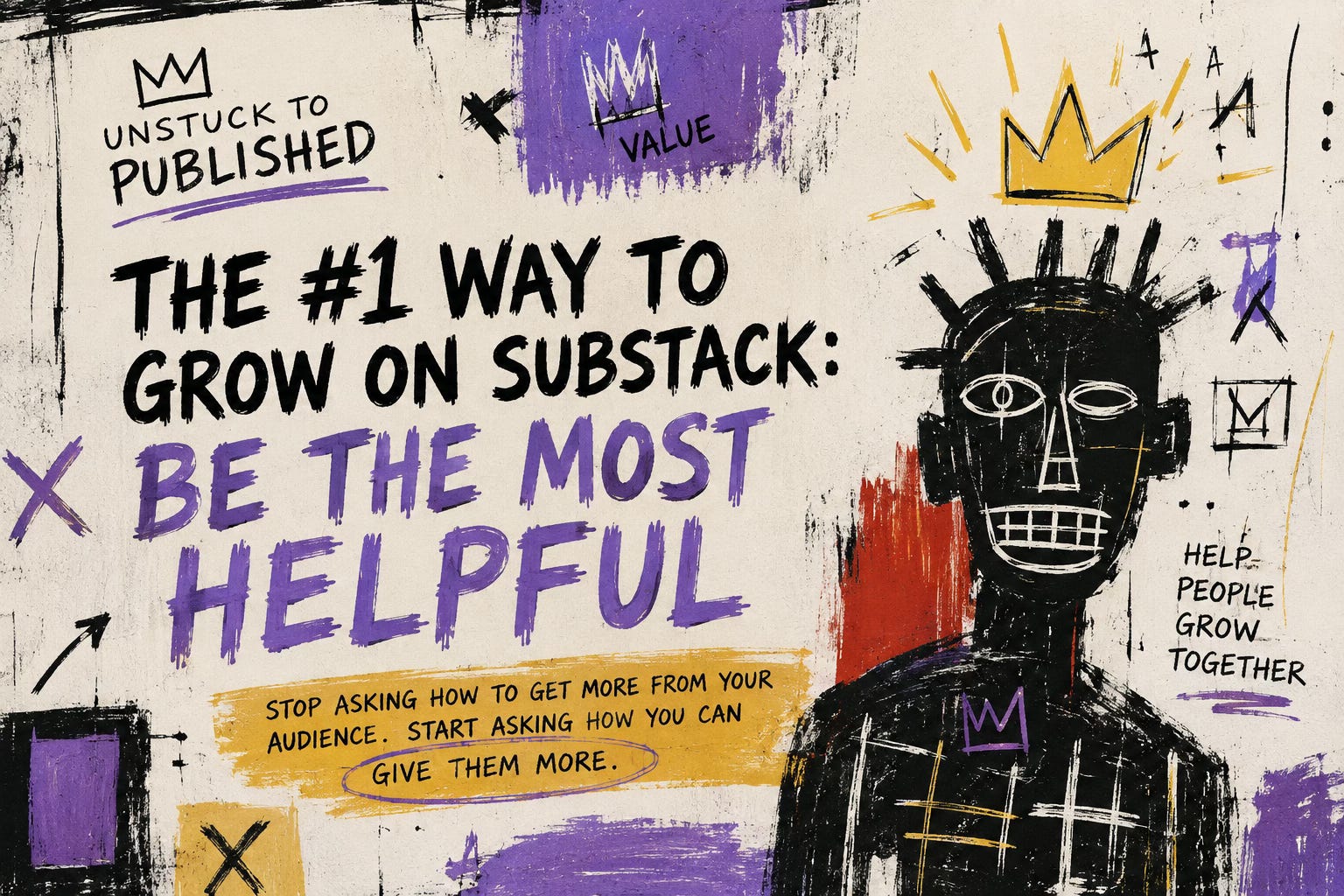
The #1 Way To Grow on Substack
I can’t promise that becoming the most helpful creator you can be will turn you into a Substack Best Seller, I can’t promise 10,000 subscribers, and I can’t promise everyone you help will subscribe, upgrade, recommend you, or even say thank you.
That’s not why you do it, but I can tell you what tends to happen when you consistently become useful to people.
They remember you.
They trust you.
They talk about you.
They come back.
Sometimes they bring somebody else with them.
That’s how reputations compound, that’s how communities compound, and often how businesses compound too.
→ Not because you figured out how to squeeze more value out of your audience, but because you became more valuable to your audience.
That’s the difference.
Your 7-Day Helpfulness Challenge
For the next seven days, stop asking:
How can I grow my Substack?
Every morning, ask:
→ Who can I help today?
Then do one thing. That’s it.
One.
Answer a question.
Leave a thoughtful comment.
Restack someone’s work.
Make an introduction.
Recommend a resource.
Write the article somebody needs.
Celebrate another creator.
Check on someone.
Solve one small problem.
→ Do one unexpected good thing and don’t keep score.
Don’t ask whether it converted, don’t check whether they subscribed, and don’t calculate your ROI.
Just help.
→ Then wake up tomorrow and do it again.
→ Seven days and seven acts of usefulness.
See what changes.
→ Not only in your Substack.
In you.
Final Thoughts: If You’re Stuck Right Now
We spend a ridiculous amount of time asking how to become more successful online.
More subscribers.
More views.
More money.
More recognition.
More likes.
Maybe we should spend a little more time asking how to become more useful because when I think about the people I respect most, their value isn’t measured only by what they’ve built.
→ It’s measured by what they’ve contributed.
They leave people better than they found them and that’s one hell of a way to build a reputation.
So maybe the question isn’t:
How do I get more from my audience?
Maybe it’s:
How can I become more valuable to them?
Tomorrow morning, before you open your analytics, ask yourself one question:
→ Who can I help today?
Then go help them.
Thank you so much for being here. I truly appreciate you.
— Jessica
Move first. Refine second. Publish with structure.
ICYMI, Previous Articles & Live Episodes →


Scan the QR code below to subscribe to Unstuck to Published →
💜 I want to try something with this one.
For the next 7 days, I'm asking myself one question before I ask how to grow:
Who can I help today?
If you're taking the 7-Day Helpfulness Challenge with me, drop a 🙋♀️🙋♂️ or “I'm in” below.
And if you already know how you're going to help someone today, tell us. You might give somebody else an idea, too.
I would add “grow in life, be the most helpful”. Great post