


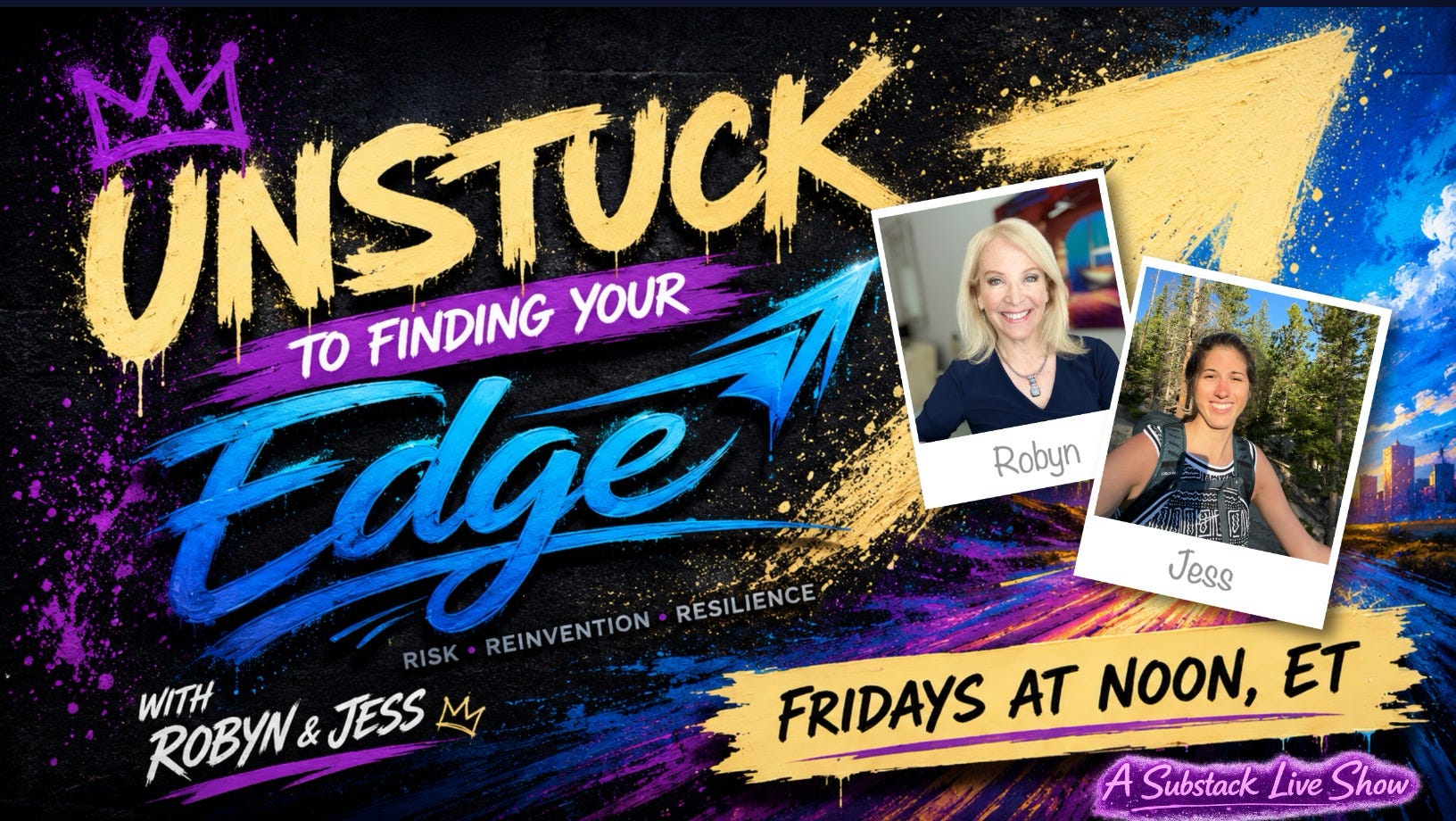
Editor’s Note: This article is based on Episode 014 of Unstuck to Finding Your Edge, my weekly Substack Live conversation with Robyn Levin of Finding Your Edge. This week, we explored why starting a podcast doesn't have to mean creating more content, buying expensive equipment, or building another complicated system. Sometimes, it's simply another way to share the work you're already doing.
When someone tells a writer to start a podcast, I think we immediately make it bigger than it needs to be.
Now I need a microphone, editing software, guests, and a recording schedule.
Another content calendar and suddenly, what could have been another way to share your ideas has become an entirely new job.
However, that’s not how I think about podcasting.
During my latest Live with Robyn Levin, I kept coming back to one simple idea:
→ A podcast is just another way to express yourself.
You’re not necessarily creating a new message.
→ You’re giving the message you already have another way to reach people.
And for writers already publishing on Substack, that distinction changes everything.
Podcasting Is A Format, Not Another Job
Think about what you’re already creating.
You write articles and you share ideas.
Maybe you host Lives or maybe you teach or have conversations with interesting people.
All of that can become audio.
An article can become a podcast episode.
A Live can become a podcast episode.
A conversation can become a podcast episode.
→ Even a five-minute thought recorded on your phone can become an episode.
You don’t necessarily need another content strategy.
→ You need another format.
Once I started thinking about podcasting this way, it became much less intimidating.
Start With What You Already Have
I didn’t start out trying to become a podcaster.
More than a year ago, I started noticing the option to add voiceovers to my Substack articles.
So I began reading them myself.
That was it.
If someone wanted to listen instead of read, I’d rather they hear the article in my voice than an automated one.
Readers responded, so I kept recording.
Eventually, I realized I had accumulated something valuable:
→ Audio.
Those recordings could become podcast episodes without requiring me to create something new.
The same thing happened when I wrote my guide about creating a podcast on Substack.
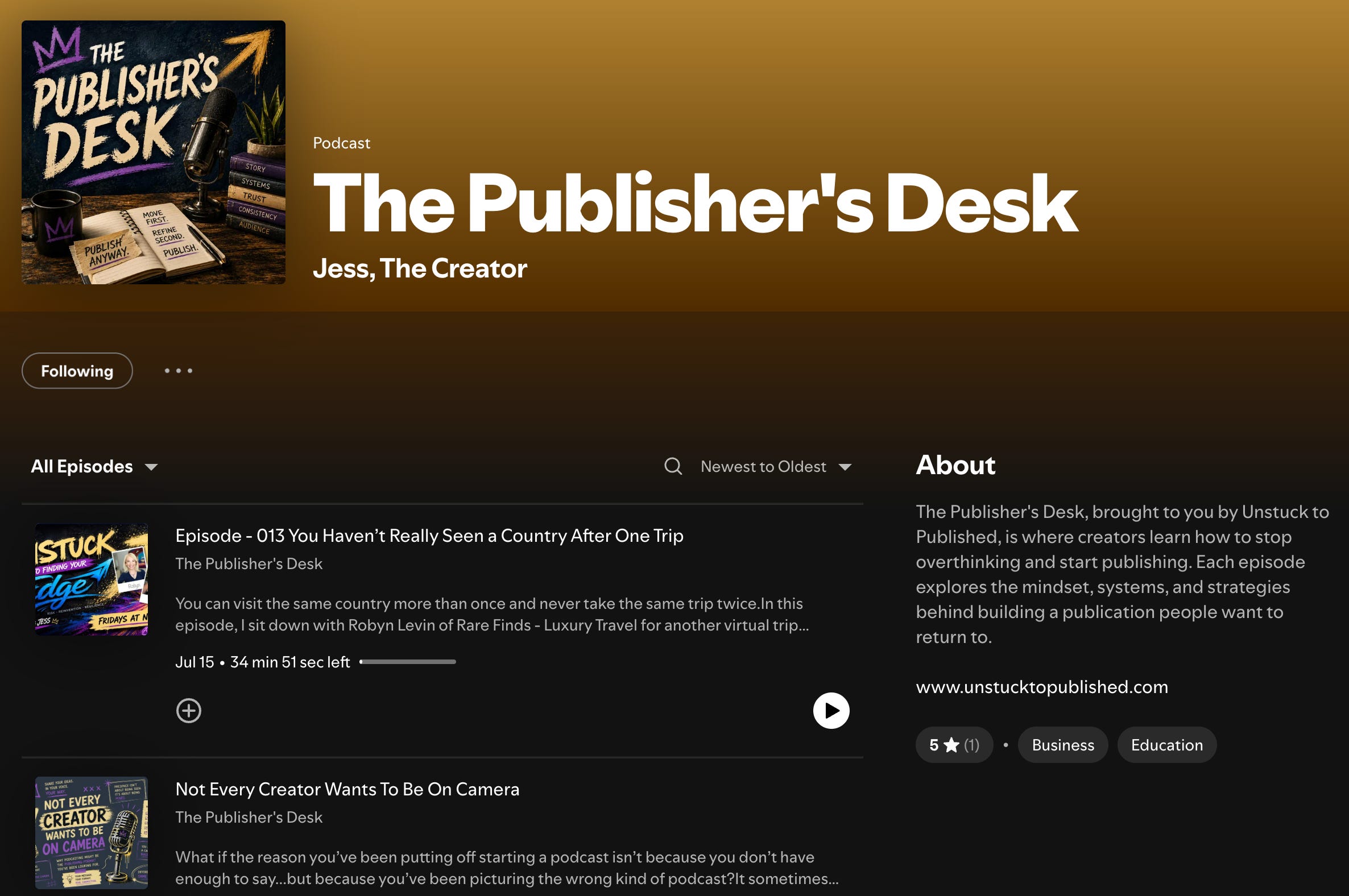
I wanted to show readers the actual process, so while writing the step by step tutorial, I created The Publisher’s Desk.
Because I’d already hosted several Lives through Unstuck to Published, I already had material for it.
Suddenly, I had a podcast with multiple episodes. →
It looked like I’d launched an entirely new content project.
In reality, I had repurposed work I’d already done.
That’s why before asking:
“What should my podcast be about?”
I’d ask:
“What have I already created that people might want to hear?”
You may already have the beginnings of a podcast sitting inside your publication.
Your Audience Doesn’t Consume Content The Same Way
You might write an excellent 2,000-word article.
However, that doesn’t mean everyone who would benefit from it wants to sit down and read 2,000 words.
Someone might want to listen while walking the dog, while another person might listen during a workout, or while someone else might put your episode on during their commute.
Robyn shared a story during the Live about turning webinars into audio years ago and hearing from people who listened while exercising or winding down at night.
→ The information hadn’t changed.
→ The way people could access it had.
That’s what makes another format valuable.
→ You’re creating another doorway into your work.
Someone who would never read every article you publish might happily listen to you for 20 minutes.
Someone who discovers you through audio might eventually become a reader and someone who already reads you might prefer having both options.

Your Voice Adds Something The Article Can’t
There’s another reason I like recording my own articles.
The words may be exactly the same, but the experience isn’t.
When you read your own work, people hear where you pause.
What you emphasize.
Your humor.
Your excitement.
Your personality.
They hear you.
Robyn called it a personal touch during our conversation, and I think that’s exactly right.
→ Writing allows someone to understand your ideas.
→ Voice gives them another way to understand the person behind them.
For creators building trust online, that’s valuable.
You Probably Don’t Need The Equipment You Think You Need
At one point during the Live, Robyn recommended getting a good microphone because audio quality matters.
Then she discovered something.
I wasn’t using one. I was recording with what I already had.
It became the perfect example of what we were talking about.
Yes, good audio matters, and yes, you can eventually invest in better equipment.
However, if finding the perfect microphone is the reason you haven’t recorded anything yet, start with your phone.
Record something.
Listen to it.
Does it sound good enough?
Publish it.
If the quality bothers you, improve your setup later.
Equipment can improve with the podcast.
It doesn’t need to come before it.
Let Substack Do Some of The Heavy Lifting
This is where podcasting through Substack becomes especially useful for writers.
Your publication and your podcast don’t have to exist as two completely separate content machines.
Recorded articles can become episodes.
Lives can become episodes.
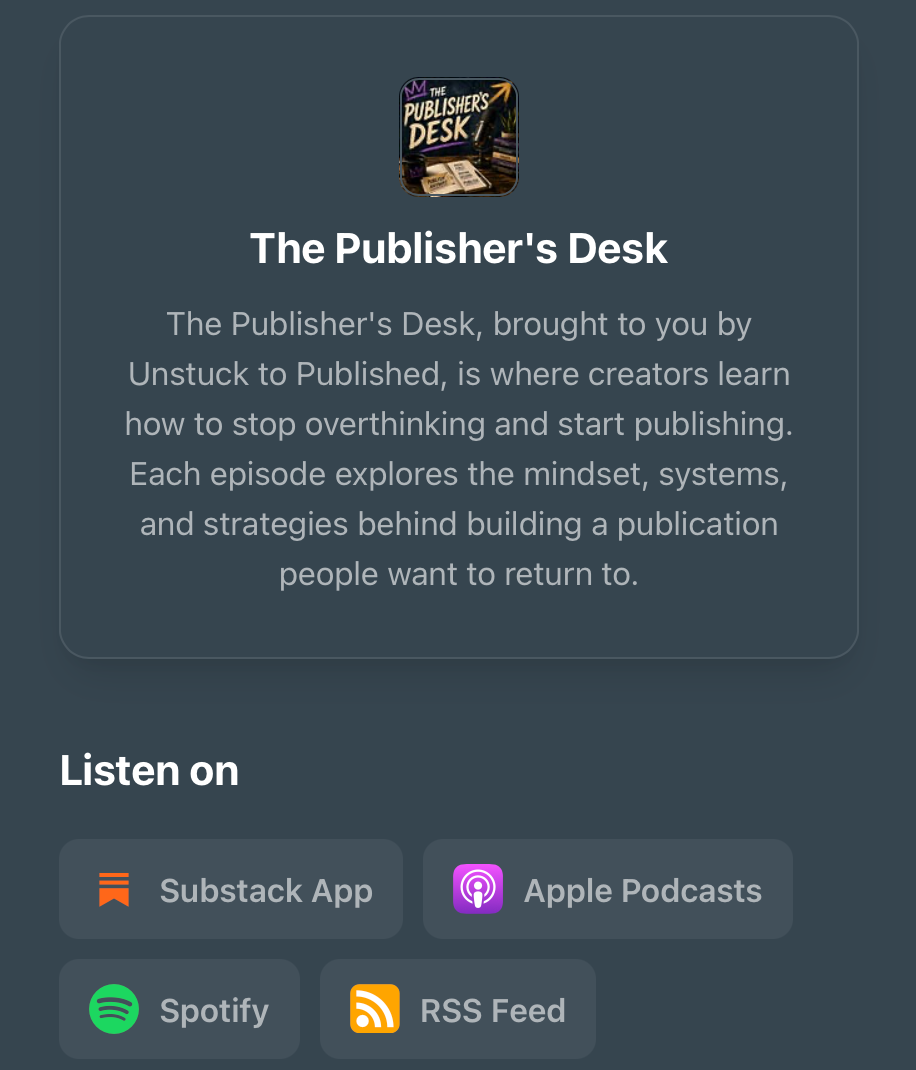
Substack provides tools that can help distribute your podcast beyond the publication itself.
Robyn summed it up well during our conversation:
“This is a great example of repurposing your content without creating more.”
Exactly!
→ Create once. Distribute intentionally.
The core idea hasn’t changed. Its ability to travel has.
Don’t Ignore The Last 10%
Automation doesn’t mean you should stop paying attention.
If you’re turning an article or Live into a podcast episode, take a minute to look at what the listener will actually see.
Does the episode title make sense on its own?
Does the description tell someone why they should listen?
Does the artwork display properly?
Is there a clear path back to your publication?
You don’t want convenience to make your work look careless.
I think of this as the last 10%.
→ Let the technology handle the repetitive work.
Then add the human judgment.
That’s what turns simple repurposing into thoughtful publishing.
The Big Lesson
This episode wasn’t really about convincing every writer to become a professional podcaster.
It was about making podcasting feel smaller, and doable.
You don’t need a studio, you don’t need a complicated format, you don’t need famous guests, and you don’t even need to know what Episode 100 will look like.
Start with one thing.
Read an article.
Record a five-minute thought.
Repurpose your next Live.
Interview someone interesting.
→ Use the phone you already have. Then see what happens.
You can improve the equipment later.
You can change the format later.
You can become a better interviewer later.
However, you can’t improve a podcast you never start.
And if you’re already publishing?
→ You may be much closer than you think.
You don’t necessarily need more content.
You need more ways for people to experience it.
In This Episode
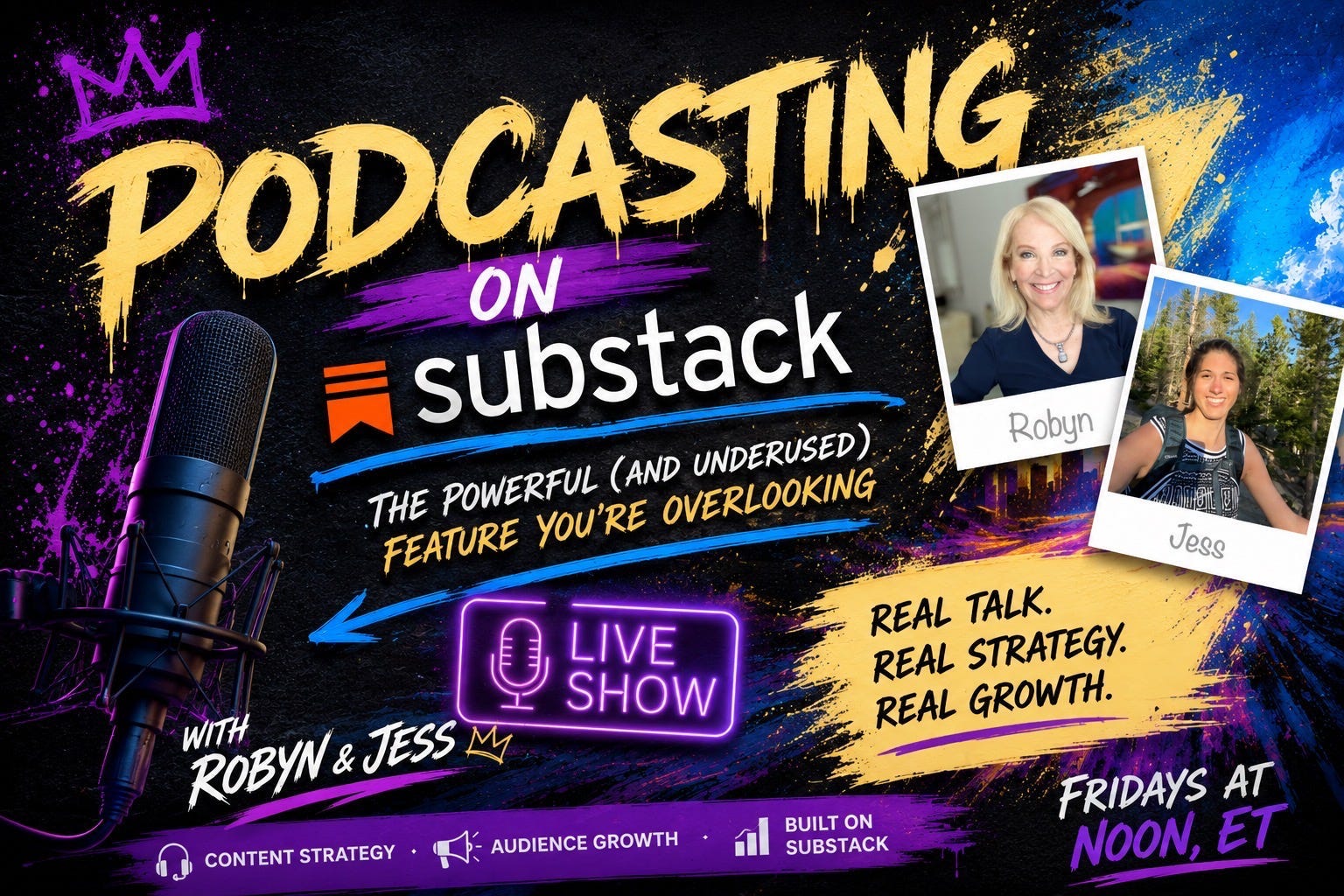
Robyn and I discuss:
Why writers tend to overcomplicate podcasting.
How to think about podcasting as another format for your ideas.
Turning existing articles and Lives into podcast episodes.
Why I started recording my own Substack articles.
Using your own voice versus automated audio.
Giving your audience different ways to consume your work.
Whether you really need a microphone to start.
Recording from your phone.
How Substack can simplify podcast distribution.
Why episode titles, descriptions, and artwork still matter.
My experience creating The Publisher’s Desk.
How to repurpose without constantly creating something new.
→ If you’ve been thinking about starting a podcast, but keep telling yourself you’re not ready, I hope this conversation makes it feel a little lighter, smaller, and simpler.
You don’t need to build an entire media company this weekend.
→ Press record on something you already know how to talk about.
Then build from there.
↑ Replay Above
Resources From This Conversation
Want the Step-by-Step Playbook?
If this episode convinced you to finally start your podcast, I’ve already created the practical next step.
My How to Create a Podcast on Substack playbook walks you through setting up and publishing your podcast without making the process more complicated than it needs to be.

Read the full playbook → Click here
Follow The Publisher’s Desk podcast by Jess, The Creator on Spotify →
Follow Jess at Unstuck to Published →
Follow Robyn at Finding Your Edge →

Follow Robyn at Rare Finds - Luxury Travel →
Thank You
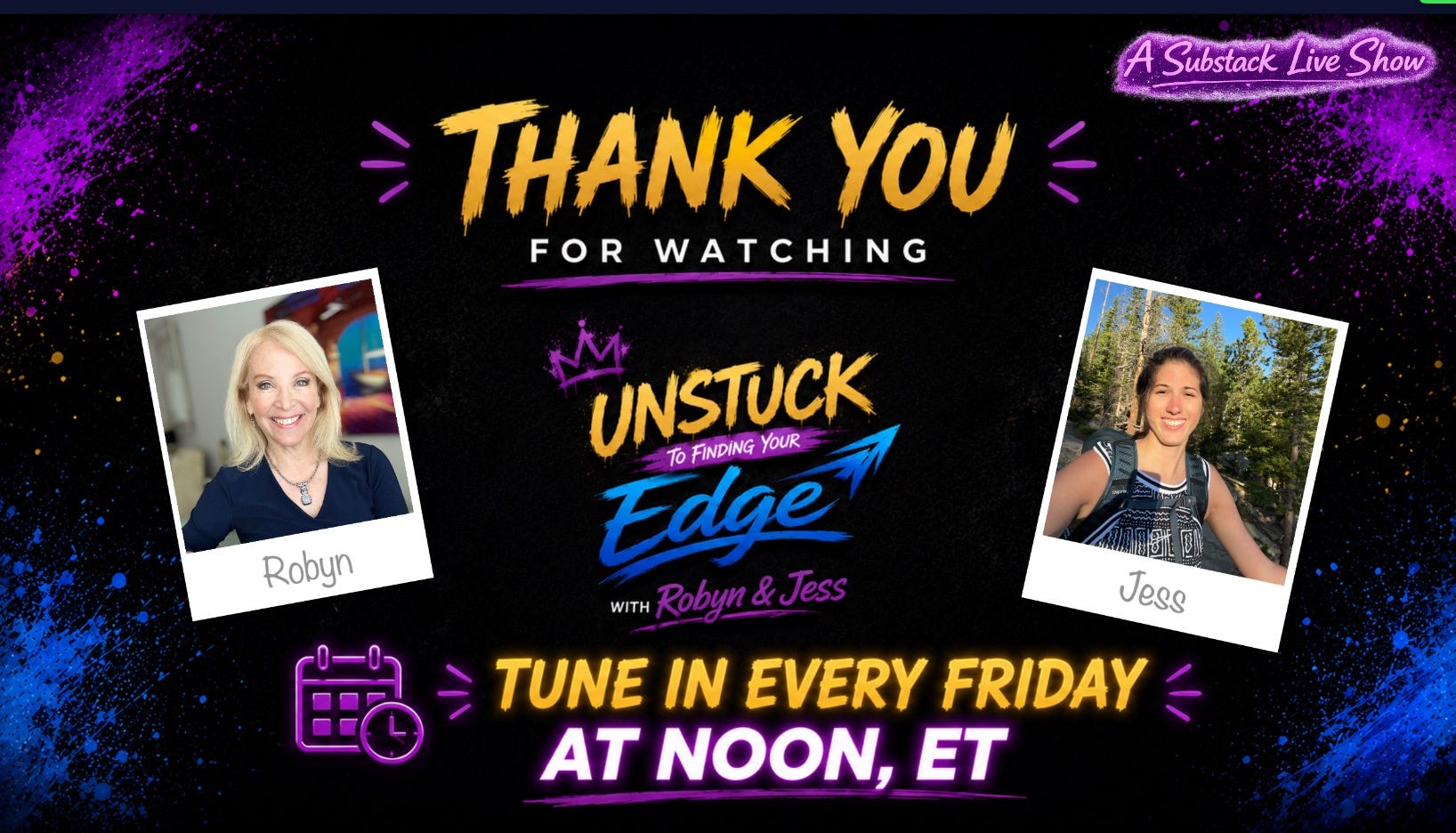
Thank you so much for everyone who tuned into this live, your presence is truly appreciated, and to the people who are watching the replay, thank you!
See you next Friday at 12pm ET for our weekly show, stay tuned!
-Jess, The Creator & Robyn Levin


