

About a month ago, I wrote an article called If You Want to Become a Better Writer, Start Journaling.
The subtitle?
Why the best place to improve your writing is somewhere nobody else will ever read.
So naturally, today I’m putting pictures of my actual journal on the internet. 😂
I see the irony.
I’ve been using a bullet journal since 2020, and part of what I love about journaling is that it’s mine.
Nobody has to read it, nobody has to understand it, and I don’t have to make it pretty enough to publish.
That privacy is part of the point.
It’s also why sharing these pages feels a little weird, but over the last few months, my bullet journal has become part of something else:
→ How I manage my publishing schedule across three publications.
And that brings me to a question I keep getting:
How do you stay consistent on Substack?
Or, more specifically:
How do you develop a publishing cadence you can actually stick to?
My answer starts before you ever open a calendar.
Your Publishing Cadence Starts With Knowing Yourself
When people talk about consistency, they usually jump straight to frequency.
How often should I publish?
Once a week?
Twice?
Daily?
My question is different: What can you actually commit to?
Not what another creator tells you to do, not what sounds impressive, and definitely not what you can pull off for two wildly motivated weeks before you disappear for six.
→ What can you repeatedly come back to?
For you, that might be once a week, twice a week, or every other week.
Maybe you’re in a season where you can go all in and publish daily.
I generally recommend starting with once or twice a week, but you have to look at your actual life.
Do you have a full-time job?
A family?
Other projects?
How much time do you realistically have to write?
Because a publishing cadence isn’t useful if your life can’t hold it.
→ Consistency starts with making a commitment to yourself that you can actually keep.
Mine just happens to involve three publications.
It Took Me Years To Figure Out This One Page
I’ve been bullet journaling since 2020.
Since May, I’ve also been going to a bullet journaling class every Tuesday and Thursday.
Those classes have helped bring more structure to my life and schedule, but they’ve also done something I didn’t necessarily expect:
They’ve sparked ideas.
I’ll be sitting there working in my journal and suddenly think of an article, see a connection between two things, or realize something I’ve been trying to make complicated could actually be pretty simple.
And somewhere in that process, my bullet journal started changing with the way I publish, but here’s what makes me laugh:
I’ve been bullet journaling since 2020.
I only figured out this particular one-page publishing system a little over a month ago.
Five-plus years of bullet journaling…for a system that basically boils down to a page, some boxes, a pen, and whatever the hell my handwriting is doing that week, but it works.
This is what one of those pages actually looks like:
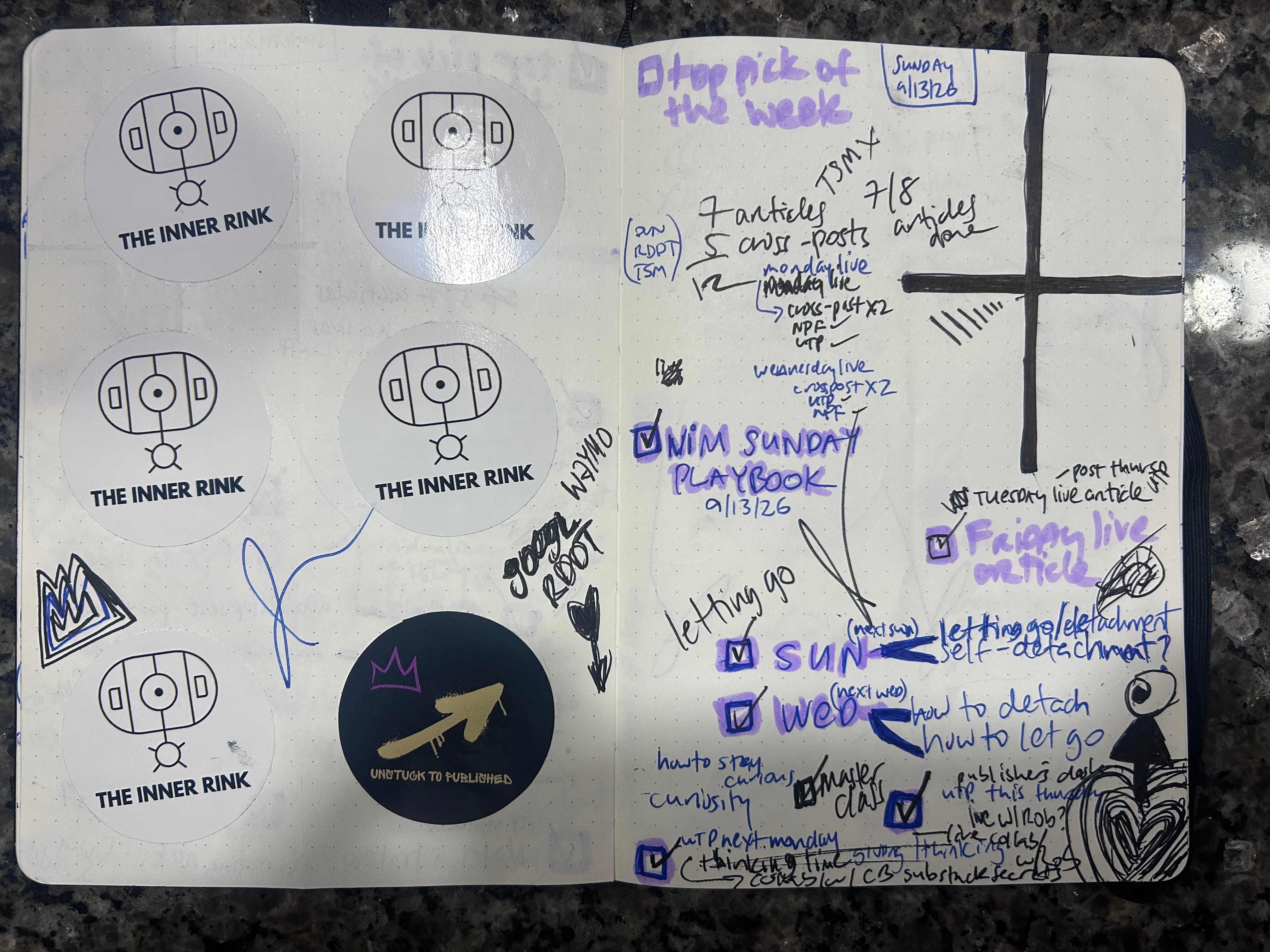
And no, you’re not supposed to understand all of this. 😂
The point is that I do.
I Needed Somewhere To See My Entire Publishing Week
I didn’t create this page because I wanted a prettier content planner.
→ I created it because I needed to see everything in one place.
Across the page, I can keep track of what I’m publishing for each publication, my Sunday and Wednesday articles, my Friday Live article, topics I’m considering, things I need to cross-post, and ideas I don’t want to lose.
Then there are my checkboxes.
Those little boxes probably shouldn’t be as satisfying as they are, but they are.
Article published?
Check.✔
Live article done?
Check.✔
Next one.
And when I open my journal, I don’t have to ask myself:
What the hell am I supposed to publish this week?
I’ve already given the work somewhere to live.
That doesn’t mean everything happens exactly as planned.
Actually, the pages prove the opposite.
This Is What Consistency Actually Looks Like For Me
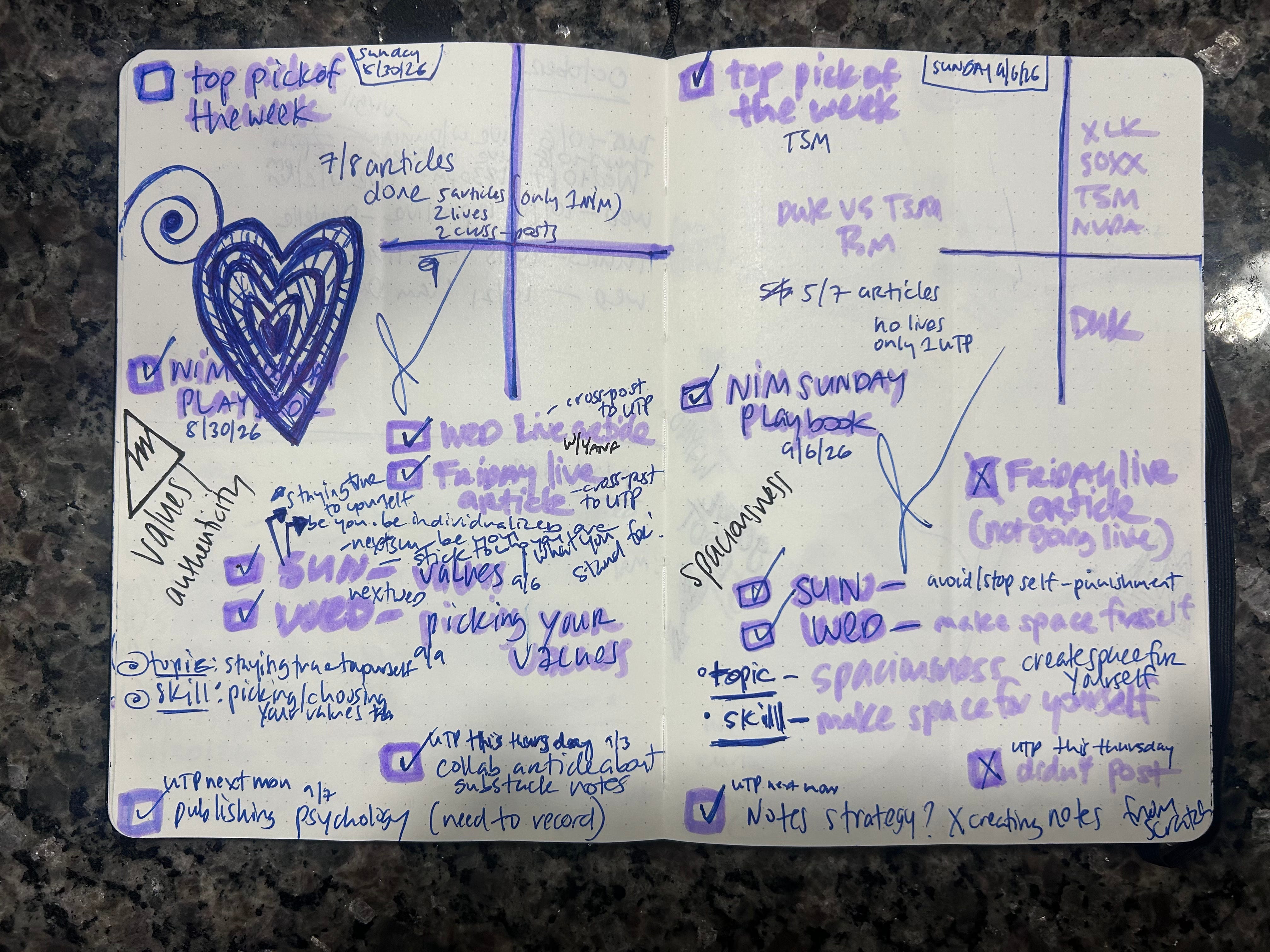
Look at it.
There are checked boxes.
Unchecked boxes.
Things crossed out.
Ideas moved.
Notes squeezed into whatever space I could find.
Plans for next week sitting beside plans for this week.
There’s even a giant heart taking up a chunk of one page because apparently that was necessary. 😂
This isn’t a picture of a perfectly executed content calendar.
It’s a working document.
Sometimes I plan an article and change my mind.
Sometimes an idea gets moved to the following week.
Sometimes I get more done than I expected.
Sometimes I don’t.
The page changes because my week changes and that’s exactly why it works.
→ I’m not trying to protect a perfect publishing streak.
I’m trying to keep publishing. There’s a difference.
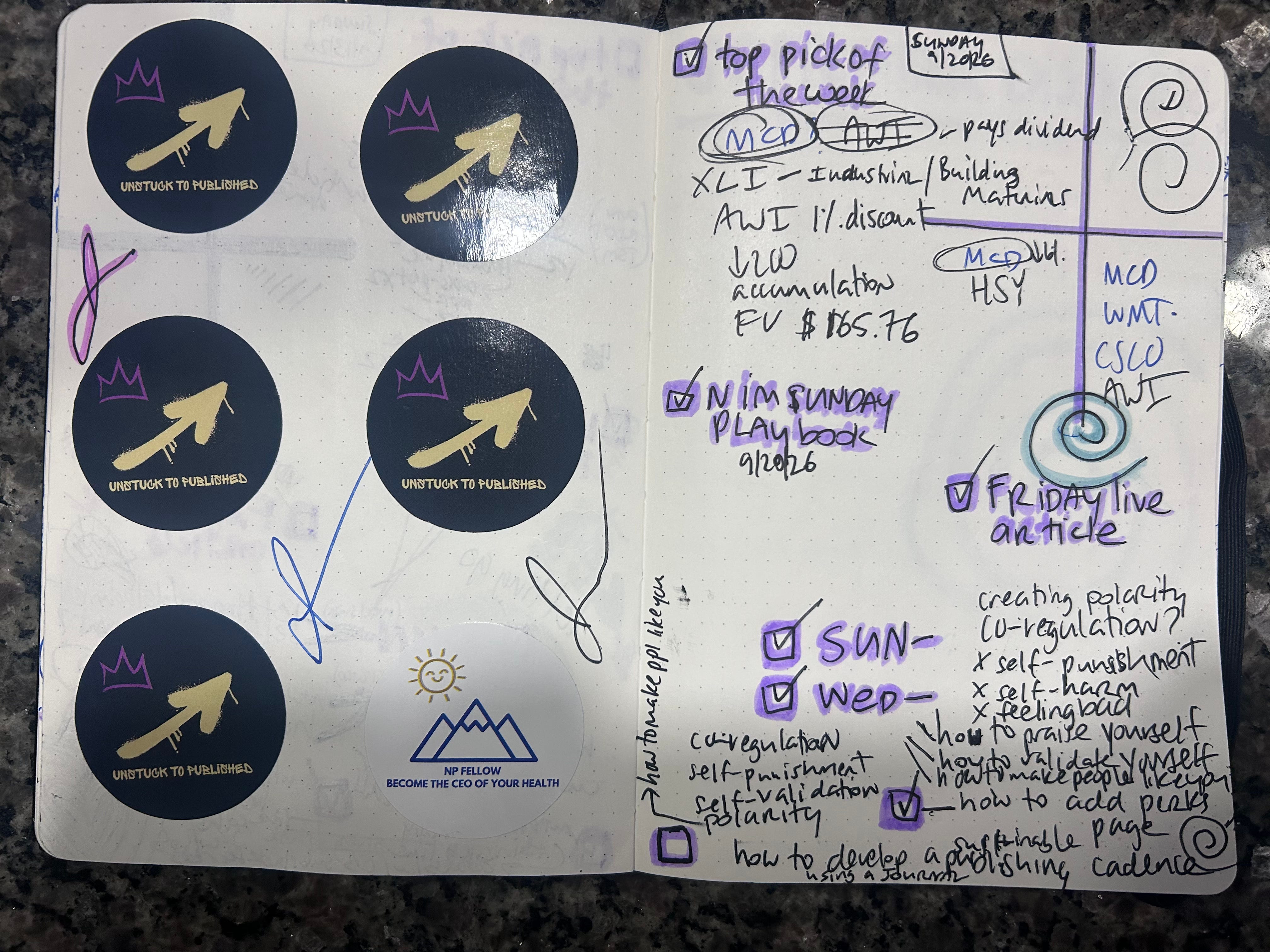
Even from week to week, the page isn’t identical.
The structure changes, the topics change, and what I need from it changes.
→ I’m not trying to force myself into a system because I decided once that this was how I was “supposed” to publish.
The system works for me. I don’t work for the system.
Missing A Week Doesn’t Mean You Failed At Consistency
This is where I think we make publishing harder than it needs to be.
We turn consistency into perfection.
Miss your publishing day?
You failed.
Need to publish less?
You’re falling behind.
Take a break?
There goes your consistency.
Nope.
If I notice I’m getting burned out, I can do less.
If I need a break, I can take one.
If I decide I need three weeks away from publishing, I can make that decision intentionally.
But I also want to make another commitment: I’m coming back in three weeks.
→ That’s the part I care about because my journal isn’t a record of me doing everything perfectly.
It’s proof that I keep coming back.
Don’t Copy My Page
I’m showing you my journal because I want you to see the system I actually use.
I’m not showing it to you so you can recreate it box for box.
I’m running three publications. You might be running one.
My publishing schedule might make absolutely no sense for your life.
Good, it doesn’t need to.
Instead, ask:
What do I need to see every week to keep the publishing commitment I made to myself?
Maybe that’s simply:
The day you’re publishing.
The article you’re planning to write.
A space to dump new ideas.
A checkbox when it’s done.
That’s it.
You can add to it later, change it later, or scratch half of it out next Tuesday if you realize it isn’t working.
I did.
It took me years of bullet journaling to arrive at the page I’m using now and I’m sure it won’t look exactly like this forever either.
And No, You Don’t Get To Read The Rest of My Journal 😂
I’m showing you these pages because they’re part of my publishing process.
That’s where the line is.
Some pages of my journal help me plan articles, some help me think, some spark ideas that eventually become something I publish, and some are mine.
I still get to decide what I share and what stays private.
Which is kind of funny when I think back to that first journaling article.
I told you journaling could make you a better writer because it gives you somewhere to write that nobody else will ever read.
→ I still believe that.
Now I’ve just discovered that the same journal can also help me become a more consistent publisher.

20% OFF UNSTUCK TO PUBLISHED 💜
If you’ve been thinking about joining the paid side of Unstuck to Published, now’s a pretty damn good time.
Join annually for $177.60/year (normally $222) and unlock:
📕 The Ultimate Substack Beginner’s Blueprint ($47 value)
🎓 My Substack Masterclass — 10 Things I’d Do If I Were Starting My Substack Today ($197 value)
✅ Build Your Substack in 90 Minutes Foundational Checklist
💬 Private Community Chat & direct access to me for questions and hands-on support
🔓 Full access to my paid Substack content + subscriber perks
20% off. One year. Everything inside.
👉 Join Unstuck to Published for $177.60/year
The tools are here. Let’s build the damn thing. 💜
If You’re Stuck Right Now: Start With One Question
If you’re struggling to stay consistent on Substack, don’t start with my schedule.
Don’t start with the creator publishing five times a week and don’t start with whatever somebody on the internet told you the algorithm wants.
→ Start with yourself.
What can I realistically commit to?
Write that down.
Give the work somewhere to live.
Build a simple system around it.
And when you don’t execute the week perfectly?
Come back because consistency isn’t publishing as much as humanly possible.
It’s making a commitment you can return to.
My journal isn’t proof that I execute every publishing week perfectly.
It’s proof that I keep coming back.
Mine happens to live on one messy organized page. 💜
Thank you so much for being here. I truly appreciate you.
— Jessica
Move first. Refine second. Publish with structure.
Recent Articles & Live Episodes

How To Set Up Subscriber Perks On Substack

Someone asked me today how to set up subscriber perks on Substack.
What 52 Mondays & Three Years of Sundays Taught Us About Substack

Chris B. Writes has published every Monday for more than 52 weeks.
Scan the QR code below to subscribe to Unstuck to Published →

Okay, now I want to know: What does YOUR publishing cadence actually look like?
Once a week? Twice? Whenever life cooperates? 😂
And if you’ve been struggling to stay consistent, what’s getting in the way—the writing, finding ideas, your schedule, or trying to do too damn much?
Drop it below. I’m curious. 💜
“Consistency starts with making a commitment to yourself that you can actually keep.” YES!