Editor’s Note: Conversations spark ideas. Field Notes are what happens next. They’re not a transcript or a recap—they’re my reflections on the ideas that stayed with me after we pulled away from The Publisher’s Desk. Conversations explore ideas. Field Notes capture what was worth remembering.
David Roy of ENG Sales joined me to take a live look at my Substack sales process, from followers and free subscribers to paid memberships. I went in expecting a few sales tips (and possibly a roasting 😂).
Instead, his revenue flywheel and a seven-question diagnostic made me realize something: I’ve spent plenty of time thinking about how to attract subscribers, but not nearly enough about what happens after they arrive.
📓 Field Note 007
I invited a sales expert onto The Publisher’s Desk to audit my Substack business and I didn’t prepare anything beforehand on purpose.
I wanted David Roy, founder of ENG Sales, to see what I was actually doing with my subscribers, paid offers, and sales process.
I was prepared to get roasted.
Instead, David had me take a seven-question sales diagnostic in front of everyone and the results pointed to something I hadn’t been paying much attention to.
I was getting people into my Substack, but I didn’t have a clear process for what happened next.
The Diagnostic That Exposed A Gap
David has spent more than 15 years building and leading technical B2B sales teams.
He also scaled a business unit to $100 million by building a system that created momentum over time.
Today, he helps early-stage founders who have suddenly found themselves responsible for sales.
He’s an engineer by training, and he told us he once informed his boss that he never wanted to work in sales, which makes his approach even more interesting.
During our Live, David shared his free sales diagnostic, and we went through it together.
Seven questions. About three minutes.
The results identified customer engagement as the area where my sales process needed the most attention.
David started asking questions.
What happens when someone follows my Substack?
Do I reach out to new subscribers?
Do I have a process for understanding who’s interested in my paid offers?
My answers were pretty simple.
No.
Not really.
No.
I have welcome emails, I publish articles, and I interact with people on Substack.

However, I haven’t been treating those activities as parts of a connected process and that’s what David wanted me to see.
David Introduced Me to The Revenue Flywheel
I’ve heard plenty about sales funnels.
You attract followers, some become free subscribers, some upgrade to paid, and a smaller number might purchase a course or coaching.
David explained that the problem with funnel thinking is how easily we focus on moving people toward a purchase.
What happens when someone isn’t ready?
Do we just move on to the next person?
His alternative is a revenue flywheel built around three areas: customer engagement, improvement, and re-engagement.
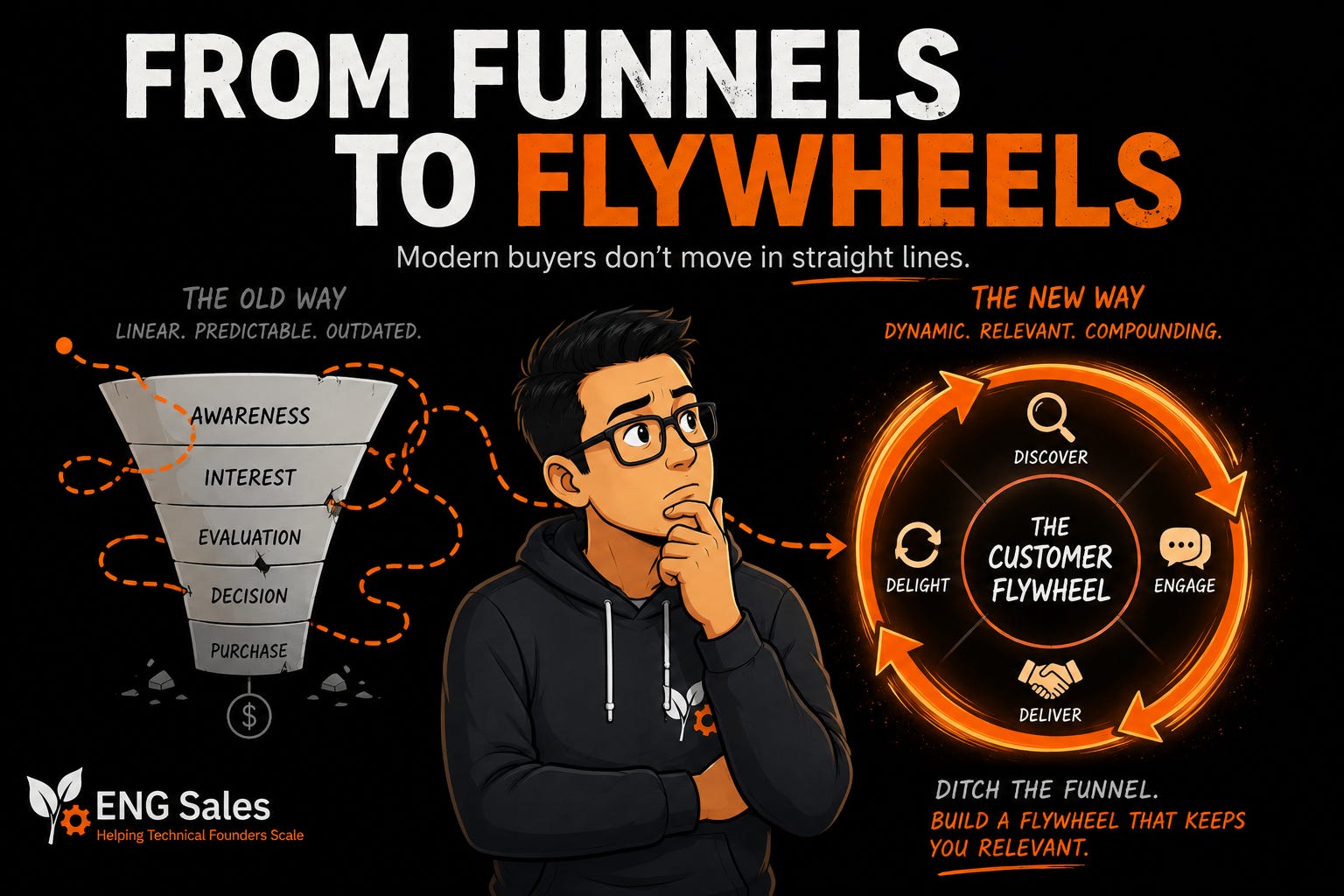
Instead of treating every interaction as a step toward an immediate sale, the flywheel focuses on understanding people’s problems, helping them get results, and staying connected.
One thing David said stuck with me: “No just means not now.”
Someone who doesn’t upgrade today might be interested later or they might never need the paid offer and that’s okay too.
The point isn’t to pressure everyone into buying something.
→ It’s to understand why they’re there in the first place.
David has a simple philosophy: “Sales is just problem solving with another human.” That makes sales feel a lot less intimidating, doesn’t it?
Then We Looked at My Actual Substack
David had started putting together a revenue flywheel specifically for my business and once we looked at it, I could see where some of the gaps were.
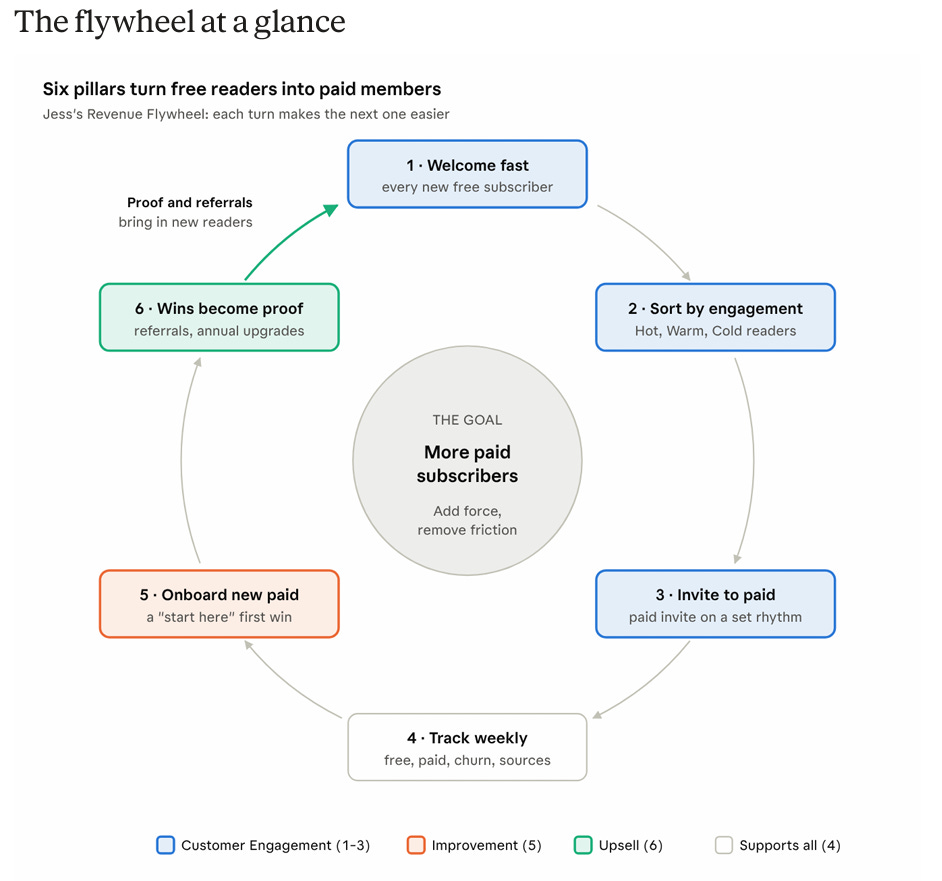
1. What happens when someone follows or subscribes?
David asked whether I send messages to new followers.
I don’t.
He explained that he uses an automated first DM to thank people for following and ask what brought them to his publication.
Then, if someone responds, he takes over the conversation himself.
He’s trying to understand what they’re interested in, not immediately sell them something.
Sometimes he recommends an article based on their answer.
Sometimes he discovers they’re interested in a topic he hasn’t written about yet.
Sometimes they don’t respond at all.
He estimated that his reply rate is probably in the single digits. I appreciated that he shared that part too.
2. Are people finding the right resources?
We also talked about my paid subscriptions and David pointed out that getting someone to upgrade is only one part of the process.
Once they’re paying, do they know where to start?
Can they easily find the masterclass, the chat, or the other resources included in their subscription?
That’s something I can look at more closely because someone joining the paid tier doesn’t automatically mean they’re using everything available to them.
3. Am I looking at what’s working?
David also recommended regularly reviewing my subscriber activity.
Where are new subscribers coming from?
How are free and paid subscriptions growing?
Are people leaving? Are they engaging with the resources?
He suggested that weekly tracking might work, but monthly could be more realistic.
That part made sense to me.
It’s easy to get caught up in publishing the next article, hosting the next Live, and sharing the next Note, but when do we actually sit down and look at what’s happening?
The DM Conversation Made Me Think
At one point, I asked David whether publishers who aren’t messaging their followers and subscribers might be leaving money on the table.
He said there was a good chance, but he also made an important point.
The way we connect with readers has to feel right for us.
David uses DMs because they help him start conversations and learn what people need.
Someone else might prefer email, comments, or community chat and he doesn’t believe in automating the entire relationship.
He uses automation to open the door, then steps in when there’s a real conversation to have.
That distinction matters to me.
I’m not interested in turning every new follower into a sales prospect who immediately receives a pitch, but I am interested in understanding why people follow my publications and what they’re hoping to learn.
Those are two very different things.
Conversation 007 Takeaway
I invited David onto The Publisher’s Desk because I wanted to learn how to get more paid subscribers.
Yes, we talked about that, but the conversation made me realize I need to pay more attention to what happens between someone discovering my Substack and deciding whether they want to become a paying subscriber.
I don’t have a clear follow-up process right now, I haven’t been asking new followers what interests them and I could do a better job of helping paid subscribers find the resources they’re already paying for.
That doesn’t mean I’m going to start sending hundreds of DMs tomorrow.
It means I have a few specific things to work on and that’s exactly why I wanted to do this audit live because I’m figuring out parts of the business side of Substack while I’m building it and I suspect I’m not the only publisher and creator doing that.

Watch Conversation 007 of The Publisher’s Desk
David and I walk through his revenue flywheel, complete his sales diagnostic, and look at how the framework could work for my Substack publications.
There’s a lot more in the replay, including his approach to welcome messages, testing different DMs, and using Substack Notes to learn what readers care about.
You can also read David’s publication, ENG Sales, where he shares practical advice for founders building sales processes without large teams or endless outreach.
One Question for Other Publishers: What happens after someone follows or subscribes to your Substack?
Do you send a message, rely on your welcome email, or let people explore on their own?
I’m curious what other publishers are doing, because David definitely gave me a few things to rethink.
— Jessica
Resources From This Conversation
Access David’s Sales Quiz: A 3-minute sales diagnostic for your sales process
David’s article about sales funnels and revenue flywheels:


About David Roy
David Roy writes ENG Sales and shows technical founders that sales is just problem solving with another human.

Thank You
Thank you so much for everyone who tuned into this live, your presence is truly appreciated, and to the people who are watching the replay, thank you!
-Jess, The Creator and David Roy
Scan the QR code below to subscribe to Unstuck to Published →