


Writers spend a lot of time thinking about what to publish next.
The next article.
The next Note.
The next Live.
The next idea.
Of course, I do it too, but during a recent Substack Live with Robyn Levin, we started talking about all the different ways you can promote, repurpose, and extend the life of something you’ve already published.
I said something I’ve been thinking about ever since:
“Every piece you publish is an asset.”
An article is an asset.
A Live is an asset.
A conversation is an asset.
You spent time creating it and there are ideas inside it.
Stories.
Quotes.
Takeaways.
Maybe an entire framework someone needs to hear.
So why do we give it one day to live?
We hit publish, drop a Note, maybe restack it once, and then immediately start worrying about what we’re going to create next.
→ I think we’re treating Publish like the finish line when it should be the beginning of distribution.
Before you create more content, ask yourself:
Have I done enough with the content I already have?
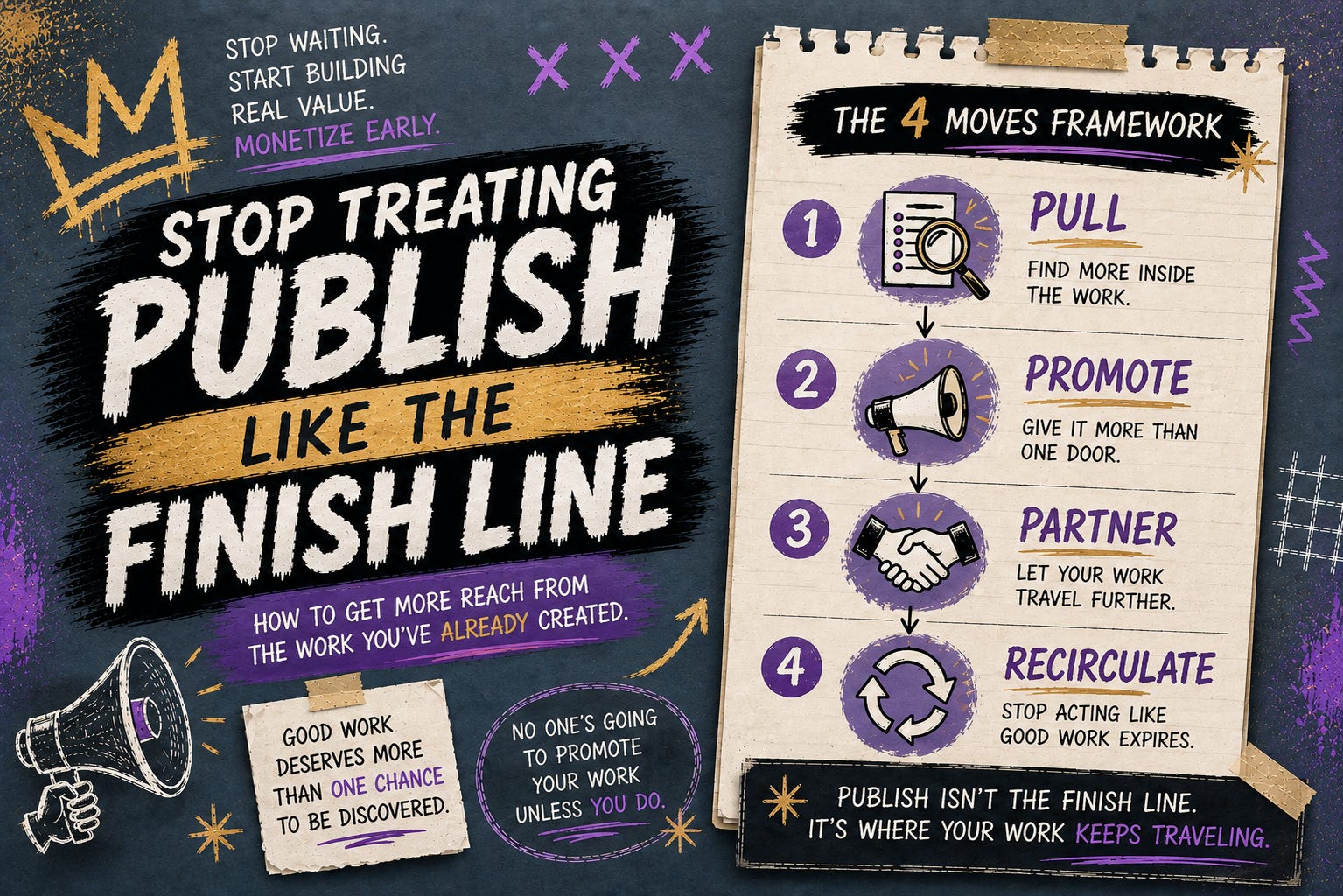
Your Work Deserves More Than One Chance To Be Discovered
Promoting your work more than once can feel uncomfortable.
You don’t want to annoy people and you don’t want to look like you’re constantly promoting yourself.
You don’t want somebody thinking: Yes, Jessica. We saw the article.
But here’s what I keep reminding myself: People miss things.
They weren’t on Substack that morning.
They didn’t see the Note.
They saw it but didn’t have time to read it.
The headline didn’t catch them, but a sentence buried halfway through the article might.
They didn’t see your promotion email.
You don’t have to promote the same article the same way every time.
That’s the difference.
Posting “HEY! READ MY ARTICLE!” five times isn’t a strategy; however, finding five different reasons someone might care about the article?
That is.
I’ve started thinking about it in four moves:
PULL → PROMOTE → PARTNER → RECIRCULATE
The 4 Moves Framework →
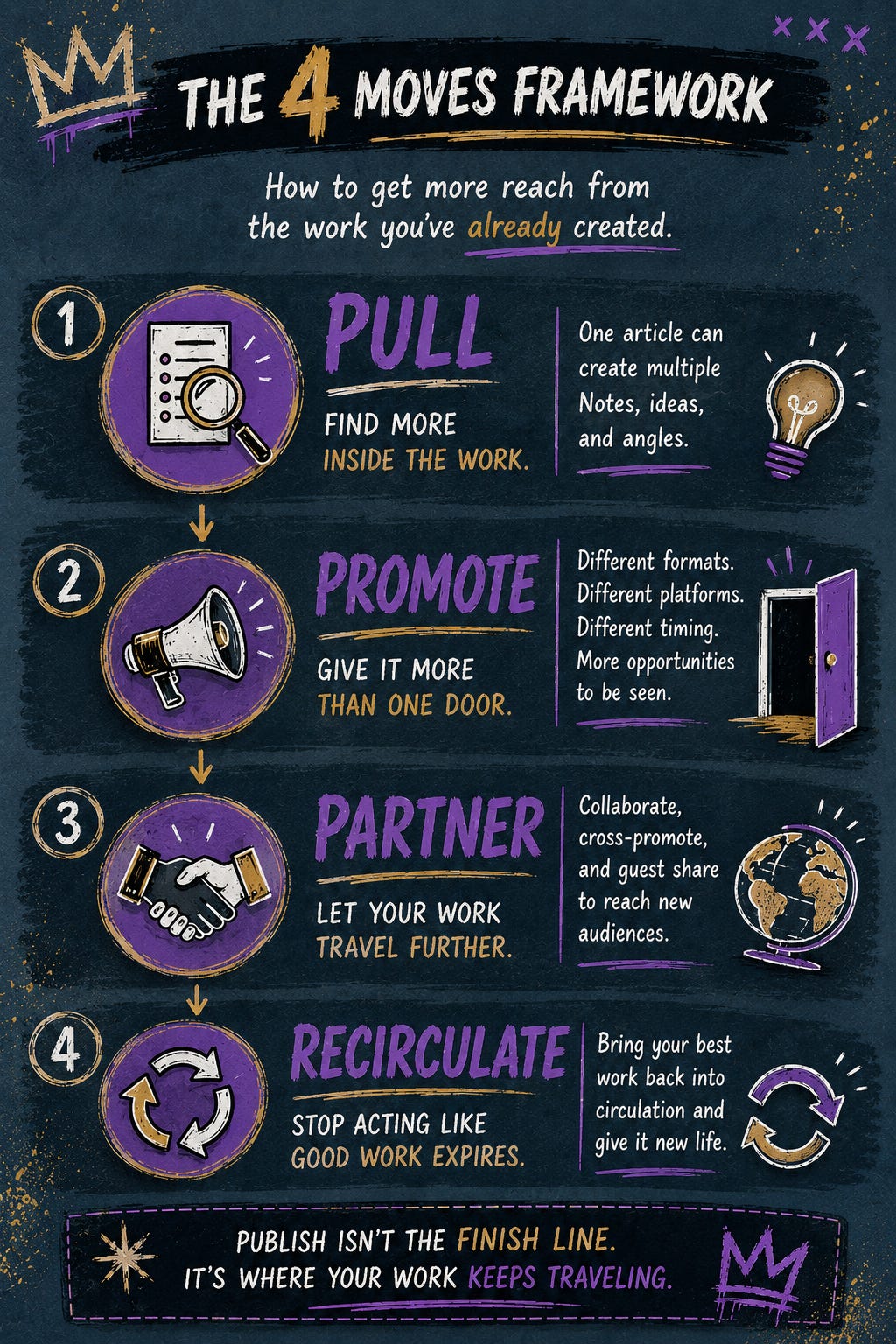
1. PULL: Find More Inside The Work
Once you publish an article, go back through it.
→ Not to edit it again.
It’s DONE. Step away from the paragraph. 😂
Go through it looking for pieces that can stand on their own.
A strong sentence.
A surprising takeaway.
A question.
A short story.
A framework.
A section that makes sense without the rest of the article.
→ Those become new entry points into the original work.
Let’s say you publish a 1,500-word article.
Inside it might be three strong quotes, two useful takeaways, one question worth discussing, and a framework someone could save.
That’s material and you already did the hard part.
You wrote it.
→ The same goes for a Live.
Once the conversation ends, you still have a recording, transcript, clips, quotes, stories, questions, and ideas that could become future Notes or articles.
In our Live, Robyn and I talked about adding context and useful takeaways to a replay instead of immediately publishing the bare recording.
In fact, that’s how this article exists.
It started as a conversation and then I went back and asked:
→ What’s the larger lesson here?
Now you’re reading it.
2. PROMOTE: Give The Article More Than One Door
This is where Notes become useful.
Instead of publishing one Note with the article link and considering promotion complete, pull different ideas from the article and let each become its own reason to discover the piece.
During the Live, I talked about creating several Notes from one article rather than repeatedly posting the same announcement.
Here’s one way to do it →
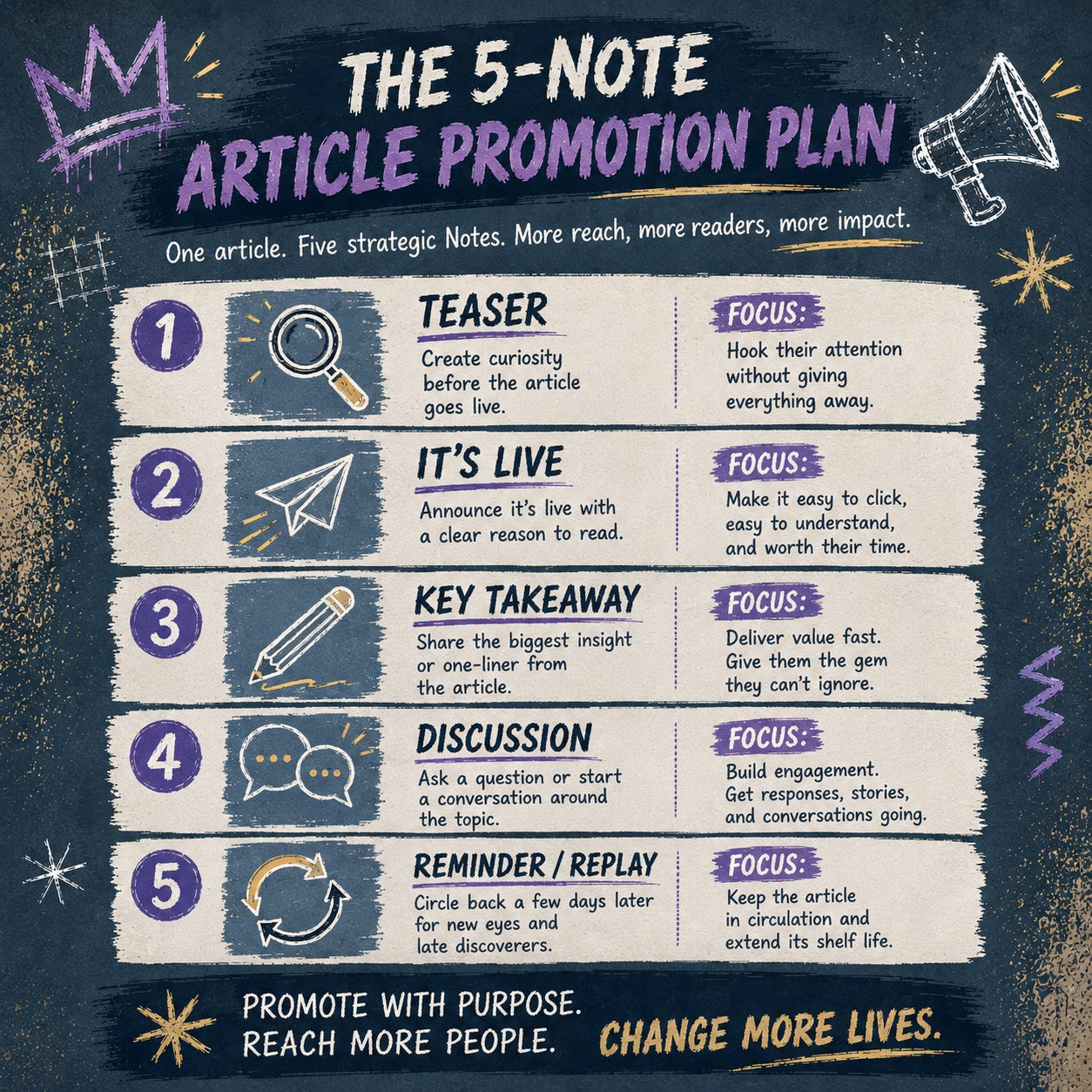
The 5-Note Article Promotion Plan
Note 1: The article is live
Don’t merely announce it.
→ Tell people why they should care.
What’s the problem?
Who is this for?
What will they leave knowing?
Give them a reason to click.
Note 2: Pull a strong line
Find one sentence from the article that can stand on its own.
Let the idea do the promotion.
You don’t always need to yell: NEW ARTICLE!!!
Sometimes the writing itself is the advertisement.
Note 3: Pull another insight
Choose something different.
→ If your first Note focused on the problem, maybe this one gives readers part of the solution.
You’re showing another side of the same article.
Note 4: Start a conversation
Take an idea from the article and turn it into a question.
Ask readers what they think and ask about their experience.
Let the article become a conversation rather than something you published at them.
Note 5: Bring it back with the takeaway
A few days later:
In case you missed (ICYMI) this one...
→ Then give readers the main takeaway.
Not another generic link drop.
Tell them why the article is still worth their time.
→ Five Notes. One article.
Five different ways into the same work.
3. PARTNER: Let The Work Travel Beyond Your Audience
You don’t have to grow entirely inside your own publication alone.
→ Collaboration gives your work another way to travel.
When you collaborate with another writer, you’re being introduced to people who may never have encountered your work otherwise and that introduction comes with something valuable:
Context.
The other creator already has a relationship with their audience.
If they choose to work with you, invite you onto a Live, contribute to an article, or share your work, they’re helping introduce you to that audience.
Robyn and I talked about this during the Live because collaborations have become a regular part of how we’re using Substack.
We also talked about making collaboration easier by approaching someone with an actual idea instead of a vague request to “collab.”
Know their work.
Understand where your audiences overlap.
Have an idea.
Explain what their part would be.
Have a plan before you pitch.
And once the collaboration is published, you can keep extending its reach.
→ One person might publish the original article while the other cross-posts it to their publication.
→ During the Live, we talked about adding a short introduction explaining why you’re sharing the piece and why it matters to your readers.
That little bit of context matters.
Don’t make your audience figure out why something belongs in front of them. Tell them.
4. RECIRCULATE: Stop Acting Like Good Work Expires
You published the article three months ago.
So what?
Is it wrong now?
Is it irrelevant?
Did every person who might benefit from it read it?
Probably not. (I would hope not.)
During the Live, I talked about returning to older work months later, pulling out another insight, and putting it in front of people again.
I think writers need to get much more comfortable doing that.
Your audience changes, new subscribers arrive, people who weren’t following you three months ago are following you now, and even longtime readers haven’t consumed every word you’ve ever published.
Revisit the article.
Pull a quote.
Write a new Note around the takeaway.
Connect it to something you’re thinking about now.
Restack it with a new observation.
Read it again and discover that you have something new to say about it.
→ Your archive shouldn’t be a graveyard.
Your archive is a library and an asset. Use it and grow it.
Final Thoughts: Publish Isn’t The Finish Line
Sometimes the next move isn’t to create more.
→ It’s to do more with what you’ve already created.
So after your next article goes live, don’t immediately race toward the next blank page.
Ask yourself:
What can I PULL from this?
How else can I PROMOTE it?
Who could I PARTNER with?
When could I RECIRCULATE it?
You don’t need to do all four every time.
→ You just need to stop giving good work one chance to succeed because as I said during the Live:
“No one’s going to promote your work unless you do.”
Publish isn’t the finish line. It’s where the work starts traveling.
Thank you so much for being here. I truly appreciate you.
— Jessica
Move first. Refine second. Publish with structure.

Want to Go Deeper on Sponsorships with Robyn?
There’s also something worth celebrating.
Robyn’s Finding Your Edge just reached its first 100 subscribers!!
To celebrate, she’s offering a limited-time, one-time upgrade opportunity for her publication.
She’s also introducing her Sponsorship Playbook & Workbook, Your Sponsor Kit Edge™, which draws on decades of her real-world sponsorship experience. 🐐
If these sponsorship conversations have you thinking, “I want to try this with my own publication”, Robyn’s new resource gives you a place to keep going.
→ Click below to learn more and celebrate 100 subscribers with Robyn at Finding Your Edge.
Follow Robyn at Finding Your Edge →


ICYMI, Previous Articles & Live Episodes →


Scan the QR code below to subscribe to Unstuck to Published →
Quick question for my fellow writers 👇
What’s one article in your archive that deserves another chance to be discovered?
Go find it. Pull one idea from it. Turn that idea into a Note today.
Your best work doesn’t need to stay buried just because you already hit publish. 💜
So true Jess! Amazing insights!