

You publish the article and you liked this one.
Actually, you really liked this one.
The idea was good. The writing felt sharp. You spent more time on the opening than you’d care to admit. You made the thumbnail. Checked the links. Read the whole thing one last time.
Publish. Then you wait.
A few hours later, you check the numbers.
Oh.
Not terrible, but definitely not what you expected.
So you check again.
Maybe Substack hasn’t sent all the emails yet, maybe people are at work, and maybe Tuesday at 9:17 a.m. was somehow the problem.
You come back later. Still meh and this is where something interesting happens.
The article has been live for less than a day, but your brain is already writing a second article about the first one:
People didn’t like it.
Maybe this topic doesn’t work anymore.
My last few posts did better.
Am I getting worse at this?
Should I write about something else next week?
Well, damn. That escalated quickly.
One article had a disappointing day, and suddenly your entire publication is being called into a performance review.
→ I think writers need to talk about this part of publishing more because learning how to write is one thing.
→ Learning how to emotionally handle the response to what you write is another skill entirely.
And if you don’t learn the second one, the numbers can start making your creative decisions for you.
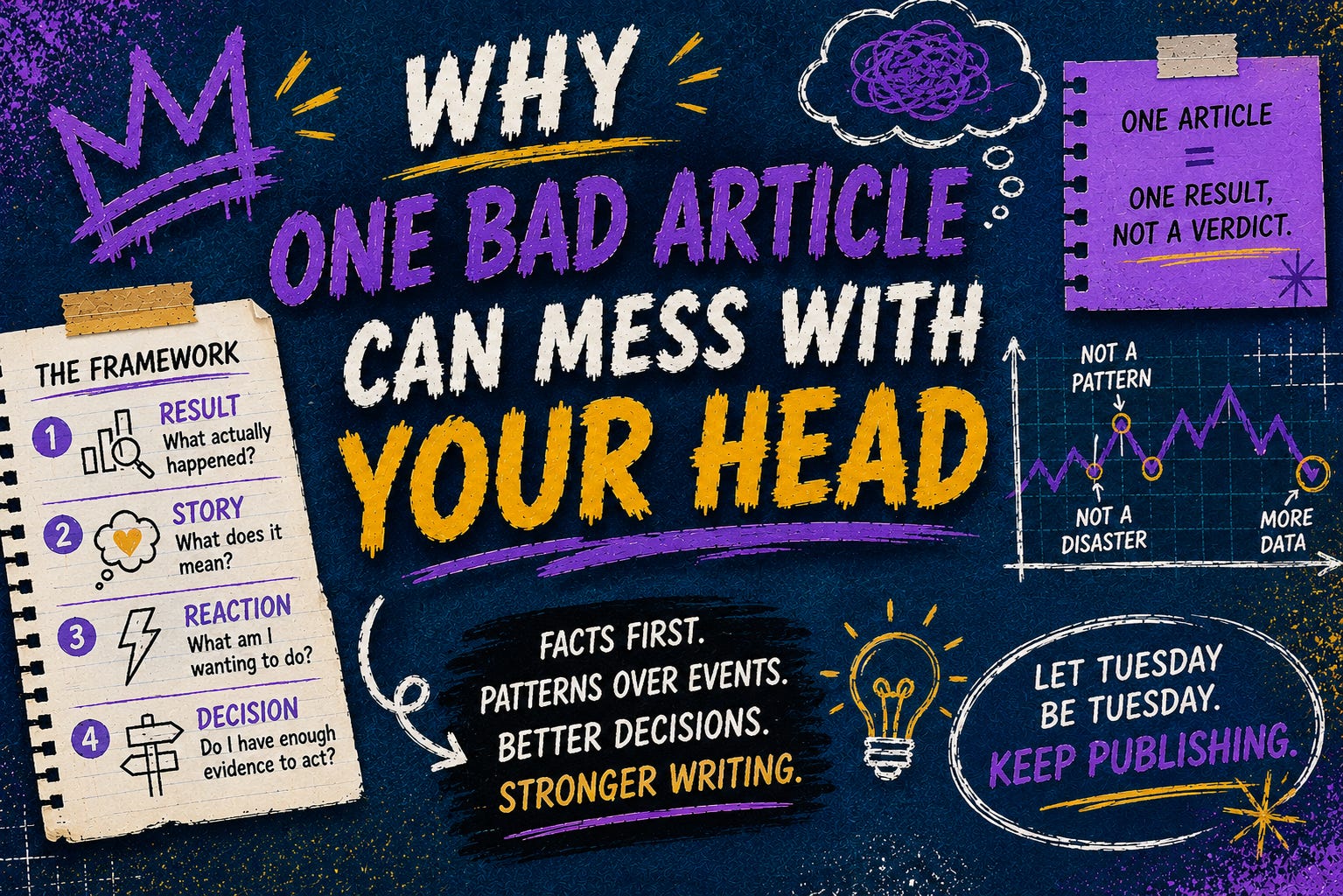
The result and the story aren’t the same thing
Say your article usually gets 1,000 views in the first few days.
This one gets 600. That’s the result.
600 views.
Everything after that is interpretation.
“My audience is losing interest.”
“This topic was a mistake.”
“The headline sucked.”
“People don’t want this from me.”
“I need to change my content.”
Those might eventually turn out to be useful conclusions, but you don’t know that yet.
You have one piece of information:
→ This article performed differently than you expected.
Your brain is probably going to want an explanation for that number.
So it starts looking for one and because you’re emotionally attached to the work, the explanation can get personal FAST.
→ The numbers stop being information about an article and they become information about you.
That’s where things get messy.
Writers are terrible at leaving a number alone
We attach stories to numbers constantly.
Twenty people liked it?
Only ten people liked it.
Three people unsubscribed?
Something I wrote pissed people off.
Nobody commented?
Nobody cared.
One person left a weird comment?
Apparently I’m spending the rest of Thursday thinking about Steve.
Meanwhile, Steve has moved on with his life.
Rude.
The problem isn’t that you notice your numbers. If you’re building a publication, of course you should pay attention to what readers respond to.
Your data can teach you things, but there’s a difference between looking for a pattern and reacting to an event.
One underperforming article is an event.
Five articles on the same subject consistently underperforming compared with your other work?
Okay. Now we have something worth investigating.
That distinction matters because when you react too quickly, you can end up abandoning good ideas before you’ve collected enough information to know whether they’re actually bad ideas.
Disappointment makes you want to DO something
This is the part I find fascinating.
→ A disappointing result creates discomfort and discomfort wants an exit.
So you start fixing things.
Change the headline.
Rewrite the opening.
Switch your topic for next week.
Post six more Notes.
Question your niche.
Research what everybody else is writing.
Maybe completely redesign your publication while you’re at it because apparently we’ve lost all adult supervision.
Doing something feels better than sitting with:
I thought this article would do better, and it didn’t.
But sometimes that’s all that happened.
→ There may be something to learn from the result.
→ There may also be absolutely nothing you need to change today.
Those are very different situations. You need a way to tell them apart.
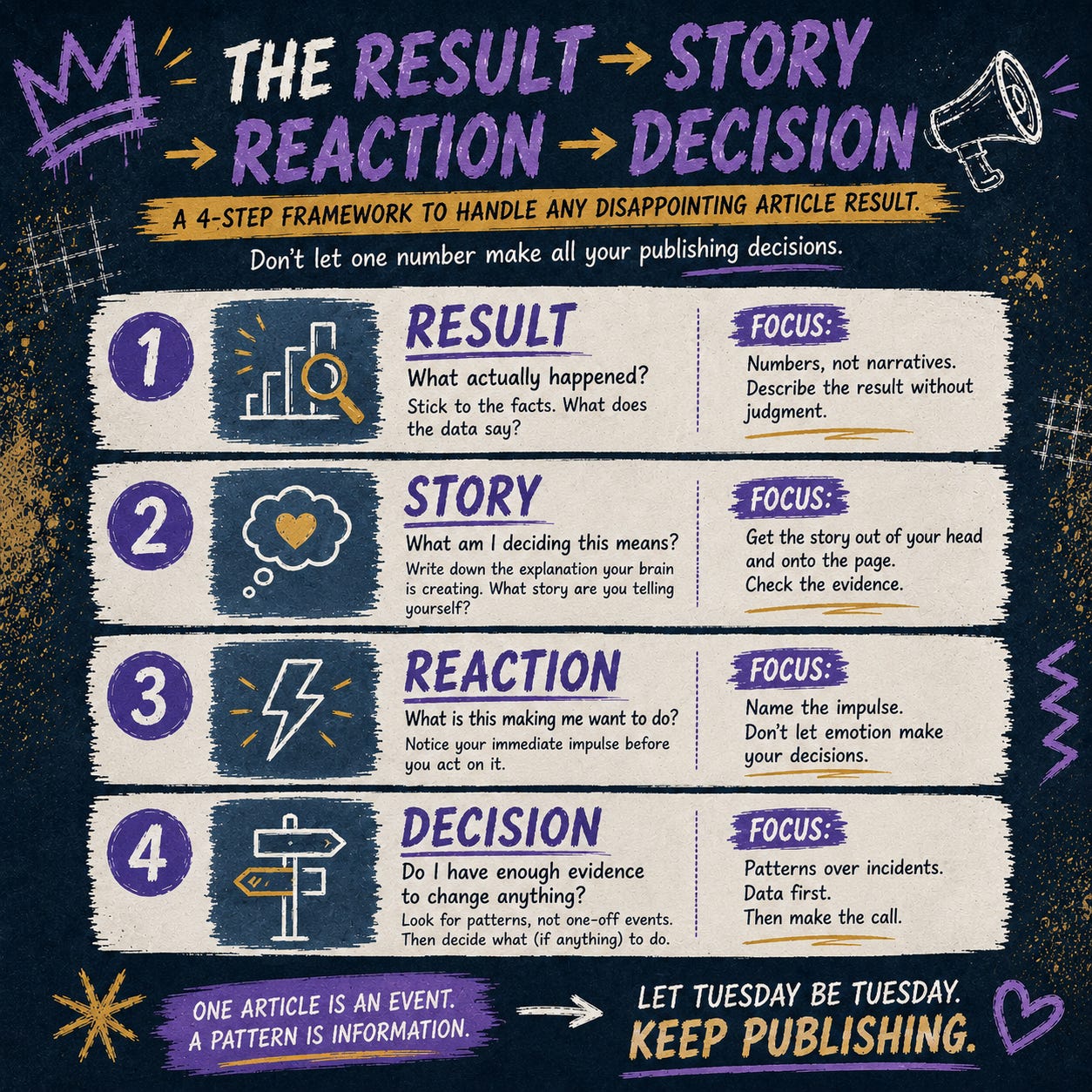
The RESULT → STORY → REACTION → DECISION Test
Before you let one article change what you’re doing, walk yourself through four questions.
1. RESULT: What actually happened?
Stick to facts.
Not:
This article tanked.
Try:
This article received 40% fewer views than my previous three articles during the first 48 hours.
Now we have something we can examine.
“Tanked” comes with judgment baked into it.
The number doesn’t. Start there.
2. STORY: What am I deciding this means?
Now write down the explanation your brain supplied.
Maybe it’s:
My audience doesn’t care about this topic.
Or:
I’m writing too much about Substack.
Or the particularly delightful:
My writing isn’t as good as I thought it was.
There it is.
→ Get the story out of your head and onto the page where you can actually look at it.
Then ask:
What evidence do I have for that conclusion?
Not what you feel.
What do you know?
You may discover you’ve built a surprisingly elaborate case from one Tuesday afternoon.
3. REACTION: What is this making me want to do?
This question catches the knee-jerk decisions.
Do you suddenly want to change your next article?
Delete something?
Stop writing about the subject?
Publish more?
Publish less?
Copy something another writer is doing?
Spend the evening refreshing your dashboard until your eyeballs become raisins?
Notice the impulse before you obey it because your immediate reaction is often designed to make the discomfort disappear.
That doesn’t automatically make it a good publishing decision.
4. DECISION: Do I have enough evidence to change anything?
This is the question that can save you from screwing with a perfectly good publishing strategy every seven days.
Look beyond the article.
What happened with your previous posts on this subject?
Did the article attract subscribers even if total views were lower?
Did people reply privately instead of commenting publicly?
Did it get restacked later?
Did readers spend time with it?
Did it lead to a conversation, inquiry, sale, recommendation, or something else you care about?
And how long has the article even been alive?
You’re trying to identify a pattern, not prosecute a single post.
Sometimes the answer will be:
Yep. Something needs adjusting.
Good. Change it.
But sometimes the answer is:
→ I don’t have enough information yet.
That’s an answer too.
Don’t confuse performance with quality
This one can hurt.
→ A good article can underperform and an article you threw together in 45 minutes can inexplicably take off while the one you lovingly edited for six hours sits in the corner eating paste.
Publishing is annoying like that.
Performance tells you how the work performed under a particular set of circumstances.
It doesn’t give you a clean measurement of how good the writing was.
Those aren’t interchangeable.
→ A strong article can have a weak headline.
→ A useful article can cover a subject your audience isn’t interested in right now.
→ An article can start slowly and keep getting discovered later.
And sometimes you simply guessed wrong.
Welcome to publishing.
The goal isn’t to protect yourself from ever being wrong.
You need enough emotional distance from the result that you can figure out what was wrong without deciding YOU were wrong.
Give the article time to become data
This is something I’m trying to get better at myself.
I want information quickly.
I publish something and naturally want to know:
Did it work?
However, publishing doesn’t always answer that question on my preferred schedule.
So annoying.
An article can continue traveling through Notes, restacks, recommendations, search, shares, your archive, and people who discover you weeks or months later.
That’s one reason I don’t love making big decisions from the first few hours of performance.
Give the work some room.
Promote it.
Pull ideas from it.
Talk about it again.
Let people find it.
Then, look at what happened.
Remember what we talked about recently?
Publish isn’t the finish line.
If you’re going to give an article more than one chance to travel, you also have to give it more than one chance to tell you how it performed.
Create a rule for yourself BEFORE you’re disappointed
This might be the most useful thing you take from this article.
→ Decide in advance what evidence you need before changing your publishing strategy.
Maybe you won’t abandon a topic based on one article.
Maybe you’ll compare at least three posts before deciding there’s a pattern.
Maybe you’ll wait 72 hours before doing a full performance review.
Maybe you’ll track views, new subscribers, comments, restacks, and conversions instead of judging everything by whichever number looks ugliest that morning.
Your rule can be different from mine.
→ The point is to create it while you’re thinking clearly.
Because post-publish Jessica who just saw disappointing numbers is not always the person I want running the strategy meeting.
She’s emotional, she’s impatient, and apparently Steve is still on her mind.
She can attend. She just doesn’t get the deciding vote.
If You’re Stuck Right Now: Your job is to learn without flinching.
Publishing gives you feedback.
Some of it feels fantastic and some of it doesn’t.
You need both.
If something repeatedly isn’t working, I want to know.
I want to look at the headline.
The topic.
The opening.
The promotion.
The timing.
The audience response.
→ I want to ask what I can do differently next time.
However, I don’t want to rebuild my publishing strategy every time one article disappoints me and I definitely don’t want one number deciding whether I’m a good writer.
So the next time you publish something and the response makes your stomach drop a little, catch yourself before the story starts running.
Ask:
What was the RESULT?
What STORY did I attach to it?
What REACTION did that story create?
Do I have enough evidence to make a DECISION?
Maybe you need to change something, maybe you need more data, and maybe your article just had a shitty Tuesday.
Let Tuesday be Tuesday.
Thank you so much for being here. I truly appreciate you.
— Jessica
Move first. Refine second. Publish with structure.
ICYMI, Previous Articles & Live Episodes →

Stop Treating Publish Like The Finish Line

Writers spend a lot of time thinking about what to publish next.
It’s Surprisingly Simple To Become An Above-Average Writer

I think we make becoming “above average” much more complicated than it needs to be.
Scan the QR code below to subscribe to Unstuck to Published →

I want to know what happens in your head when an article doesn’t perform the way you expected.
Do you immediately start questioning the headline?
Your topic?
Your writing?
Your entire existence as a person with internet access? 😂
One bad article can make you forget about the ten things that were working before it.
So tell me: What’s your first reaction when a post flops and how long does it take you to stop messing with everything because of it? 👑
I never let metrics determine how I feel. By the time I publish my most personal pieces, I already went through a very emotional release that means more to me than anyone else’s validation!