

I think we make becoming “above average” much more complicated than it needs to be.
We assume the writers doing exceptional work must have something we don’t.
More talent.
More experience.
Better connections.
More confidence.
Maybe they got lucky.
Sometimes, sure, but I’ve noticed something much less exciting.
→ A lot of people simply aren’t willing to consistently do the ordinary things that produce better work.
They want to write, but they don’t write.
They want to publish, but they keep waiting.
They want opportunities, but they wait to be chosen.
They want readers to care about their work, but they rush through the work itself.
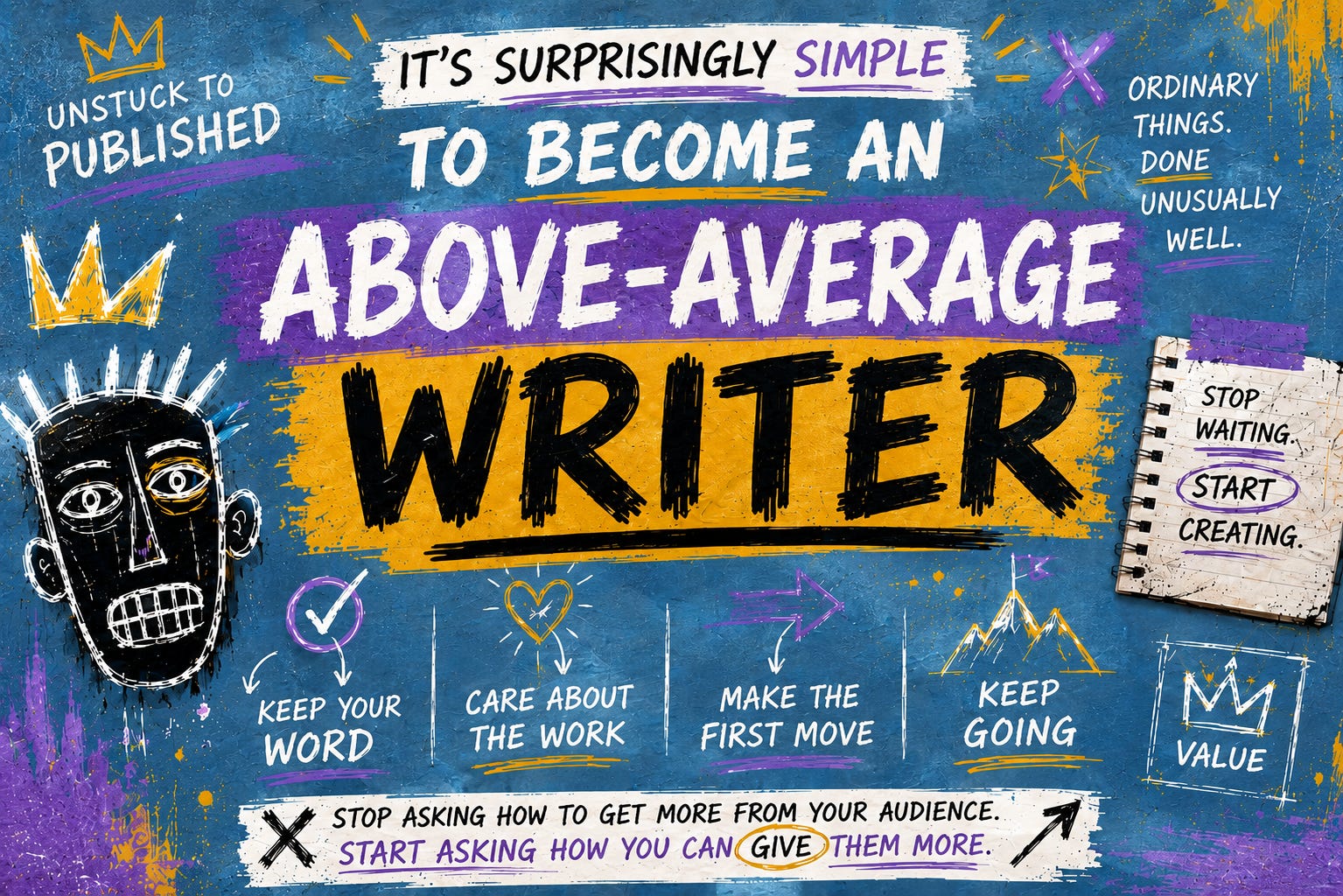
→ That’s why I think becoming an above-average writer is surprisingly simple.
Not easy; simple.
You don’t need extraordinary talent.
→ You need to consistently choose a higher standard when the easier option is sitting right there.
Most of those choices are remarkably ordinary.
Simple Doesn’t Mean Easy
Publishing when you said you would is simple.
Doing it when you’re tired isn’t always easy.
Reaching out to someone you admire is simple.
Risking rejection isn’t.
Continuing to publish when your numbers aren’t moving is simple.
Coming back when nobody seems to care?
That can be brutal.
The actions themselves aren’t complicated.
Repeating them is.
This Isn’t About Being Better Than Everyone Else
Let’s get something straight.
Being above average doesn’t mean believing you’re better than other writers.
You don’t need someone else to be mediocre for your work to be excellent and you definitely don’t need to announce that you’re above average.
Please don’t. 😂
Let the work reveal it.
→ This is about the standard you hold for yourself.
Your real competition isn’t the writer next to you.
It’s the version of you who knows the article needs another ten minutes but wants to hit Publish anyway.
The version who said Monday but decides Wednesday is close enough.
The version who wants the opportunity but keeps waiting for an invitation.
The version who disappears when the numbers stop providing applause.
That’s the competition and there are four places I’d start. →
1. Do What You Say You’re Going To Do
Become reliable.
If you tell your readers you’ll publish Monday, publish Monday.
If you say you’re coming back next week, come back.
If you tell someone you’ll send something, send it.
If you commit to a collaboration, show up prepared.
You don’t need to publish seven days a week and you don’t need some ridiculous content schedule that turns your publication into a hostage situation.
→ You need to become someone people can count on.
Reliability isn’t exciting.
Nobody is selling a $997 masterclass called Do What You Said You’d Do.
Maybe they should because think about the people you trust.
You know what to expect from them.
Their words mean something because their actions repeatedly match them.
→ That’s reputation and it’s built quietly.
One kept promise at a time.
2. Care About The Work
I don’t mean work longer, I don’t mean publish more, and I definitely don’t mean burn yourself out trying to prove how badly you want this.
I mean care.
Read the article again.
Fix the paragraph that doesn’t make sense.
Check the link before you send 2,000 people to a 404 page.
Improve the headline.
Answer the reader’s actual question instead of firing off a rushed response.
Spend another ten minutes making the thing genuinely useful.
Readers can tell when something was thrown together and they can also tell when someone gave a damn.
That doesn’t mean the work has to be perfect.
→ Perfection and craftsmanship aren’t the same thing.
Perfection says:
I can’t finish this because it could always be better.
Craftsmanship says:
I’m going to give this the care it deserves, and then I’m going to ship it.
→ Know the difference.
Perfection keeps you stuck. Craftsmanship other makes you better.
3. Make The First Move
How many opportunities are you waiting for someone else to create?
The collaboration.
The introduction.
The podcast invitation.
The Live.
The conversation with the writer you admire.
The opportunity you keep hoping someone will notice you’re perfect for.
Go first.
Send the email.
Leave the thoughtful comment.
Invite the person.
Make the introduction.
Pitch the idea.
Start the conversation.
Will everyone say yes?
Nope.
Some people won’t answer, some invitations will go nowhere, and some ideas will die quietly in an inbox somewhere.
Welcome to being a person who asks for things. 😂
However, something changes when you stop building your work around being chosen.
You start participating in creating what happens next.
4. Keep Going When Nobody Is Watching
This is the hard one.
It’s easy to keep publishing when the numbers are moving.
Subscribers are coming in.
People are commenting.
Your article is being shared.
Paid subscriptions hit your inbox.
Your Note takes off.
Of course you want to come back tomorrow.
But what happens when the internet gives you...Nothing?
Five likes.
No comments.
No new subscribers.
The invitation gets ignored.
You publish something you were proud of and it lands with the digital equivalent of a tumbleweed rolling across the screen.
Now what?
You can decide the silence means you’re not good enough.
Or you can look at the work.
What can you learn?
What needs to change?
What should you try next?
→ Evaluate, learn, and refine.
Then come back.
Persistence doesn’t mean blindly repeating something that isn’t working.
→ It means you don’t confuse a disappointing result with a final verdict because a lot of above-average work gets built before anybody rewards you for making it.
That’s the part nobody sees.
Ordinary Things, Done Unusually Well
Look at those four things again.
Be reliable.
Care about the work.
Make the first move.
Keep going.
None of them is revolutionary.
There’s no secret publishing hack hiding in there.
No special credential required, no minimum subscriber count, and no permission slip and that’s the point.
We spend so much time wondering whether we’re talented enough to do exceptional work.
I think there’s a better question.
Are you willing?
Are you willing to keep your word when breaking it would be easier?
Are you willing to care about the paragraph nobody would blame you for leaving alone?
Are you willing to send the email before someone comes looking for you?
Are you willing to come back after the work gets ignored?
Not in one extraordinary moment.
In ordinary decisions nobody else may ever see.
Make One Above-Average Decision
Don’t leave this article promising yourself you’re going to become an above-average writer.
That’s too big and frankly, it doesn’t give you anything to do.
Instead, look at the next decision in front of you.
Ask yourself:
What would the easy decision be?
Then:
What would the stronger decision be?
And finally:
Am I willing to make it?
Maybe the stronger decision is finishing the article.
Maybe it’s giving the draft another ten minutes.
Maybe it’s finally sending the invitation.
Maybe it’s keeping the publishing promise you made to yourself.
Maybe it’s coming back after the post nobody noticed.
Pick one.
→ Make one above-average decision today.
Tomorrow, make another. Then another.
That’s how standards are built. One decision at a time.
Final Thoughts: If You’re Stuck Right Now
We spend a lot of time wondering what separates exceptional writers from everyone else.
I don’t think it’s always extraordinary talent.
Sometimes it’s much less exciting.
Exceptional writers:
They keep their word.
They care about the work.
They make the first move.
They come back when nobody applauds.
Ordinary things. Done unusually well.
You don’t have to become an above-average writer today.
→ Make one above-average decision. Then make another tomorrow.
Eventually, you won’t need to ask what an above-average writer would do.
It’ll simply be your standard.
Thank you so much for being here. I truly appreciate you.
— Jessica
Move first. Refine second. Publish with structure.
ICYMI, Previous Articles & Live Episodes →

The #1 Way To Grow On Substack: Be The Most Helpful

Everyone wants to know the secret to succeeding on Substack.
Your Substack Profile Name Might Be Costing You Subscribers

💛 Editor’s Note: Every once in a while, I come across a publishing tip that’s so simple it’s easy to overlook.

Scan the QR code below to subscribe to Unstuck to Published →
What’s ONE above-average decision you can make today?
Finish the draft. Give the work another ten minutes. Send the email. Make the first move. Come back after the post nobody noticed.
Mine is: __________.
What’s yours? 👇
Ordinary things. Done unusually well.
Great article Jess!
I always find it interesting how easy it to be "above average". It's really about owning what you say you will do and being consistent. You readers just want you to show up and provide a little value each day. That's the key.
Thanks for sharing!