

I love productivity advice.
Probably a little too much.
Give me a better writing routine, a new way to organize my day, or some tiny trick that promises to help me get more done and I’m listening, but recently, I heard something that made me realize we may be asking the wrong question.
I was listening to an episode of The Mel Robbins Podcast with board-certified psychiatrist Dr. Sasha Hamdani.
The conversation itself was about ADHD.
However, buried inside it was an idea about understanding productivity that I couldn’t stop thinking about as a writer.
When Dr. Hamdani talked about tracking task performance, she broke it into three separate places where someone might struggle:
Starting the task.
Staying with the task.
Finishing the task.
And I immediately thought:
→ Writers need this.
Because how often do we say:
“I need to be more productive.”
“I need to focus.”
“I need more discipline.”
Okay.
But where, exactly, is the problem?
Do you sit in front of the blank page for 45 minutes before writing a sentence?
Do you start easily but somehow end up checking Substack, answering an email, researching something you absolutely didn’t need to research, and reorganizing your desktop?
Do you have 36 promising drafts and nothing ready to publish?
Those aren’t the same problem.
So why are we trying to solve all of them with the same productivity advice?
Maybe before you try to become a more productive writer, you need to figure out where your writing is breaking down.
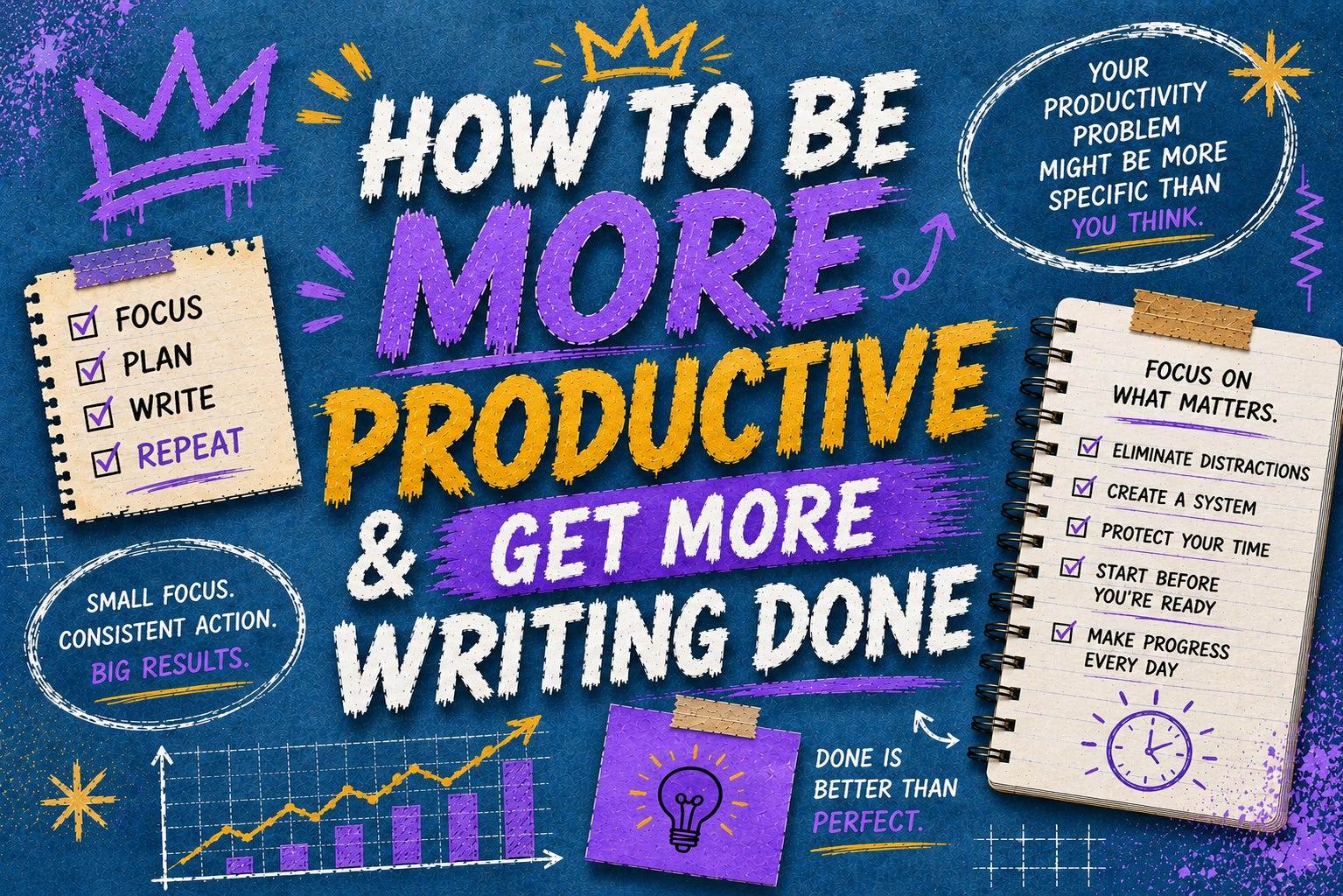
Your Writing Has Three Jobs
Let’s make this ridiculously simple.
A productive writing session requires you to do three things:
START.
Get yourself into the work.
STAY.
Remain with the work long enough to make meaningful progress.
FINISH.
Bring the work across the line.
→ That’s our framework and before we start fixing anything, I want you to figure out which one is costing you the most writing because your problem may not be productivity.
It may be much more specific.
1. Do You Have A START Problem?
You know you need to write and you may even want to write, but somehow everything happens before the writing.
Coffee.
Email.
Substack.
A little research.
Maybe you’ll just check your stats quickly.
Oh, someone left a comment. Better answer that.
Twenty-seven minutes later, your blank document is still sitting there like:
Hello???
Starting creates friction because the work hasn’t begun generating momentum yet.
There’s nothing to react to, nothing to edit, and nothing to improve.
→ Just you and the blank page and I think writers sometimes make that moment harder by expecting themselves to begin brilliantly.
Don’t.
Your first job is to create something you can work with.
Write the bad opening.
Put down the obvious sentence.
Start in the middle.
Write:
What I’m actually trying to say is...
You can fix ugly writing, but you can’t edit a blank page.
→ If START is your problem, your goal isn’t to have an incredible writing session.
Your first goal is much smaller: Get into the work.
2. Do You Have A STAY Problem?
Maybe starting isn’t difficult for you.
→ You open the document and you’re off.
Then...
Ping.
Email.
Text.
Substack notification.
Interesting link.
Sudden urgent need to Google whether an em dash should have spaces around it.
And now the writing session has become an archaeological dig through the internet.
Your problem isn’t getting into the work.
→ It’s staying there.
This is where I’d stop treating distraction like some mysterious personality defect and start looking at what repeatedly pulls you away.
Your phone?
Notifications?
Too many tabs?
Writing somewhere people constantly interrupt you?
Researching while you’re drafting?
Checking your article stats?
You may not need more motivation. You may need fewer exits.
Put the phone somewhere else.
Close the tabs you don’t need.
Turn off notifications.
→ Separate research from drafting when you can and give yourself a defined period where your only job is to stay with the piece.
Also, notice something important: You don’t have to focus perfectly for four hours.
Maybe you write beautifully for 30 minutes. Great.
→ Protect those 30 minutes like they owe you money.
The goal isn’t to imitate somebody else’s perfect writing routine.
The goal to create conditions that make it easier for you to stay.
3. Do You Have A FINISH Problem?
This one is sneaky because writers with a finishing problem can look incredibly productive.
They’re always writing.
New ideas everywhere.
Drafts everywhere.
Notes everywhere.
Outlines everywhere.
And somehow nothing is ready to publish, starting feels exciting, and finishing requires decisions.
Is the argument clear enough?
Does this section belong?
Is the headline right?
Do I need another example?
Could the ending be stronger?
Should I rewrite the opening?
Maybe I should let it sit for another day.
And suddenly you’re on Draft 14 of an article that was probably ready at Draft 6.
At some point, improving the article turns into avoiding the moment when someone else gets to see it.
→ That’s where craftsmanship can quietly become perfectionism.
So if FINISH is your problem, define what finished means before you disappear into endless refinement.
Is the point clear?
Does the article deliver what the headline promised?
Have you removed what doesn’t belong?
Have you checked the facts and links?
Have you given it a thoughtful edit?
Yes? Ship it.
A finished article can teach you something. A permanently improving draft can’t.
Stop Guessing About Your Productivity
This was the second idea from Dr. Hamdani’s conversation that stayed with me.
She emphasized tracking patterns and establishing a baseline before deciding what needs attention.
In her clinical context, that included looking separately at task initiation, distractibility, completion, and factors such as sleep and mood.
I’m not suggesting we turn our writing lives into a clinical assessment.
I am suggesting we steal the underlying principle: Collect some evidence about yourself because writers are spectacularly good at making sweeping declarations based on one bad afternoon.
“I have no discipline.” (start problem)
“I can’t focus.” (stay problem)
“I’m terrible at finishing things.” (finish problem)
Maybe or maybe you haven’t actually looked.
For your next five writing sessions, track a few things:
What time did I start?
How difficult was it to begin?
What distracted me?
How long could I stay with the work?
What was my energy like?
Did I finish what I intended to finish?
That’s it.
We’re not building a 42-column spreadsheet and hiring a data scientist to analyze Tuesday’s newsletter.
→ We’re looking for patterns.
Maybe you discover you don’t have a writing problem at all.
You have a 9 p.m. writing problem.
Maybe you can focus beautifully until you open Substack.
Maybe your strongest sessions happen before you check email.
Maybe starting takes forever, but once you’re in, you can write for an hour.
Maybe you produce drafts quickly and lose three days trying to make them perfect.
→ Now we’re getting somewhere because you have something more useful than: I need to be more productive.
You have a diagnosis of the writing process itself.
Pay Attention To The Writer, Too
There’s another piece of productivity advice I think we ignore because it isn’t sexy enough.
→ Pay attention to the condition you’re in when you’re asking yourself to write.
In Dr. Hamdani’s discussion of tracking patterns, sleep was important enough to track alongside task behavior.
Her broader clinical discussion also treats attention as something that doesn’t exist in isolation from things such as energy and emotion.
Those points were made specifically in the context of ADHD, so I’m not turning them into universal medical claims about writers, but they prompted a useful question for me:
What state am I asking myself to write in?
Exhausted?
Distracted?
Frustrated?
Hungry?
Phone buzzing?
Fourteen tabs open?
And then we’re surprised the writing feels difficult.
Sometimes we respond by demanding more discipline.
FOCUS HARDER.
Maybe that’s not the first move and maybe the first move is noticing the conditions surrounding your best work.
You might discover that changing when or where you write does more for you than another productivity system ever did.
Build A Writing Routine Around Reality
There’s no perfect writing routine.
I know. Devastating.
I would’ve enjoyed buying it too. 😂
However, if you track your own behavior long enough, you can start building something better:
→ A routine based on evidence about yourself.
If mornings consistently produce your best writing, protect them.
If you struggle to begin, create a tiny starting ritual.
If your phone destroys your attention, get it out of reach.
If research sends you down rabbit holes, research separately.
If you can only focus deeply for 30 minutes, build around 30 minutes instead of feeling guilty that somebody on the internet writes for four hours before sunrise.
If you struggle to finish, give the piece a deadline and define what “done” means.
The point isn’t to become a machine.
→ The point is to stop designing your writing life around the writer you think you’re supposed to be.
Build it around the writer you actually are.
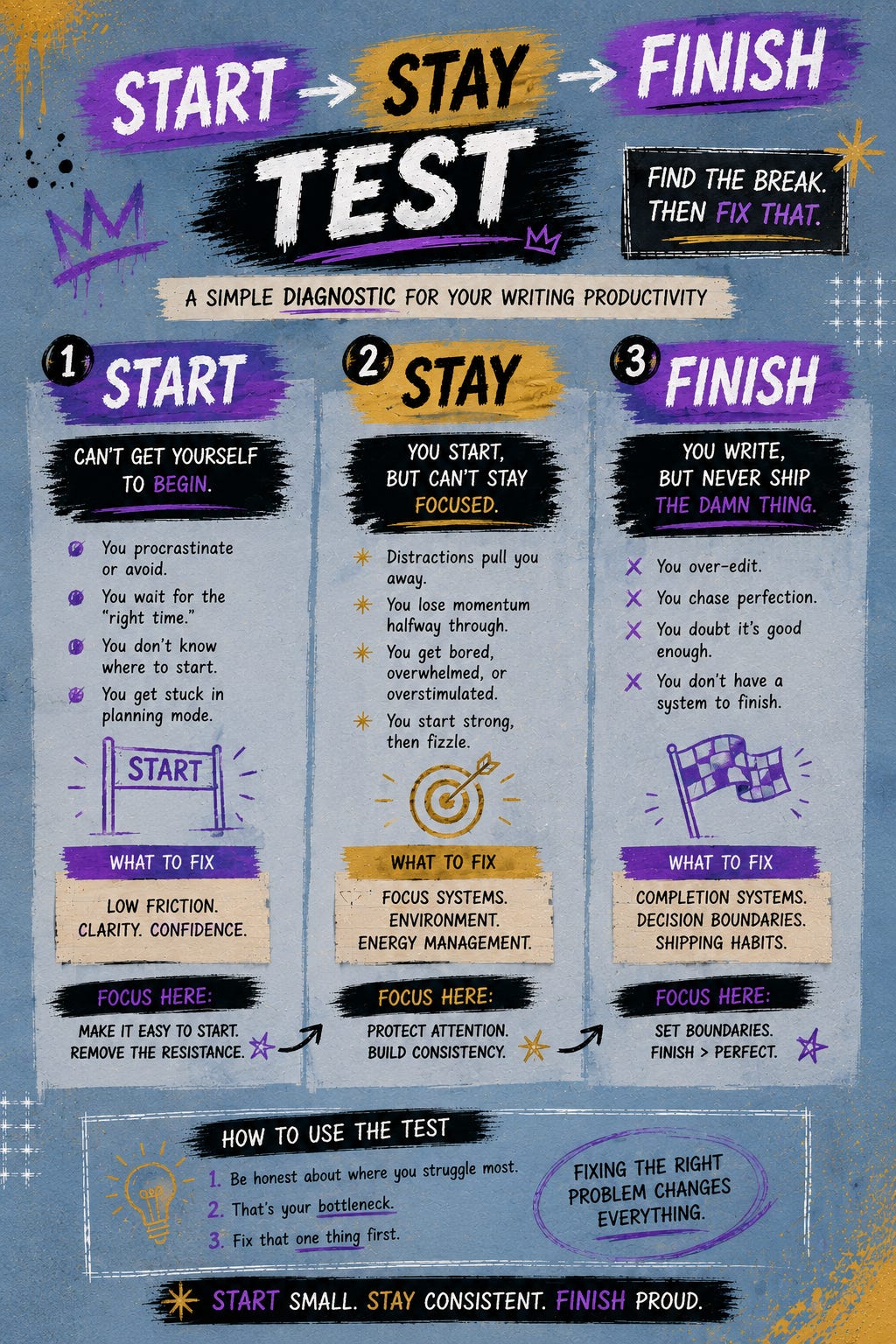
Try The START → STAY → FINISH Test
Before your next writing session, don’t try to fix anything.
→ Observe.
When you sit down, ask:
START: How long does it take me to actually begin?
Once you’re writing:
STAY: What pulls me out of the work?
And when you’ve made progress:
FINISH: What stops me from bringing this across the line?
Do that for five writing sessions. Then look at what you’ve collected.
→ Where’s the break?
Because once you know that, you can stop trying every productivity trick that wanders across your feed.
You can work on the problem you actually have.
Final Thoughts: If You’re Stuck Right Now—You Probably Don’t Need Another Productivity Hack
That’s the irony.
We go looking for ways to become more productive because we want another answer.
A better app.
A morning routine.
A timer.
A system.
A trick.
However, sometimes the most useful thing you can do is pay closer attention to what you’re already doing.
Where do you stop?
Where do you wander?
Where do you hesitate?
Where does the work repeatedly fall apart?
START.
STAY.
FINISH.
→ Find the break.
Then fix that because “I need to be more productive” is too vague to change anything.
But:
I need to start faster. (start problem)
I need to protect 30 minutes from distraction. (stay problem)
I need to stop editing and publish the damn thing. (finish problem)
→ Now we have something we can work with.
Your challenge this week isn’t to become a more productive writer.
It’s simpler.
→ Track five writing sessions.
Find where you’re getting stuck.
Then make one change.
Thank you so much for being here. I truly appreciate you.
— Jessica
Move first. Refine second. Publish with structure.
ICYMI, Previous Articles & Live Episodes →
Stop Treating Publish Like The Finish Line

Writers spend a lot of time thinking about what to publish next.
It’s Surprisingly Simple To Become An Above-Average Writer

I think we make becoming “above average” much more complicated than it needs to be.

The #1 Way To Grow On Substack: Be The Most Helpful

Everyone wants to know the secret to succeeding on Substack.
Scan the QR code below to subscribe to Unstuck to Published →
Okay, writers. I want to know. 👇
Where does your writing usually break down?
🟣 START — getting yourself to begin
🟡 STAY — staying focused once you do
🟣 FINISH — getting the damn thing published 😂
Mine is: Start.
What’s yours?
Jess, this one hit. 👏
I’ve been thinking about this a lot lately — productivity as a writer isn't really about writing more. It’s about making it easier to actually sit down, get the idea out, and keep moving.
That’s something I’ve had to learn while building Growth OS.
I’m writing, publishing, building, engaging with people, thinking about strategy, running the business… and there’s always another thing that could pull my attention away.
The biggest unlock for me has been creating before perfecting.
Get the thought down.
Build the first version.
Publish it.
Learn from it.
Then do it again.
Because honestly, sometimes “I need to make this better” is just procrastination wearing a nice outfit. 😂
And I love that Unstuck to Published keeps coming back to the actual goal: get the work published.
Ideas don't create much value sitting in your drafts.
They become useful when you put them into the world.
Really enjoyed this one, Jess. 👊