

Someone asked me recently,
“How do I become a better writer?”
They expected me to recommend a book, or a writing course, or a better editing app.
Instead, I gave them a much simpler answer.
→ Start journaling.
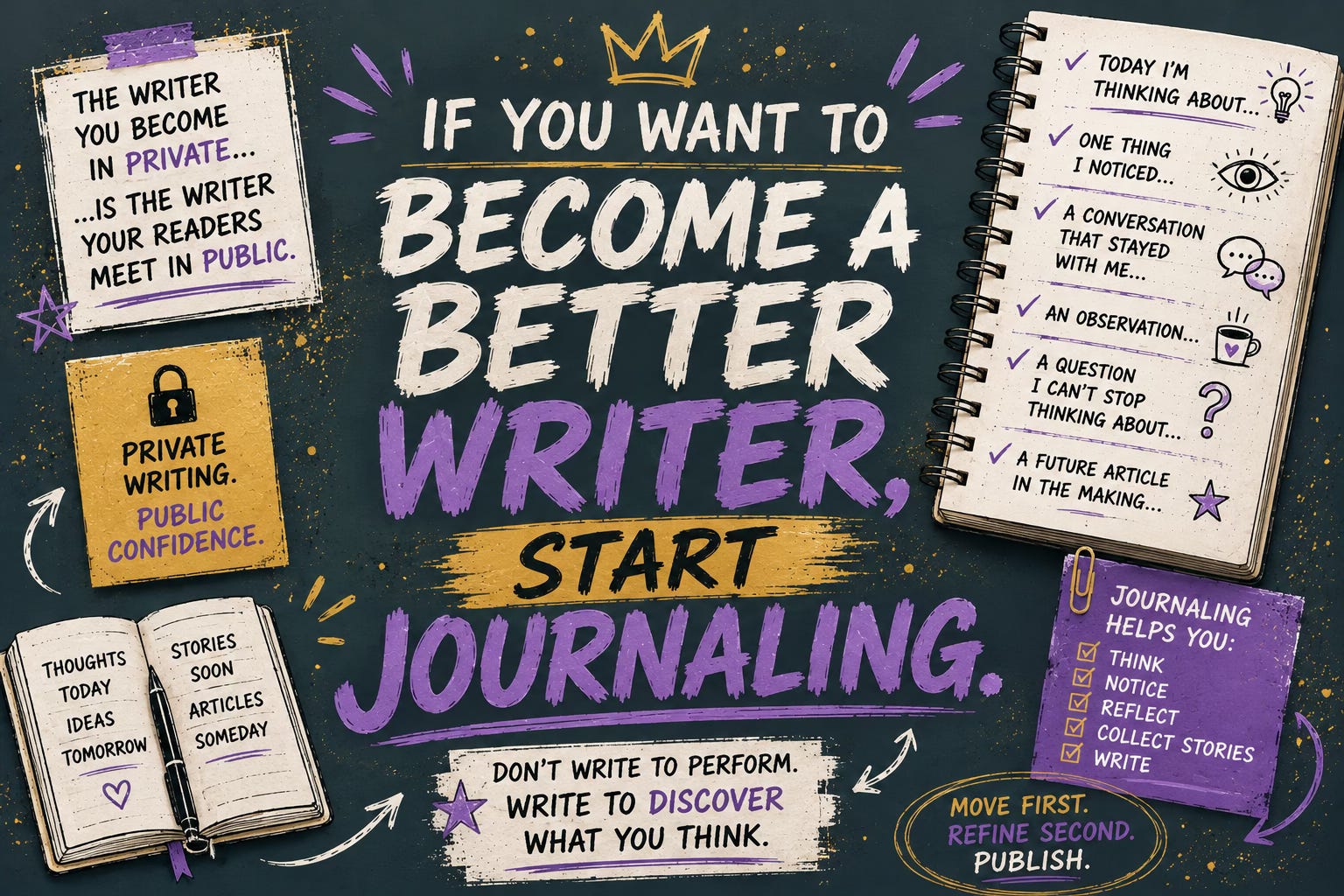
Not because I want you to become a journaler, but because I want you to become a better writer.
Most people think great writing begins the moment they open a blank Substack draft.
I don’t.
I think it begins long before you ever click Publish.
It begins the moment you start paying attention to your own thoughts.
That’s what journaling really is.
Not writing beautifully, not writing for an audience, and not trying to sound intelligent.
→ Just thinking on paper.
The writing nobody else will ever read is often the writing that prepares you to create something thousands of people eventually will.
The Biggest Mistake New Writers Make
One of the biggest mistakes I see new writers make is that they only write when it’s time to publish.
Every writing session becomes a performance.
Every sentence feels permanent.
Every paragraph feels like it has to be impressive.
That creates pressure and pressure leads to perfectionism.
Perfectionism leads to overthinking and overthinking eventually leads to avoidance.
→ A journal removes all of that.
Nobody is grading it, nobody is subscribing to it, and nobody is waiting for it.
It’s one of the few places where you’re allowed to write simply to discover what you think. That’s where better writing begins.
You Have Permission To Journal
Before we go any further, I want to give you something.
→ Permission.
Permission to write badly.
Permission to write privately.
Permission to change your mind halfway through a sentence.
Permission to fill a page with thoughts that never leave the notebook.
Somewhere along the way, many of us learned that writing only had value if it was polished enough to share or maybe something even harder happened.
Maybe someone read your journal without your permission or maybe your private thoughts stopped feeling private.
If that’s your story, I understand why opening a blank notebook doesn’t immediately feel safe.
So let me say this clearly.
→ Your journal belongs to you.
It isn’t content, it isn’t homework, and it definitely isn’t something you owe the internet.
Nobody gets to decide what happens to those pages except you.
→ It’s simply a conversation with yourself and you get to decide whether that conversation stays private forever.
There’s no rule that says your journal has to become your newsletter.
In fact...I hope most of it never does because the freedom comes from knowing nobody else has to read it.
That’s what allows honesty to show up and honesty is where good writing begins.
Your Journal Isn’t Content
This may be the most important idea in this entire article.
Don’t journal because you plan to publish it.
Journal because you don’t.
The page isn’t asking you to perform.
It isn’t asking you to build an audience.
It isn’t asking you to become more productive.
It’s simply asking you to be honest.
The more private your writing becomes, the stronger your public writing often becomes.
Not because you copy your journal into your newsletter, but because your journal gives you something your audience never can.
A place to think before anyone is watching.
The writer you become in private is the writer your readers eventually meet in public.
Two Questions I Hear All The Time
Whenever I encourage people to start journaling, two questions almost always come up.
1. “What if someone reads it?”
That’s a real concern.
→ The good news is that journaling doesn’t have to look one specific way.
Your journal can be:
A notebook you keep somewhere safe.
A password-protected notes app.
An encrypted digital journal.
A handwritten page you shred afterward.
Even a document you delete as soon as you’ve finished writing.
Remember...the value isn’t keeping every word forever.
→ The value is the act of writing.
You don’t owe anyone access to your private thoughts.
2. “What if I don’t know what to write?”
Perfect. That means you’re starting honestly.
Don’t try to write something profound.
→ Start by writing something true.
Try finishing one of these sentences:
Today I’m thinking about...
I can’t stop thinking about...
Something surprised me today...
One thing I noticed...
Today felt difficult because...
If I were completely honest...
That’s enough.
The goal isn’t beautiful writing.
The goal is honest thinking.
5 Benefits of Journaling
1. Journaling Develops Clarity
Have you ever noticed how confusing something feels......until you write it down?
Thoughts are messy.
Writing forces them into order.
That’s one of the greatest gifts journaling gives us.
→ Clarity.
Readers rarely remember complicated writing.
They remember clear writing and clear writing almost always begins with clear thinking.
2. Journaling Develops Courage
Every writer experiences fear.
Fear of sounding foolish.
Fear of being judged.
Fear that nobody will care.
A journal gives you a place to write before any of those fears matter.
Nobody is watching, nobody is evaluating, and definitely nobody is clicking Unsubscribe.
Over time, the blank page becomes less intimidating because you’ve met it over and over again without pressure.
Confidence isn’t something you suddenly discover.
It’s something you quietly practice.
3. Journaling Develops Consistency
Nobody expects a musician to perform without rehearsing and nobody expects an athlete to compete without practicing.
But somehow, writers expect themselves to produce their best work only when it’s time to publish.
→ Journaling changes that.
Five minutes with your morning coffee.
A paragraph before bed.
A page while you’re waiting in the school pickup line.
Every entry is another repetition and repetition builds confidence long before it builds skill.
4. Journaling Helps You Find Your Voice
One of the biggest questions new writers ask is:
“How do I find my writing voice?”
The funny thing is...you usually don’t find it by trying.
→ You find it by forgetting that anyone is listening.
Without an audience, something changes.
You stop performing.
You stop trying to sound like your favorite author.
You stop writing the way you think you’re supposed to write.
You simply write the way you think.
Over time, that voice becomes familiar. Then recognizable and recognizable voices build loyal readers.
5. Journaling Helps You Collect Stories
Every article starts somewhere.
Mine rarely begin as polished outlines.
More often, they begin as:
A conversation.
A question.
An observation.
Something I noticed while walking through the grocery store.
A sentence I couldn’t stop thinking about.
Most great writing isn’t invented.
It’s noticed.
Journaling trains you to notice.
→ It gives those small moments somewhere to live before they disappear.
Weeks later...
One sentence becomes a newsletter.
One paragraph becomes a podcast.
One observation becomes your next article.
The blank page becomes much less intimidating because you’re never really starting from zero.
You’re simply returning to thoughts you’ve already taken the time to notice.
A Simple Journaling Practice for Writers
If you’re not sure where to begin...keep it simple.
Set a timer for ten minutes.
Open a blank page.
Start with one sentence: Today I’m thinking about...✍️👩🏻💻🧑💻
That’s it.
No word count, no editing, and no expectations.
Some days you’ll write one paragraph and some days you’ll write three pages.
Both count.
Showing up matters far more than sounding brilliant.
Your Permission Statement
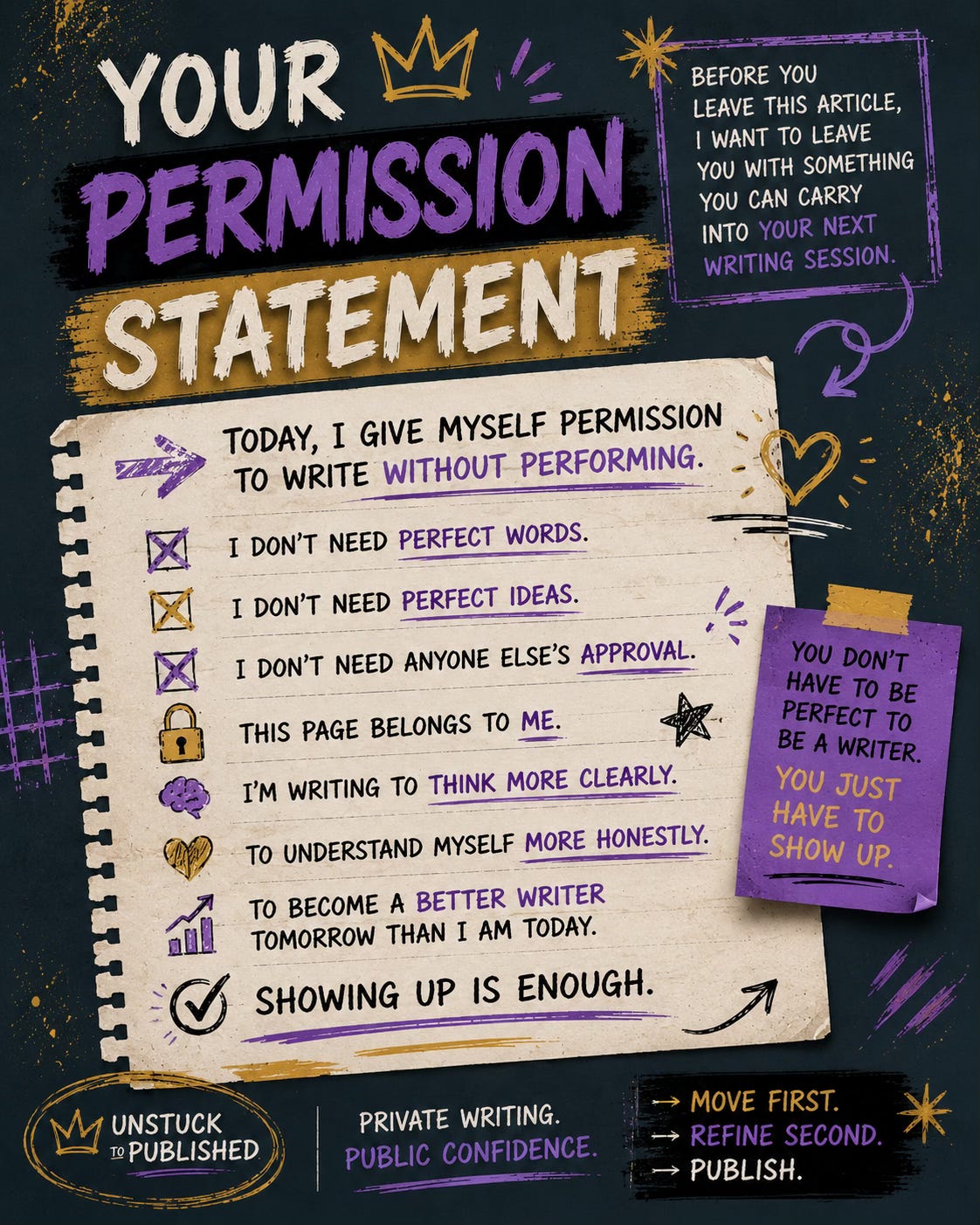
Before you leave this article, I want to leave you with something you can carry into your next writing session.
→ “Today, I give myself permission to write without performing.
I don’t need perfect words.
I don’t need perfect ideas.
I don’t need anyone else’s approval.
This page belongs to me.
I’m writing to think more clearly.
To understand myself more honestly.
To become a better writer tomorrow than I am today.
Showing up is enough.” ←
Your Challenge
Before you close this article...open a notebook or a blank document.
→ Set a timer for ten minutes.
→ Write one sentence. Then another.
Don’t edit, don’t judge, and don’t ask yourself whether anyone will ever read it because they don’t have to.
The goal isn’t to write something worth publishing today.
The goal is to become the kind of writer who keeps showing up tomorrow.
Journaling Resources
How to use rapid logging in bullet journaling.
How to keep a simplified bullet journal.
How to identify and shrink your resistance to achieve your goals with journaling.
Zentangle art and patterns to draw in a meditative, relative state!
Final Thoughts: If You’re Stuck Right Now
People often ask me how to become a better writer.
They’re usually hoping I’ll recommend the perfect book, the perfect course, or the perfect app; however, better writing rarely begins with better tools.
It begins with paying closer attention.
Attention to your thoughts.
Attention to your questions.
Attention to the moments most people rush past without noticing.
→ That’s what journaling teaches us.
Not how to write beautifully.
How to think honestly.
How to notice more.
How to listen to ourselves before we ask anyone else to listen to us.
Writing isn’t just about finding the right words.
It’s about discovering what you actually believe before you try to explain it to someone else.
So if you ever ask me how to become a better writer...you’ll probably hear the same answer every time.
→ Start journaling.
Not because every journal entry deserves to be published, but because every writer deserves one place where they never have to perform.
The page doesn’t need your best writing.
→ It just needs your honesty.
Honesty has a funny way of turning into clarity.
Clarity turns into confidence.
Confidence turns into better writing.
Long before anyone ever clicks Publish.
📓 Free Download
I’ve created a simple Journaling Starter Page you can print or use digitally to begin your own journaling practice.

Thank you so much for being here. I truly appreciate you.
— Jessica
Move first. Refine second. Publish with structure.
ICYMI, Previous Articles & Live Episodes →


Scan the QR code below to subscribe to Unstuck to Published →
📓 Thanks for reading.
One line from this article has stayed with me:
"The writer you become in private is the writer your readers eventually meet in public."
I'm curious...do you have a place where you write just for yourself? Or would this be your first time giving journaling a try?
I'd love to hear your thoughts below. 🤗
Journaling is healthy in so many ways! Helped me get over a sad time and write an eBook in 6-weeks. Published it on Amazon in 2022. Who Knew? Wasn't even a plan. Great article, Jess!