


You can post six Notes a day.
Schedule two weeks of them in advance, study which time gets the most likes, restack the winners, and try to reverse-engineer the algorithm until your eyeballs fall out.
However, somewhere in all that strategy, it’s easy to forget what Notes actually give you:
→ A way to meet people.
That became one of the bigger themes when Robyn and I sat down for Episode 012 of our Substack Live series.
We started talking about what to post.
We ended up talking about something much more useful:
What happens after somebody stops scrolling.
Because discoverability might introduce you, but a conversation is what gives somebody a reason to remember you.
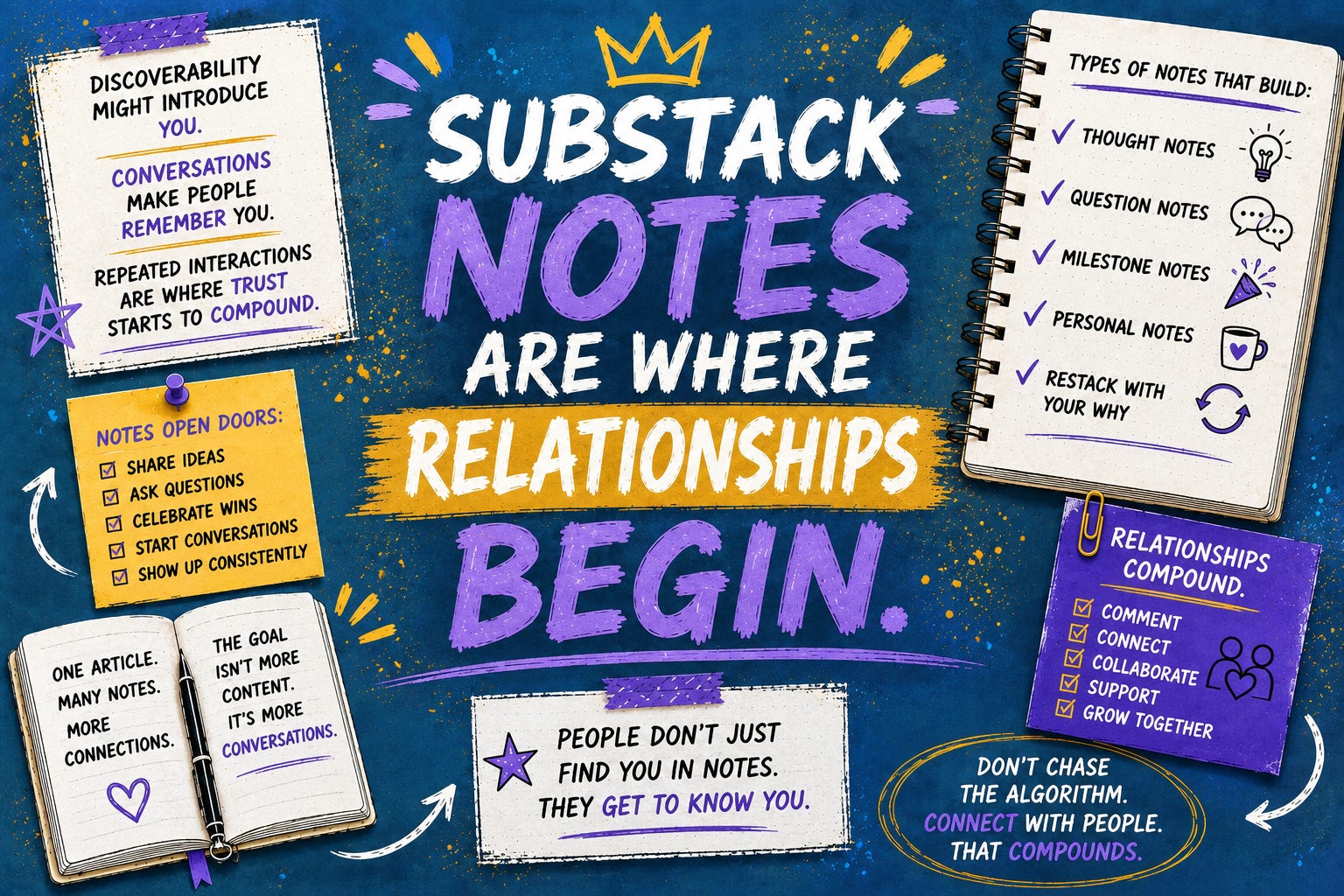
Notes Give Your Work More Doors
Before Notes, your Substack publication mostly depended on long-form posts and whatever traffic you could bring in from somewhere else.
Notes changed that.
→ Your articles still go directly to the people who already subscribed.
→ Notes can put your ideas in front of people who haven’t found you yet.
And that means every article you publish can become more than one announcement.
This is where I see writers leaving SO much on the table.
They publish an article.
Then:
“New post is live!”
Maybe they restack it later. Then, they move on.
Nope.
→ One article can give you a week’s worth of conversations without you inventing five completely new things to say.
During the Live, Robyn and I walked through a simple sequence.
You can tease the article before publication.
When it goes live, announce it and share the link.
Later, pull out one sentence or idea that can stand alone.
Share another takeaway from a different angle.
Ask a question inspired by the article.
Then bring the article back later with an ICYMI Note and another link.
→ Same article. Different doors.
And importantly, every Note doesn’t need the link. Sometimes the idea itself should do the work.
Write The Note That Makes Someone Stop
Robyn accidentally gave this one a name during our conversation:
The Note Stopper.
And I’m keeping it. 😂
A Note Stopper gives somebody a reason to interrupt the scroll.
Maybe it’s an opinion people in your niche aren’t saying.
Maybe it’s a sentence pulled from your latest article.
Maybe it’s something you learned the hard way.
Maybe it’s a question that hits a nerve.
Maybe it’s simply a photograph from your day.
Robyn shared one of my favorite examples during the Live.
She posted a photo from Portugal with basically two words:
“No edit needed.”
That simple Note became one of her best-performing Notes at the time, with around 120 likes.
No complicated content strategy and no 17-part hook formula.
She showed people something worth looking at.
→ There’s a lesson there.
Sometimes the thing you think is too ordinary to post is exactly what makes someone feel like there’s an actual human being behind the publication.
Show your desk.
Your notebook.
The book you’re reading.
A place you’re visiting.
Your face occasionally.
Yes, even your dog.
People are curious about the people whose work they read. Let them see you.
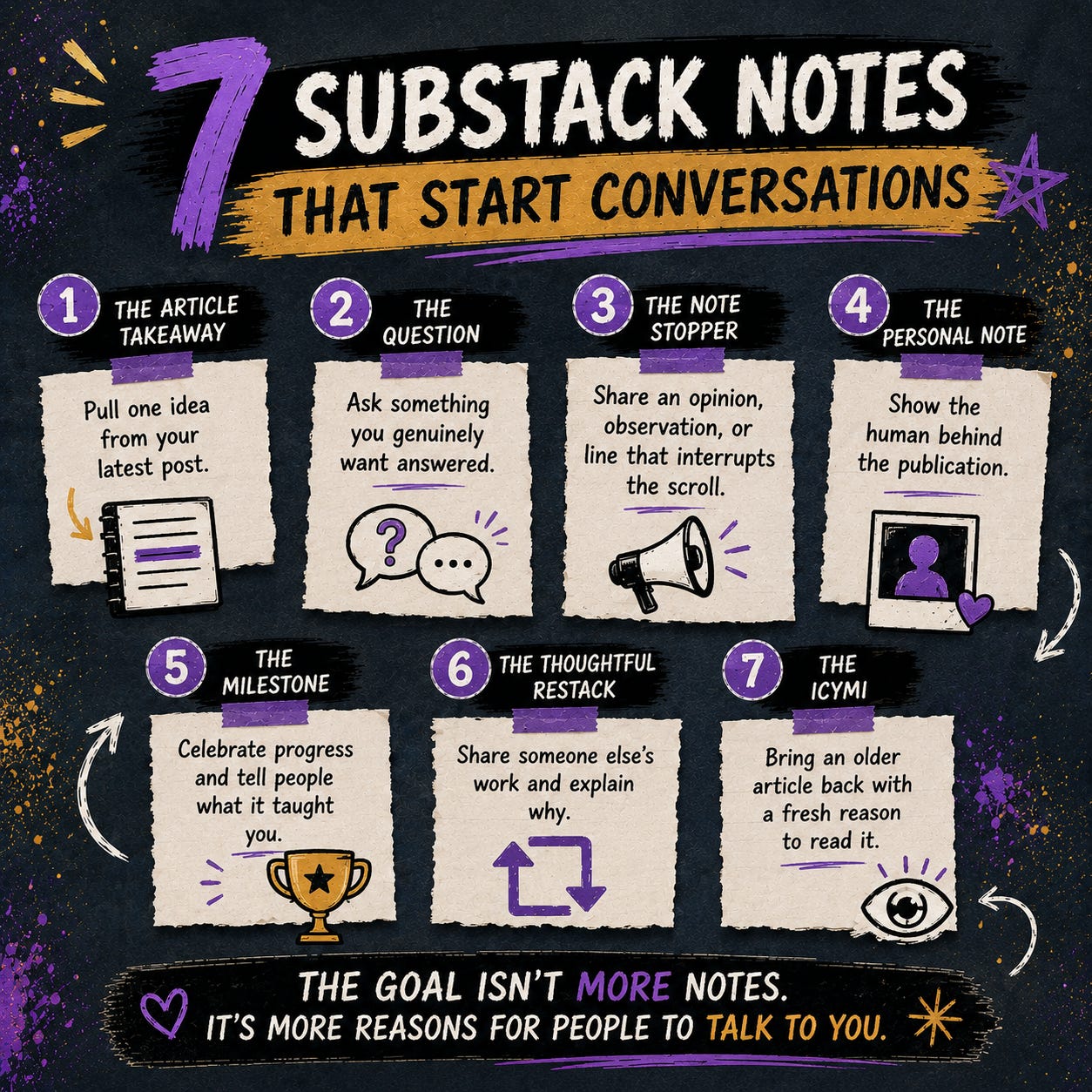
Ask Better Questions
This might be my favorite Notes strategy from the entire conversation.
Ask people something you actually want the answer to.
Not engagement bait.
A real question.
What are you struggling with on Substack?
What’s one decision keeping you stuck?
What are you overthinking right now?
What are you building?
Where are you getting frustrated?
Something interesting happens when people start answering.
The Note stops being your post.
The Note becomes a tiny room full of people talking and now you’re learning.
You’re hearing what your readers call their problems.
You’re seeing what they’re trying to build.
You’re noticing what keeps coming up.
You’re hearing the exact words they use to describe it.
That’s useful as hell because those comments can become future articles, they can give you ideas for products, they can tell you what your audience needs help with, and the next time you write, you aren’t guessing how your readers talk about the problem.
They already told you.
That’s the part of Notes I think gets overlooked when we reduce everything to impressions, likes and subscriber counts.
A question can create a conversation.
A conversation can create familiarity.
Familiarity gives trust somewhere to start.
And yes, eventually that person might subscribe or buy something from you. That’s exactly what we talked about during the Live.
However, it started with two people talking in a Note.
Celebrate The Milestones WITH People
Another type of Note we talked about was the milestone Note.
First subscriber.
First paid subscriber.
100 subscribers.
1,000 subscribers.
First product sale.
Ten published articles.
One year of publishing consistently.
Bestseller badge.
Whatever represents progress for YOU.
And no, you don’t have to wait until the number looks impressive enough for Instagram. 😂
People on Substack genuinely like watching other people build things.
However, there’s a small change I’d make to the standard:
“OMG! I reached 500 subscribers! Thank you!”
→ Celebrate it.
→ Then tell us something the milestone taught you.
Maybe reaching 100 subscribers taught you that publishing every Sunday matters more than waiting for inspiration.
Maybe your first paid subscriber changed how you thought about what people would pay for.
Maybe your first year taught you that the article you nearly didn’t publish became the one that brought in the most readers.
Now the milestone isn’t simply an announcement.
You’re bringing your readers along for the ride.
During the Live, we talked about how those milestones make a publication feel alive.
People can see that something is happening there.
And when they helped you get there?
Say we did this because you didn’t build the publication alone.
Restacking Can Be Relationship Building Too
Here’s another tiny move that changes the entire feel of a restack.
Don’t always hit the button and disappear.
→ Tell people why you’re sharing it.
If Robyn writes something I think my readers should see, I can restack it.
Cool.
Or I can add:
I just read Robyn’s piece about A. This part changed how I’m thinking about B.
Now I’m doing something different.
I’m recommending her work that gives my readers context.
It tells Robyn I actually read the damn thing and it creates another point of connection between our audiences.
Robyn pointed out during our Live that genuine restacks like these often lead to comments, replies and sometimes another restack from the original writer.
We talked about how adding your own thought turns the share into something closer to a recommendation.
Funny how that works.
You support someone’s work, they notice, you talk, you keep running into each other, and eventually, the person who was once some random writer in your Notes feed isn’t random anymore.
Sound familiar?
That’s how a lot of Substack relationships begin.
Don’t Let The Algorithm Eat Your Brain
At one point in the Live, we got into frequency.
One Note a day?
Three?
Six?
Thirty?!
Then we got into timing.
Morning?
Afternoon?
Weekends?
Then scheduling, multiple publications, and whether talking about different subjects hurts your views, and eventually I reached the only conclusion I can personally live with:
→ I can’t spend my life trying to beat an algorithm.
I have multiple interests and I have multiple publications so I’m going to write about them.
Could that affect my numbers?
Maybe.
Am I going to turn myself into a one-topic content robot because I’m terrified an algorithm might get confused?
Nope.
As I said during the Live:
“I can’t think about things I cannot control.”
A few minutes later I also said:
→ “We should think about how we can make an impact or make money instead of beating some algorithm.”
THAT’s the strategy I want writers to remember →
Test things.
Pay attention.
If a Note performs well, use it again.
Restack it later.
Try photos.
Try questions.
Try clips from your Lives.
Schedule Notes if that makes consistency easier.
→ If you haven’t been posting at all, start with one Note a day rather than deciding you suddenly need 30 and turning Substack into a second unpaid job.
However, don’t become so obsessed with cracking Notes that you forget there are PEOPLE on the other side of them.
If You're Stuck Right Now: The Metric You Can’t See on Your Dashboard
A Note gets a like and then somebody comments on another one.
A week later, you recognize their name and you read their article and you restack it and tell people why you liked it.
They show up in your comments again.
Maybe you eventually jump on a Live together, collaborate on an article, and recommend each other’s publications.
Or, buy something from each other, refer somebody, and become friends.
There’s no neat little analytics box that captures all of that, but it’s happening.
→ That’s the compounding effect of showing up around people.
Which is why I don’t think the best question is:
How many Notes should I post today?
I’d rather ask:
Did anything I posted today give somebody a reason to talk to me?
Because discoverability gets you into someone’s feed.
Relationships give them a reason to keep you in their world and sometimes the relationship that changes your Substack starts with one little Note.
Thank you so much for being here. We truly appreciate you.
— Jessica & Robyn
Move first. Refine second. Publish with structure.

Want to Go Deeper on Sponsorships with Robyn?
There’s also something worth celebrating.
Robyn’s Finding Your Edge just reached its first 100 subscribers!!
To celebrate, she’s offering a limited-time, one-time upgrade opportunity for her publication.
She’s also introducing her Sponsorship Playbook & Workbook, Your Sponsor Kit Edge™, which draws on decades of her real-world sponsorship experience. 🐐
If these sponsorship conversations have you thinking, “I want to try this with my own publication”, Robyn’s new resource gives you a place to keep going.
→ Click below to learn more and celebrate 100 subscribers with Robyn at Finding Your Edge.
Follow Robyn at Finding Your Edge →


ICYMI, Previous Articles & Live Episodes →


Scan the QR code below to follow Jess at Unstuck to Published →
I’m curious about this one 👇
Has a conversation you started on Substack Notes ever turned into something bigger?
A new subscriber. A friendship. A collaboration. A client. Someone you now talk to regularly.
I think we spend so much time asking, “What should I post on Notes?” that we can miss what happens after someone responds.
That’s where it gets interesting.
Tell me about a relationship that started with a Note, comment, or random Substack interaction. I’d love to hear the story. 👑
Thank you so much, Melanie! We appreciate you so much! I also came for the long-form writing and don’t really like Notes either but like you said they’re necessary and it’s all good!!