You open Substack and you decide you should probably post a Note today.
And then…Nothing.
What the hell am I supposed to post?
The problem probably isn’t that you’ve run out of things to say.
→ It’s that you’re treating Notes like a separate content machine.
You write your articles over here. Then you open Notes and expect your brain to produce an entirely different supply of clever little thoughts over there.
No wonder Notes start feeling like work because now you’re basically running two publications: the one where you write your actual articles and this hungry little creature called Notes that apparently needs to be fed every morning.
I think there’s a much easier way to use Notes.
→ Stop starting from zero.
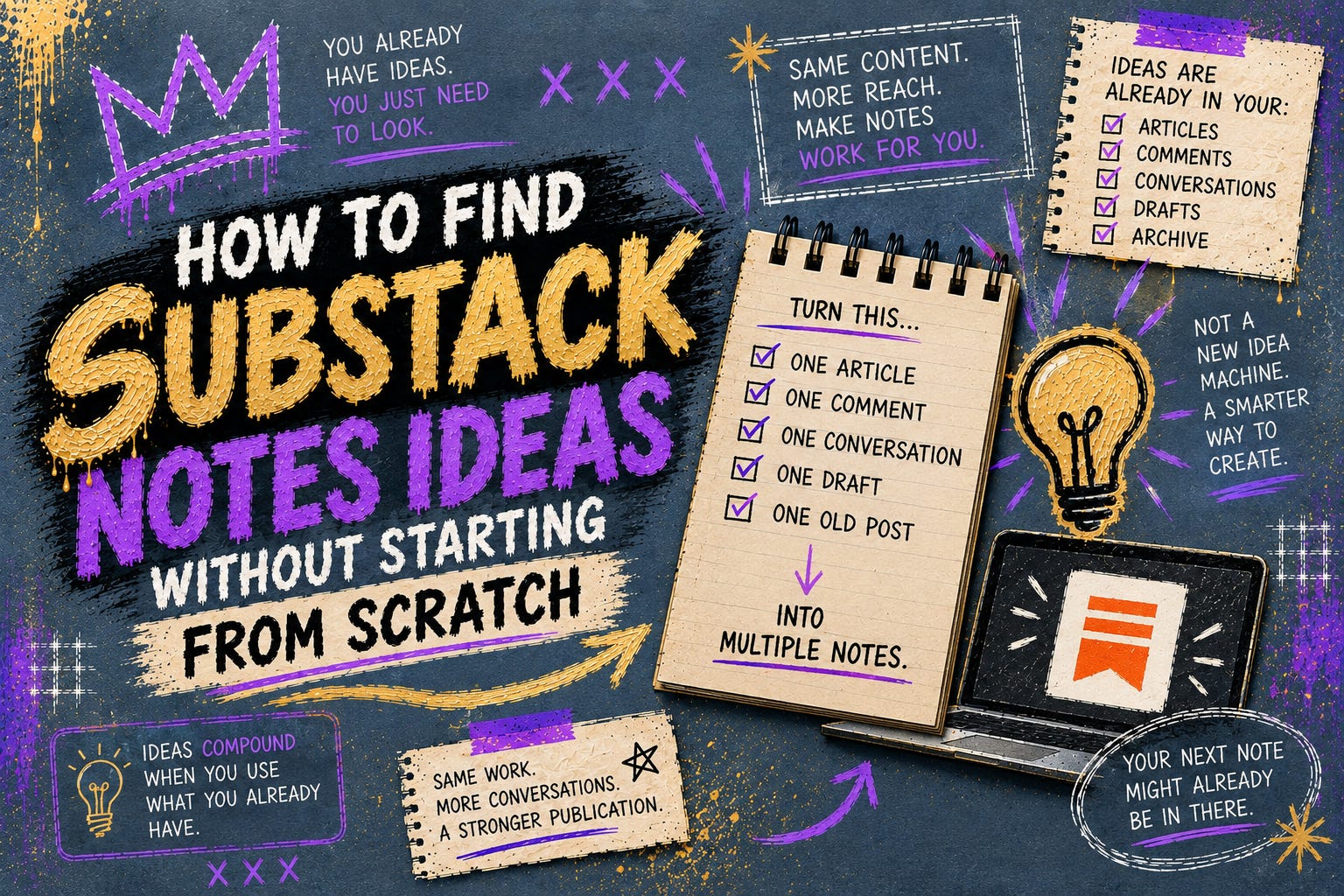
Your next Note is probably already hiding inside something you’ve written, discussed, noticed, or started thinking about.
Your Articles Have More Than One Job
I’ve talked before about why I don’t think hitting publish should be the finish line.
You can spend hours writing an article, publish it, promote it once, and then immediately move on to making something else.
WHY?
→ There are probably five, ten, maybe twenty smaller ideas sitting inside that one article.
Use them.
Pull out a sentence that can stand on its own.
Take one point and add a question.
Tell the story you cut because the article was getting too long.
Share the mistake that led you to write it.
Come back to one part three weeks later because something happened that made you think about it differently.
That isn’t being repetitive.
→ Your subscribers aren’t sitting around with clipboards documenting every idea you’ve ever mentioned and even when someone has heard an idea from you before, you can come back to it with a different story, question, example, or perspective.
One article shouldn’t have to live for 24 hours and then get buried under everything you publish next. Let it keep working.
Your Readers Are Giving You Notes Ideas Too
This is one of my favorite places to find them.
Someone comments on your article and asks a question.
→ There’s a Note.
Someone disagrees with something you wrote.
Well, hello there. 😂
→ There’s probably a Note.
Three people latch onto one sentence you almost deleted from the article?
→ PAY ATTENTION TO THAT. Most likely a Note!
Sometimes the thing you think is the main point isn’t the thing your readers want to talk about.
Notes give you somewhere to follow those threads without turning every thought into a 1,500-word article.
Respond to the question.
Ask another one.
Clarify something.
Take the conversation somewhere you hadn’t planned.
And sometimes one of those conversations gives you your next article.
That’s when Notes start getting really useful.
→ You’re not standing in front of an empty box every morning demanding that your brain produce Content Idea #487.
You’re paying attention to what’s already happening around your work.
Use Notes Before You Write The Article
This works in the other direction too.
Sometimes I have an idea and I’m not sure there’s an article in it yet.
→ Instead of immediately opening a draft and trying to squeeze 1,200 words out of a thought that currently has about 14 words worth of life in it, I can put the idea on Notes.
Then I watch what happens.
Do people respond?
Does someone ask a question I hadn’t considered?
Do people have stories of their own?
Does the conversation make me want to say more?
Or does the Note get absolutely nothing and quietly disappear into the Substack abyss?
That doesn’t automatically mean the idea is bad.
I’m very careful about making giant decisions based on one piece of performance data.
We’ve already talked about what creator brain can do with that, but the response can give you information.
Maybe the idea needs a different angle, maybe there’s a more interesting question underneath it, or maybe the conversation takes the idea somewhere you hadn’t considered.
Maybe you post the Note and realize: Oh shit. I have a LOT to say about this.
Now you’ve got an article.
Bring Old Ideas Back
Creators have a weird relationship with old content.
We publish something six months ago and start acting like it’s been placed in a museum.
DO NOT TOUCH.
That idea has already been used.
According to who?
→ If you wrote something useful six months ago, you probably have subscribers today who weren’t following you then and the people who were following you probably don’t remember every sentence you’ve ever written.
I don’t remember every sentence I’ve ever written.
Bring good ideas back.
That doesn’t mean copying and pasting the exact same Note every Tuesday until your subscribers stage an intervention.
Look at the old idea again.
Is it still useful? Have you changed your mind? Have you tested it since then? Did a reader ask something that makes it relevant again? Do you have a better example now?
→ That’s not running out of ideas. That’s building on your body of work.
There’s a difference.
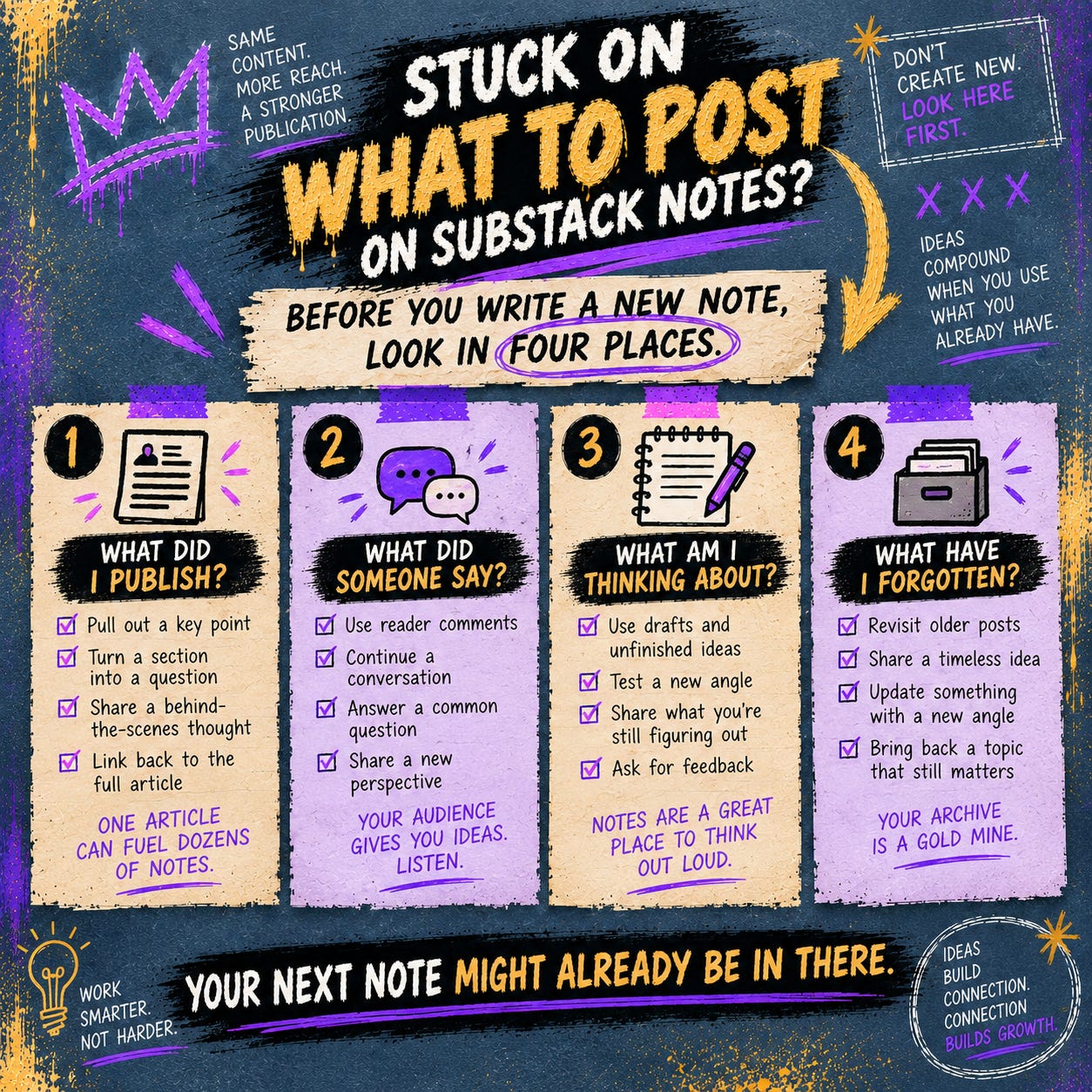
Before You Write A New Note, Look In Four Places
This is the part I want you to remember the next time you open Notes and your brain decides it has left the building.
Before trying to invent something new, ask yourself four questions:
What did I publish?
Look at your recent articles. Is there one idea, sentence, story, example, or question worth pulling out and continuing?What did someone say?
Check your comments, replies, DMs, and conversations. What are people asking about, disagreeing with, or responding to?
What am I thinking about?
Look at your drafts and unfinished ideas. Is there something you’re curious about but haven’t figured out yet? Put a smaller version on Notes and see where the conversation goes.
What have I forgotten?
Go into your archive. What did you write three months ago? Six months ago? A year ago? Is there something worth bringing back because you have new readers, a new example, or something else to say about it now?
That’s it. You don’t need an elaborate Notes factory.
You need places to look.
Notes Can Be Part Of The Work
This is the shift that makes Notes much easier for me.
Instead of thinking:
I wrote my article. Now I also need to make Notes.
Think about Notes as something happening around the work you’re already doing.
→ Before you publish, a Note can help you play with an idea.
→ After you publish, Notes can keep pieces of that article moving.
Readers respond. Their responses give you somewhere else to go. One conversation sparks another thought. That thought becomes another Note. Maybe eventually it becomes another article.
Then that article gives you more things to talk about.
→ It keeps moving.
Notes stop being this separate obligation hanging over your head and become part of how you write, promote, listen, and figure out what you want to make next.
If You’re Stuck Right Now: You Don’t Need 20 Brilliant Thoughts By Sunday
I’ve seen the advice to batch huge piles of short-form content ahead of time and if that works for you?
Go for it, but I know what would happen if I sat down on Sunday and told myself I needed to manufacture 20 clever Notes before I could leave.
By Note #17, I’d be posting:
Writing is a journey. Believe in yourself. ✨
Someone please confiscate my laptop. 😂
I’d rather have places to look when I don’t know what to post because consistency gets a whole lot easier when every Note doesn’t have to begin with a blank page.
My recent articles.
My archive.
My drafts.
My comments.
Questions readers have asked.
Conversations I’ve had.
Ideas I’m still figuring out.
I don’t think the goal of Notes is to prove you can produce the highest volume of tiny thoughts on the internet.
→ Use them to talk to people. Keep your articles alive. Play with unfinished ideas. Listen to what your readers are telling you. Bring an old idea back when you have something new to add.
And occasionally?
Post the random thought you had while standing in your kitchen.
It’s Notes. We’re allowed to have some fun here. 😂
So tomorrow, when you open that little Notes box and your brain gives you absolutely nothing, don’t sit there trying to become interesting on command.
→ Open your latest article. Read your comments. Check your drafts. Dig through something you published three months ago.
You’re probably sitting on more material than you realize.
Your next Note might already be in there.
Thank you so much for being here. I truly appreciate you.
— Jessica
Move first. Refine second. Publish with structure.
ICYMI, Previous Articles & Live Episodes →
How The Paywall Works on Substack (And When to Use It)

Last week, someone asked me a simple question:


Stop Treating Publish Like The Finish Line

Writers spend a lot of time thinking about what to publish next.
Scan the QR code below to subscribe to Unstuck to Published →